
Can dogs understand human emotions? Many dog owners believe the answer is yes after seeing their dogs comfort them during difficult times or share in their excitement. While these moments may seem almost magical, scientific research suggests that dogs can recognize human emotional cues through facial expressions, tone of voice, body language, and even scent. Understanding how dogs perceive our emotions can help strengthen the human-dog bond and improve communication.
Understanding how dogs recognize human emotions is not just fascinating—it has practical implications for training, bonding, and overall well-being. Emotional recognition allows dogs to respond appropriately to their owners, strengthen trust, and even anticipate human needs. For example, a dog might approach gently when it senses sadness or become excited when it detects happiness, showing a sophisticated level of social awareness.
Research in canine cognition has revealed that dogs are highly attuned to human cues, including facial expressions, tone of voice, body language, and even subtle chemical signals in sweat. This ability is a result of thousands of years of domestication, during which dogs evolved alongside humans and became highly skilled at reading our emotional states.
In this post, we will explore the science behind dogs’ emotional intelligence, how they detect and interpret human emotions, the factors influencing this ability, and practical ways owners can use this understanding to foster stronger, more empathetic relationships with their dogs.
Can Dogs Understand Human Emotions? The Science Behind Canine Emotional Intelligence
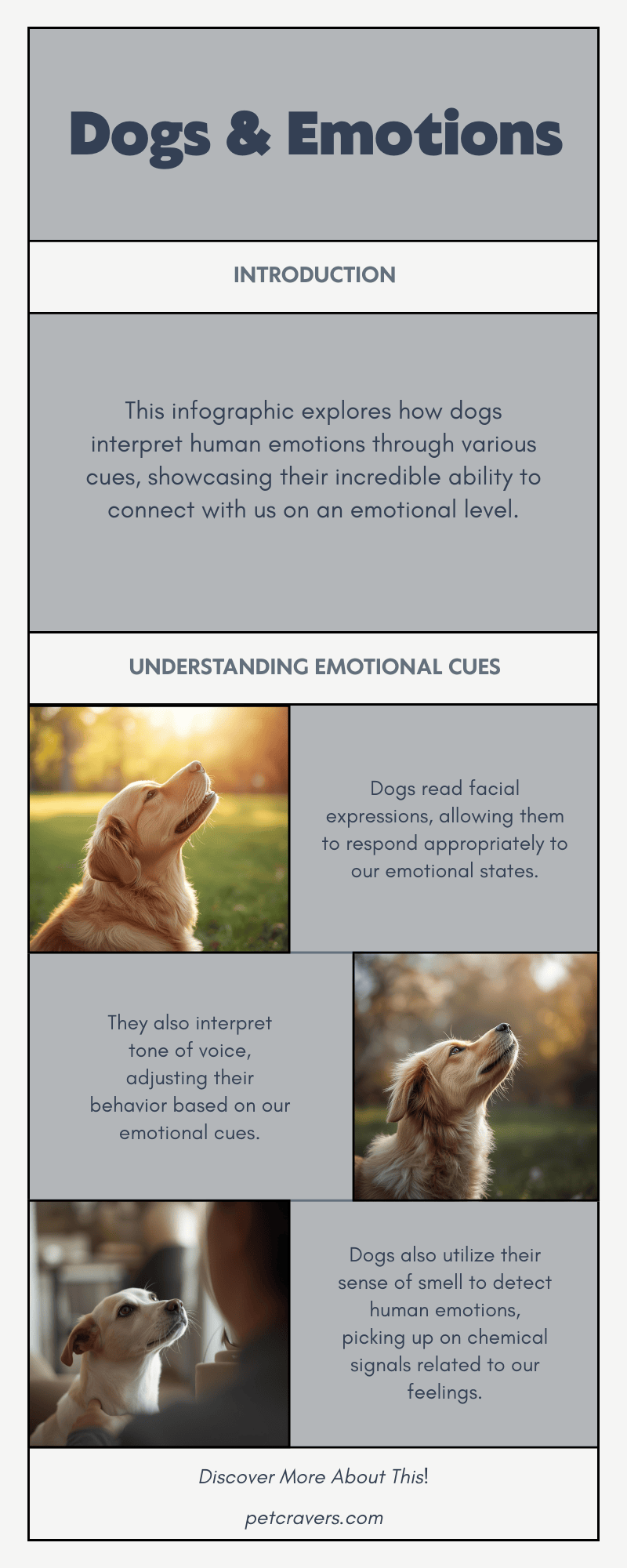
Dogs are not just pets—they are social partners that have evolved to live closely with humans, developing remarkable sensitivity to our emotions. This social intelligence, often referred to as emotional intelligence in animals, allows dogs to detect, interpret, and respond appropriately to human feelings.
1. Evolutionary Background
Dogs have been domesticated for over 15,000 years, evolving from wolves into companions that rely heavily on human cues for guidance and survival. This long-term co-evolution has fine-tuned their ability to perceive emotional states, giving them an adaptive advantage in forming bonds and receiving care.
2. Neurological Evidence
Research using functional MRI (fMRI) has shown that dogs’ brains activate in specific regions when exposed to human emotional signals. Key findings include:
- Reward centers are more active when dogs see happy or familiar faces.
- The temporal cortex responds to vocal tones conveying different emotions.
- Olfactory processing areas help interpret chemical changes associated with stress, fear, or excitement in humans.
3. Cognitive Mechanisms
Dogs combine sensory inputs—visual, auditory, and olfactory—to form a holistic understanding of human emotional states. This cross-modal processing allows them to react appropriately even when one type of cue (e.g., facial expression) is ambiguous.
4. Implications
Understanding the science behind canine emotional intelligence helps explain why dogs can comfort us when we are sad, become excited when we are happy, or remain alert when we are anxious. It also provides a foundation for effective training, behavior management, and strengthening the human-dog bond.
These findings provide compelling evidence that dogs can understand human emotions by integrating multiple social and sensory cues.
How Dogs Understand Human Emotions Through Sight, Sound, and Scent
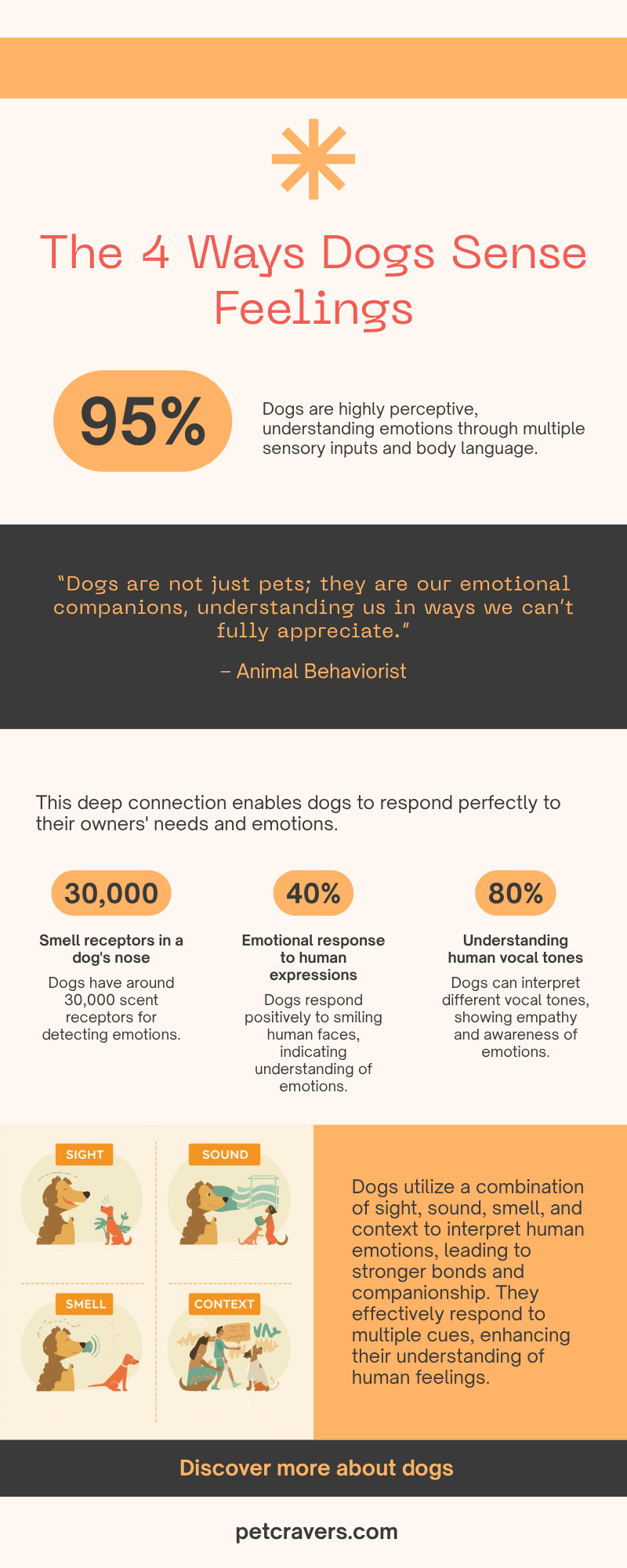
To answer the question, can dogs understand human emotions, it is important to examine how they process visual, auditory, and olfactory information. Dogs are experts at reading human emotional cues, using a multi-sensory approach to understand what we are feeling. They rely on a combination of visual, auditory, olfactory, and contextual signals to interpret emotions accurately.
1. Visual Cues
- Facial expressions: Dogs can distinguish between happy, angry, sad, or neutral expressions. Studies show they often react differently to smiling versus frowning faces.
- Body posture and gestures: A relaxed posture signals safety, while tense or defensive posture may trigger alertness or caution.
- Eye contact: Dogs use eye gaze to gauge attention, mood, and intent. Direct eye contact from a friendly human is usually reassuring, whereas prolonged or intense staring may be interpreted as threatening.
2. Auditory Cues
- Tone of voice: Dogs are sensitive to the pitch, volume, and intonation of our speech. A high-pitched, cheerful tone can excite a dog, while a low, harsh tone may cause submission or avoidance.
- Rhythm and cadence: Dogs can detect subtle differences in speech patterns that indicate emotional state, such as stress, happiness, or frustration.
3. Olfactory Cues
- Dogs’ sense of smell is 40 times more sensitive than humans’, allowing them to detect chemical changes in sweat, pheromones, and other secretions.
- Stress, fear, and excitement can produce unique scents that dogs can recognize, helping them respond appropriately.
- Strong scientific evidence also supports dogs’ ability to detect emotions through scent. In the study Olfactory communication of emotion: Can dogs detect human emotional chemosignals?, Biagio D’Aniello and colleagues demonstrated that dogs can distinguish between human chemosignals associated with happiness and fear. When exposed to fear-related scents, dogs showed increased signs of stress and often sought reassurance from their owners. In contrast, happiness-related scents encouraged more relaxed and socially engaged behavior. These findings suggest that dogs rely not only on visual and auditory cues but also on subtle chemical signals to interpret human emotional states.
4. Contextual and Behavioral Cues
- Dogs integrate environmental and situational context, such as body movement, social setting, and previous experiences, to interpret emotions accurately.
- For example, a wagging tail combined with a relaxed posture and happy vocal tone signals excitement, while the same tail wag in a tense posture may indicate anxiety or overstimulation.
By combining these cues, dogs develop a rich understanding of human emotions, allowing them to act empathetically, anticipate needs, and adjust their behavior in ways that strengthen the human-dog bond.
If you’d like to learn more about how dogs perceive and respond to people, Inside of a Dog: What Dogs See, Smell, and Know by Alexandra Horowitz is a highly recommended resource. Drawing on research in canine cognition and behavior, the book explains how dogs use their senses to understand their environment and interact with humans, offering valuable insights into the science of canine emotional intelligence.
How Dogs Respond After They Understand Human Emotions
If dogs can understand human emotions, their behavior should change in response to different emotional states—and scientific studies show that it does. Dogs not only detect human emotions—they respond to them in meaningful ways, demonstrating empathy, social intelligence, and adaptability. Their reactions vary depending on whether the emotion is positive, negative, or ambiguous.
1. Positive Emotions
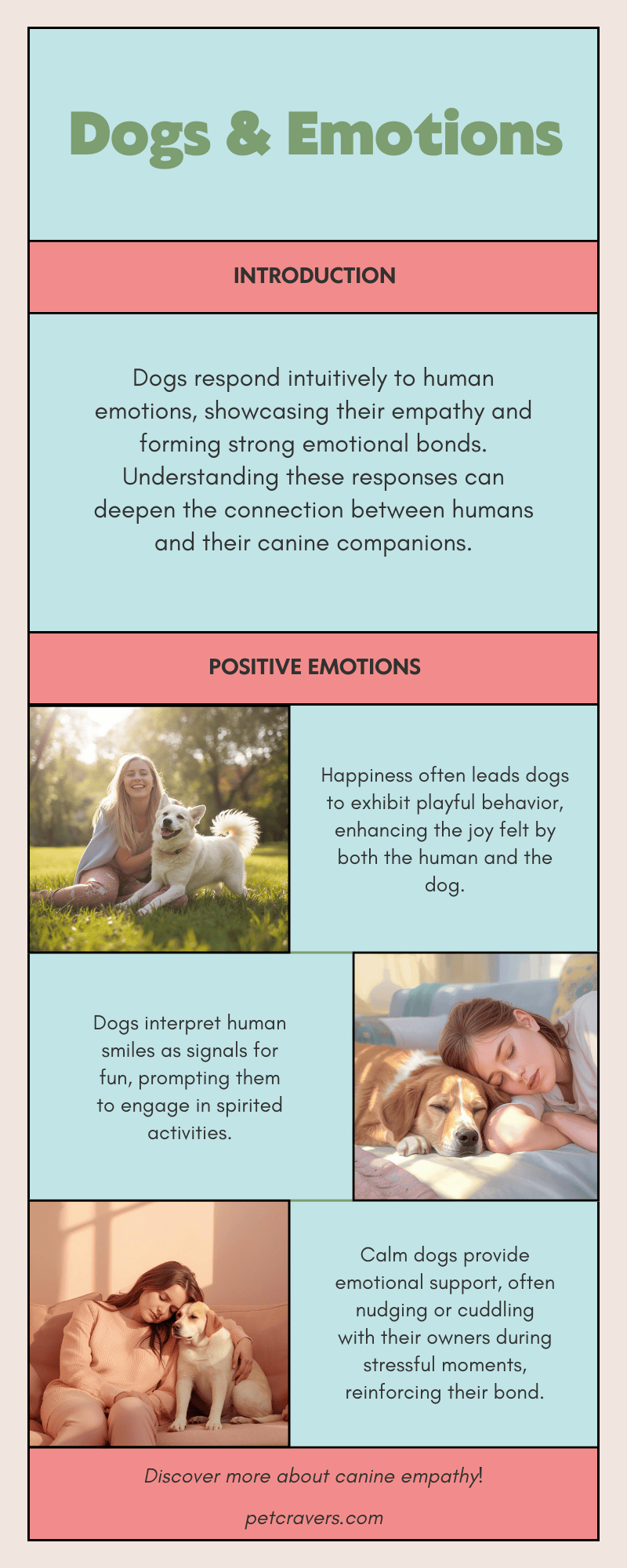
- Happiness and excitement: Dogs often mirror joyful emotions by wagging their tails, jumping, licking, or engaging in playful behavior.
- Reward-seeking behavior: When owners display excitement or pride, dogs may become more eager to perform learned behaviors or participate in games.
- Reinforcing bonds: Responding to positive emotions strengthens the emotional connection and trust between dog and owner.
2. Negative Emotions
- Stress, fear, or sadness: Dogs may respond with calming signals, such as nuzzling, lying nearby, pawing, or gentle nudges to comfort the owner.
- Alertness or caution: Dogs can become protective, more vigilant, or cautious when they sense anxiety or distress in humans.
- Avoidance behaviors: Some dogs may retreat if negative emotions are intense or associated with prior negative experiences.
3. Mirroring and Modulating Behavior
- Dogs often mirror human emotions—matching energy levels or mood—as a social strategy.
- They can also modulate their behavior to soothe distressed owners or maintain harmony in the environment. For example, a dog may remain calm when the owner is stressed to avoid adding tension.
4. Anecdotal Examples
- Dogs comforting owners during grief or illness.
- Alerting owners to emotional changes, such as anxiety attacks or mood swings.
- Playing or initiating interactions to cheer up a sad owner.
These behavioral responses highlight dogs’ empathetic abilities and explain why they are often described as emotional companions. By observing these reactions, owners can better understand their dog’s perception of their feelings and respond in kind.
Scientific Studies on How Dogs Understand Human Emotions
Researchers have conducted numerous experiments to determine whether dogs can understand human emotions rather than simply react to learned behaviors. The ability of dogs to recognize and respond to human emotions is not just anecdotal—it is supported by extensive scientific research. Studies have used behavioral experiments, brain imaging, and cross-modal testing to understand how dogs perceive and react to our emotional states.
1. Facial Expression Recognition
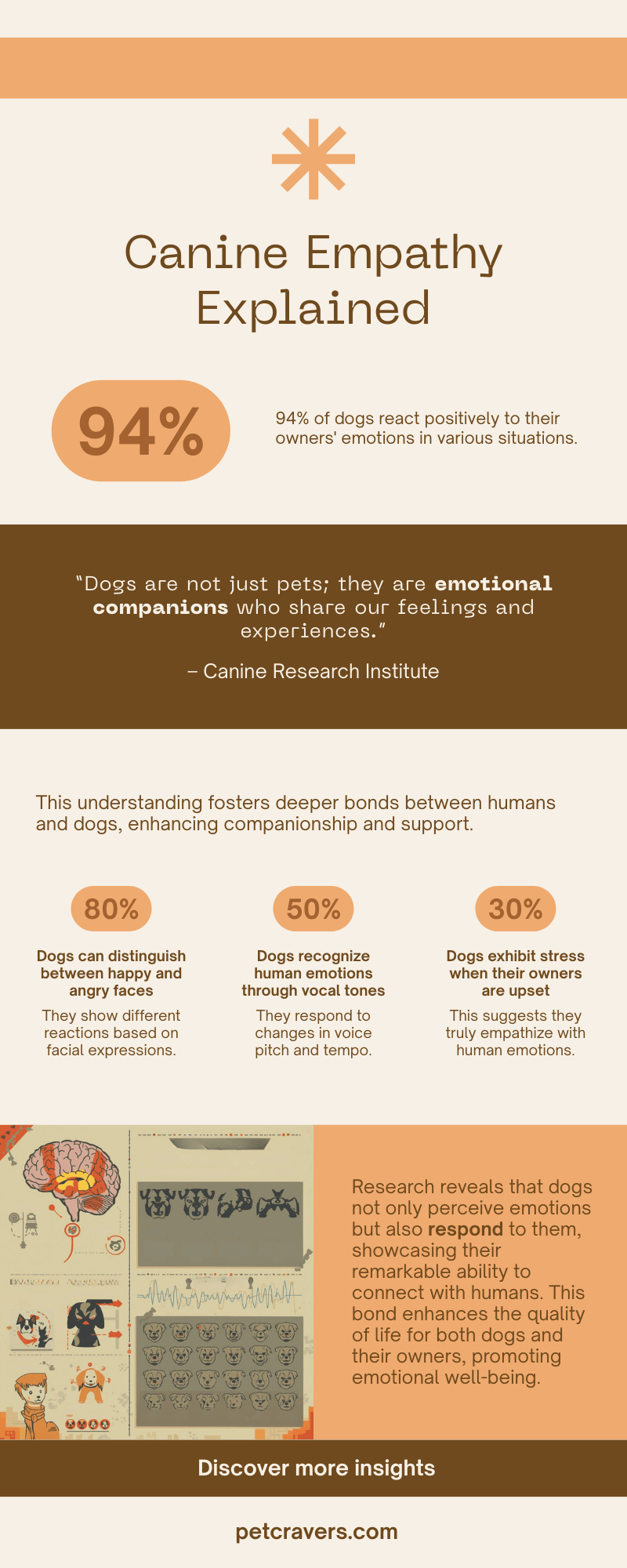
- Research shows that dogs can distinguish between happy and angry human faces.
- Dogs tend to approach happy faces more readily and show signs of stress or caution toward angry or threatening expressions.
- Landmark research published in 2015 in Current Biology, titled Dogs can discriminate emotional expressions of human faces by Corsin A. Müller and colleagues, provided the first compelling evidence that dogs can distinguish between happy and angry human facial expressions. In controlled experiments, dogs successfully learned to discriminate emotional expressions even when shown unfamiliar faces or only part of a person’s face. The findings suggest that dogs do not simply memorize individual faces—they can interpret the emotional meaning behind human facial expressions. This study offers strong scientific support for the idea that dogs are capable of recognizing human emotions through visual cues.
- These studies confirm that visual cues alone can trigger meaningful emotional responses.
2. fMRI Studies on Dogs’ Brains
- Functional MRI scans reveal that dogs’ reward centers in the brain activate when they see positive human emotions, such as smiles.
- Other brain regions, including the temporal cortex, respond to vocal cues and emotional tone, indicating cross-modal processing.
- These findings suggest that dogs not only perceive emotions but also experience a form of emotional engagement or anticipation.
3. Cross-Modal Studies
- Experiments combining visual, auditory, and olfactory cues show that dogs integrate multiple sensory inputs to confirm human emotional states.
- For example, a dog may observe a happy facial expression, hear a cheerful tone, and smell chemical signals of excitement, resulting in a coordinated, empathetic response.
4. Real-World Observations
- Dogs have been observed comforting owners in distress, playing actively when owners are joyful, and adjusting behavior based on subtle emotional cues.
- Service dogs and therapy dogs exemplify this ability, responding reliably to human emotional needs in clinical and everyday settings.
These studies collectively demonstrate the scientific basis of dogs’ ability to recognize human emotions, highlighting their social intelligence and adaptive communication skills.
Many of the findings on dogs’ ability to understand human emotions and social cues are also explored in The Genius of Dogs by Brian Hare and Vanessa Woods. Drawing on years of research in canine cognition, the authors explain how domestication shaped dogs into exceptionally skilled observers of human behavior. The book highlights dogs’ remarkable ability to interpret facial expressions, gestures, tone of voice, and other social signals, reinforcing the scientific evidence that dogs have evolved to communicate and cooperate closely with people.
Factors Influencing Dogs’ Emotional Perception
While many dogs are naturally skilled at recognizing human emotions, several factors can influence the accuracy and intensity of their perception. Understanding these can help owners optimize interactions and training.
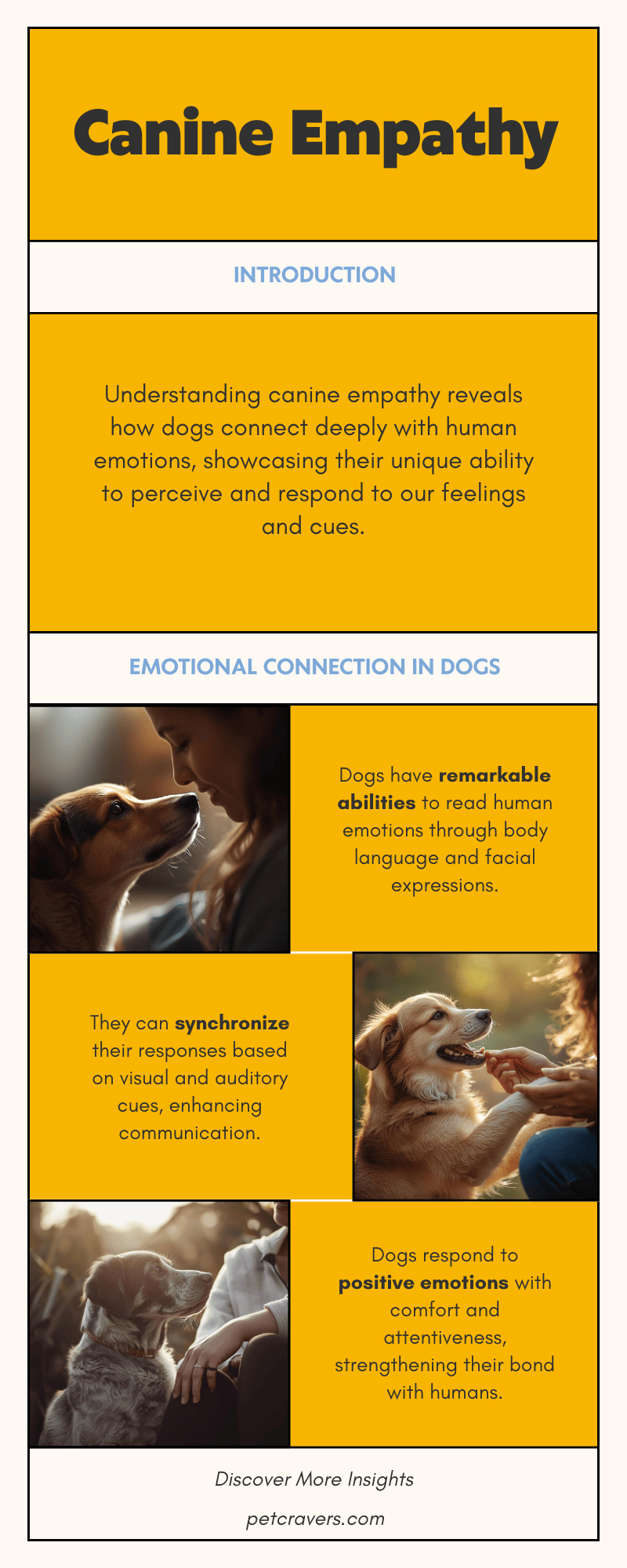
1. Breed Differences and Evolutionary Traits
- Breeds with a history of close human companionship, such as Border Collies, Golden Retrievers, and Labradors, tend to excel at reading human emotional cues.
- Breeds historically bred for independent work or guarding may rely less on social cues and more on situational context.
2. Age and Experience
- Puppies undergo critical developmental periods during which exposure to humans shapes their social and emotional perception.
- Older dogs may rely on accumulated experience with their owners to interpret emotional cues more accurately.
3. Socialization
- Dogs that interact regularly with humans from an early age tend to be more attuned to subtle emotional signals.
- Limited or negative socialization can reduce a dog’s ability to detect or respond appropriately to emotions.
4. Attachment and Bond with the Owner
- Dogs form stronger emotional bonds with people they trust and live with consistently.
- A secure attachment enhances sensitivity to emotional changes, leading to more reliable empathetic responses.
5. Context and Environmental Factors
- Stressful or unfamiliar environments can influence a dog’s responsiveness to human emotions.
- Dogs may prioritize environmental scanning over emotional observation when feeling insecure or threatened.
Recognizing these factors helps owners tailor interactions, training, and support, ensuring their dog can perceive and respond to emotional cues effectively.
Practical Applications for Owners
Knowing that dogs can understand human emotions can help owners improve communication, training, and daily interactions. By leveraging this ability, owners can improve communication, foster trust, and create a harmonious home environment.
1. Enhancing Training Outcomes
- Use positive emotional cues, such as smiling and upbeat tones, to reinforce learning.
- Dogs respond better to training when they perceive their owner as calm, confident, and encouraging.
2. Strengthening the Human-Dog Bond
- Responding to your dog’s empathy builds mutual trust and attachment.
- Spend time engaging in activities that elicit joy, such as play, walks, and cuddling, reinforcing positive emotional associations.
3. Managing Negative Emotions
- Dogs often mirror human stress, anxiety, or frustration.
- Being mindful of your own emotional state can help prevent unnecessary stress in your dog. Deep breathing, calm tones, and relaxed posture improve your dog’s comfort.
4. Facilitating Socialization
- Introducing dogs to new people and environments while maintaining calm and positive cues helps them interpret emotions accurately.
- Use consistent gestures and facial expressions to guide reactions in social situations.
5. Supporting Therapy or Service Work
- Emotional recognition is essential for therapy dogs, service dogs, and emotional support animals.
- Owners can train dogs to respond appropriately to emotional cues for therapeutic or assistance purposes.
By applying these strategies, owners can maximize their dog’s emotional intelligence, leading to happier, more confident dogs and stronger, more empathetic human-dog relationships.
Can Dogs Really Understand Human Emotions? Limitations and Misconceptions
While dogs are remarkably perceptive to human emotions, there are limits to their understanding and common misconceptions that owners should be aware of.
1. Dogs Do Not Fully Understand Human Thoughts
- Dogs can detect emotions such as happiness, sadness, or anger, but they do not comprehend complex thoughts or nuanced emotional contexts.
- Emotional recognition is based on cues, not on interpreting abstract concepts or reasoning like humans do.
2. Misinterpretation of Cues
- Dogs may misread signals if cues are conflicting or inconsistent.
- For example, a neutral facial expression combined with tense body language may confuse the dog, causing an inaccurate response.
3. Individual Variation
- Not all dogs have the same sensitivity to emotional cues. Factors such as breed, age, socialization, and personality affect perception.
- Some dogs may be highly empathetic, while others may be more independent or less responsive to emotional changes.
4. Anthropomorphism
- Owners may over-interpret behaviors, attributing human-like understanding or motives to their dog.
- While dogs respond to emotions, their actions are guided by instinct, learned associations, and social cues rather than conscious empathy in the human sense.
- Research also suggests that people differ in how they interpret canine emotions. For example, the study Human empathy, personality and experience affect the emotion ratings of dog and human facial expressions by Anna Kujala and colleagues found that a person’s empathy, personality, and previous experience with dogs can influence how they perceive emotional expressions in both dogs and humans. This highlights that while dogs can recognize many human emotional cues, owners should avoid assuming that every canine behavior reflects human-like thoughts or emotions. Objective observation and an understanding of normal canine body language are essential for accurately interpreting a dog’s responses.
5. Environmental and Situational Factors
- Stressful environments or unfamiliar settings can reduce a dog’s ability to perceive emotional cues.
- Dogs may prioritize safety or novel stimuli over emotional observation, temporarily limiting recognition.
By understanding these limitations, owners can set realistic expectations, communicate more effectively, and avoid misreading their dog’s responses, ultimately fostering healthier interactions.
Conclusion
Dogs are extraordinary companions, not only because of their loyalty but also because of their remarkable ability to perceive and respond to human emotions. Through a combination of visual, auditory, and olfactory cues, dogs can detect happiness, sadness, stress, and excitement, often responding in ways that show empathy, social intelligence, and deep emotional connection.
Scientific research, including behavioral studies and fMRI scans, confirms that dogs’ responses to human emotions are rooted in both evolutionary adaptation and learned experience. While dogs do not fully understand human thoughts or complex emotional nuances, their reactions are reliable indicators of sensitivity to mood and intent.
Understanding this ability has practical benefits:
- Enhancing training outcomes through positive emotional reinforcement.
- Strengthening the human-dog bond by recognizing and responding to each other’s emotional states.
- Managing interactions with both familiar people and strangers more effectively.
By observing your dog’s behavior, providing consistent emotional cues, and fostering positive interactions, you can create a stronger, more empathetic relationship with your canine companion. The growing body of evidence strongly suggests that dogs can understand human emotions by combining facial expressions, vocal tones, body language, and scent cues. Recognizing the science behind this and remarkable ability not only deepens our appreciation for dogs but also allows us to communicate more effectively and live harmoniously alongside them.




Leave a Reply