
Every November, something shifts in my neighbor’s house. Her collie, Wren, stops meeting the leash at the door. She sleeps through the morning walk, picks at breakfast, and spends most afternoons flat on the rug with her chin on her paws. By April, she’s back to hurling herself at the garden gate.
It’s tempting to call that seasonal depression. Plenty of people do, and there’s a name for it already circulating: seasonal affective disorder in dogs. So it’s worth asking directly — can dogs genuinely experience seasonal mood changes the way humans do?
The honest answer is: not in the way most articles suggest. There is no veterinary diagnosis called seasonal affective disorder in dogs. There has never been a study designed to look for one. What we do have is something more interesting and more useful — a small body of evidence that seasons shape canine physiology and activity patterns, alongside a great deal of owner observation that hasn’t been tested.
That gap matters, because a dog who is slower and quieter in winter could be responding to shorter days. Or they could be in pain, unwell, bored, cold, or quietly anxious. Those possibilities look almost identical from the sofa, and one of them needs a vet.
This guide walks through what’s known, what’s plausible, what’s speculative, and what you can do this week that’s genuinely low-risk.
The Quick Answer
No — seasonal affective disorder is not an established diagnosis in dogs. No peer-reviewed study has identified seasonal affective disorder in dogs as a clinical condition, and leading veterinary bodies say there isn’t evidence dogs experience it as humans do.
But yes — dogs’ bodies and behavior do shift with the seasons. Objectively measured activity in pet dogs is lower in winter than spring, and sled dogs show higher melatonin in winter than summer. Shorter days, cold or wet weather, and quiet household routines reliably reduce walks and outdoor time.
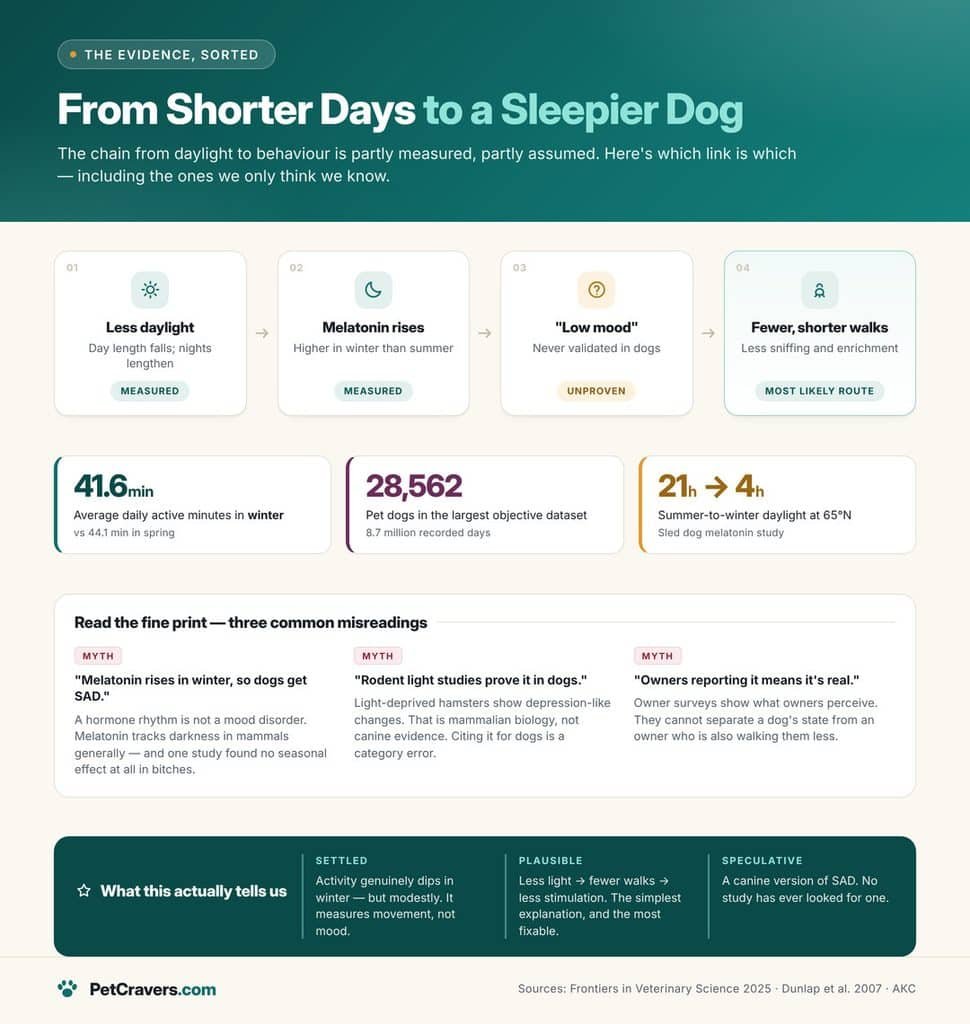
The practical upshot: seasonal shifts are plausibly real but usually mild, and the mechanism is often simpler than “depression” — less exercise, less enrichment, less daylight, and more time alone indoors. Because low energy, appetite changes, withdrawal, and sleep changes are also classic signs of pain and illness, any change that’s sudden, persistent, or worsening deserves a veterinary check rather than a seasonal explanation.
What “Seasonal Affective Disorder” Actually Means — and Why It Doesn’t Map Onto Dogs
The human diagnosis, briefly
In people, seasonal affective disorder is a real, formally defined condition — a type of depression that recurs in a seasonal pattern, with episodes lasting around four to five months a year. The U.S. National Institute of Mental Health describes winter-pattern symptoms that include oversleeping, overeating (especially carbohydrates), social withdrawal, low energy, and loss of interest in things previously enjoyed. Diagnosis requires a seasonal pattern across at least two consecutive years, plus episodes in that season being more frequent than at other times of year (NIMH).
The leading explanation involves light: reduced winter daylight is thought to disrupt the body’s daily rhythms and shift serotonin and melatonin signaling, so sleep, mood, and behavior all drift.
Note what makes this a diagnosis: agreed criteria, a required two-year pattern, and structured questions about mood and functioning. Every one of those elements is missing for dogs.
Why the canine version is a description, not a diagnosis
This is the crux, and most articles skip it.
To diagnose a mood disorder you need a way to measure mood. We can’t ask a dog how they feel, and there’s no validated behavioral test that reliably identifies depression in dogs. Researchers who have tried have run into this wall in a revealing way. A UK research team tested whether dogs who spent more time “awake but motionless” in their kennels also showed the pessimistic thinking style seen in depressed humans — the hypothesis wasn’t supported (Harvey et al., 2020, *Applied Animal Behaviour Science*). Another study from the same group found that dogs relinquished to shelters spent more time awake and motionless, but the researchers explicitly could not conclude those dogs were in a depression-like state (Harvey et al., 2019, *Animals*).
So even in a well-funded, well-designed setting, “is this dog depressed?” is genuinely hard to answer. Adding “seasonally” on top multiplies the difficulty.
The American Kennel Club puts it plainly. Its chief veterinary officer, Dr. Jerry Klein, states that “there is no scientific evidence that dogs get seasonal affective disorder (SAD) as described in humans,” and notes there’s no way to objectively measure or diagnose the condition in dogs (AKC). PetMD’s veterinary-reviewed article goes further: “Currently, there’s no evidence indicating that dogs get seasonal affective disorder or seasonal depression” (PetMD).
That’s not a failure of curiosity — it’s a statement about where the evidence currently sits. And it’s why you’ll see the phrase used in two very different ways online: as a search term owners type at 11pm, and as a clinical label that doesn’t exist yet.
Seasonal Change or Something Else? A Side-by-Side Comparison
Here’s where owners usually need the most help. The signs below overlap heavily, and no table can sort them for you — this is an educational comparison, not a diagnostic tool. Its only job is to help you notice patterns worth mentioning to a vet.
| What you might see | Pattern that leans toward a benign seasonal shift | Pattern that should prompt a vet call |
| Energy / activity | Gradually slower from late autumn; still keen once actually moving | Sudden drop over days; sluggish even for things they love |
| Interest in walks | Hesitates at the door in rain or cold, then enjoys the walk | Refuses walks entirely, or lags/limps partway through |
| Appetite | Eats normally, or slightly more; weight roughly stable | Skips meals, eats less, loses weight, or drinks much more |
| Sleep | Sleeps more; wakes easily and is bright when up | Hard to rouse; disoriented on waking; restless or vocal at night |
| Play | Shorter play sessions, especially outdoors | No interest in toys or chase at all, even indoors |
| Social contact | Still seeks you out; may lean in more | Withdraws, hides, avoids touch, or becomes newly irritable |
| Mobility | Slightly stiffer on cold mornings, loosens up | Reluctance to jump, climb stairs or rise; stiffness that doesn’t ease |
| Toileting | Unchanged | New indoor accidents in a house-trained dog |
| Vocalization | Unchanged, or mildly more whining at the door | New howling, pacing, panting, or distress when left alone |
| Response to a good day | A bright, dry, interesting day lifts them noticeably | No lift, regardless of weather or activity |
| Timing | Changes track day length and weather within days | Onset unrelated to weather; persists well into spring |
The single most useful discriminator in that table is the last one: does a genuinely good day fix it? A dog whose spirits lift on a sunny Saturday with a long sniff-heavy walk is showing you something environmental. A dog who doesn’t budge needs a different conversation.
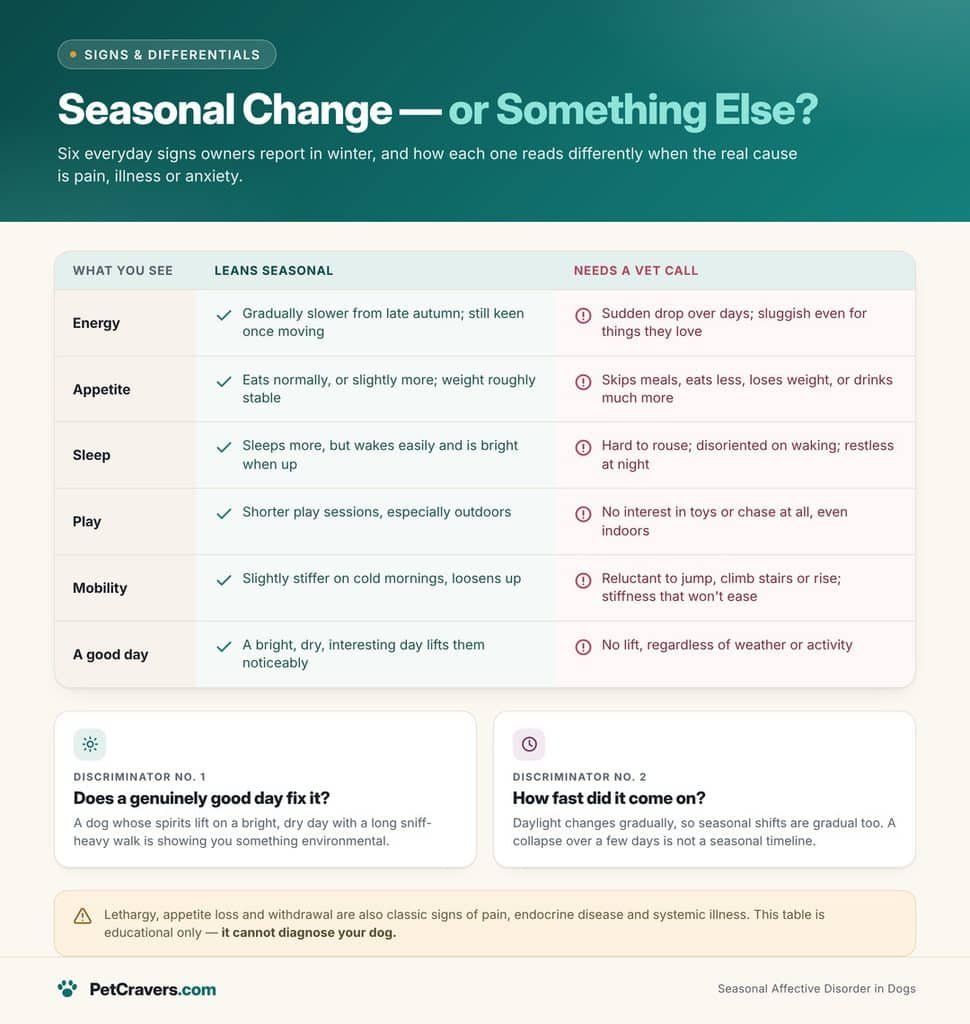
The second most useful signal is onset speed. Seasonal change is gradual because daylight changes gradually. A dog who went from normal to barely moving over a handful of days is not on a seasonal timeline.
What Could Genuinely Be Behind a Winter Behavior Shift
It helps to sort candidate explanations by how much evidence stands behind them, rather than presenting them all as equally likely.
What the evidence supports
Activity really does dip in winter — and we can measure it. This is the strongest canine-specific finding available. A 2025 study using accelerometer data from 28,562 pet dogs across North America — over 8.7 million recorded days — found dogs were less active in winter than in spring, and that activity varied independently with climate, season, location, and day of the week (*Frontiers in Veterinary Science*). The differences were real but modest: roughly 41.6 versus 44.1 active minutes per day. That’s a gentle slope, not a collapse.
Worth noticing what this study does not say. It measured movement, not mood. A dog moving less in winter is a dog moving less in winter.
Dogs’ melatonin shifts with the seasons. A study of sled dogs at two latitudes found peak melatonin levels were higher in winter than summer at both locations, and that the melatonin peak was prolonged at higher latitudes — where daylight ranges from about 21 hours in summer to 4 in winter (Dunlap et al., 2007, *Comparative Biochemistry and Physiology Part A*). This is genuine physiological seasonality. It’s also the study most often cited as “proof” that dogs get SAD, which it isn’t — melatonin tracks darkness in mammals generally, and a hormone rhythm is not a mood disorder.
A useful counterweight: a 2023 study of melatonin in bitches found levels varied significantly between individual dogs but not by season (*Animals*, open access). So even the hormonal picture is less tidy than the internet suggests.
Photoperiod shapes canine skin and coat. Canine flank alopecia is a non-inflammatory, often cyclical hair loss that develops during the short-day months in both hemispheres — a pattern that argues strongly for a light-driven mechanism rather than temperature (University of Minnesota Animal Dermatology Handbook). This is the clearest documented example of a seasonally patterned condition in dogs, and it’s a good corrective to the idea that seasonal biology must mean seasonal depression. Daylight demonstrably affects canine physiology — just, here, in the fur.
Weather changes what dogs and owners actually do. In a study of 3,123 older English adults wearing accelerometers for a week, everyone was less active on shorter, colder, wetter days — but dog walkers were markedly buffered. On the worst days, dog walkers were still 20% more active and spent 30 minutes a day less sedentary than non-dog owners on the best days (Wu, Luben & Jones, 2017, *Journal of Epidemiology and Community Health*). This is a human study, but it captures the mechanism that most likely explains much of the canine “winter blues”: weather changes the walk, and the walk changes the dog.
What’s plausible but unproven
*Owner surveys consistently find that owners perceive a winter change.* A frequently cited UK PDSA survey reported that around one in three dog owners noticed their dog seeming less playful or more withdrawn in winter. There’s a real signal here — many people independently reporting the same thing isn’t nothing.
But perception surveys can’t separate the dog’s state from the owner’s. As Dr. Klein notes of that survey, it “was subjective and relied on the owner’s perceptions of their pets. So, it was anecdotal rather than scientific” (AKC). Owners feeling flat in February may read a sleeping dog as sad, and may also have been walking that dog less. Both effects point the same direction and are very hard to disentangle.
Owner mood may transfer. Dogs are adept at reading human emotional signals, and household stress is a well-recognised influence on canine behavior. It’s reasonable to think a household that’s gloomier and more sedentary in winter produces a dog that’s gloomier and more sedentary. Reasonable, but not demonstrated for seasonality specifically.
Explore: The 25 Best Dog Breeds for Every Type of Owner: Find Yours
Reduced exercise and enrichment have real behavioral consequences. The Royal Kennel Club makes this point directly in its guidance on canine “depression”: through long, wet winters it’s hard to give dogs the exercise they need, and “a lack of being able to do the things they have been selectively bred to do, or just the things that they love, can result in a whole host of behaviour problems, some of which will present a lot like depression” (Royal Kennel Club). This is expert clinical opinion rather than trial evidence, but it’s the most parsimonious explanation on the table — and happily, the most fixable.
What’s speculative
A direct, SAD-like mood disorder in dogs. No study has looked for it. Anyone presenting it as established fact is going beyond the evidence.
Rodent sunlight studies as a canine model. You’ll often see a study where light-deprived hamsters or grass rats developed depression-like brain changes. It’s interesting mammalian biology. It tells us nothing specific about dogs, and citing it as canine evidence is a category error.
Breed-based claims. Statements like “herding breeds are more prone to seasonal affective disorder” are unsupported. There is no research establishing breed predispositions for seasonal mood change, and the traits people are actually observing — sensitivity to routine, arousal levels, exercise needs — vary enormously within any breed.
Explore: The 50 Most Popular Dog Breeds in the World
Artificial light “confusing” a dog’s seasonal clock. Plausible in principle, essentially untested in dogs living in homes.
Signs Owners Notice During Seasonal Shifts
If you want a list to watch against, these are the changes owners most often describe — with a reminder that every one of them has non-seasonal causes too.
- Lower energy. More time lying down, slower to get up, less interest in the door.
- More sleep, differently distributed. Longer daytime naps; sometimes more restlessness at night, which is worth noting separately.
- Appetite changes in either direction. Some dogs eat more as activity falls (and gain weight); some eat less. Any sustained appetite change is a medical question first.
- Shorter, less intense play. Chasing and tugging give way to mouthing a toy and losing interest.
- Withdrawal. Choosing a quiet room, engaging less with family, less following-you-around.
- Irritability. Snapping when disturbed, guarding resting spots, less tolerance for handling.
- Reluctance outdoors. Hovering at the door in bad weather, or cutting walks short.
- Clinginess. The opposite of withdrawal — a dog who suddenly can’t be in another room.
Notice how ordinary these are. That’s the problem: they’re ordinary because they’re nonspecific. Lethargy, reduced appetite, and withdrawal are among the most common presenting signs of pain, endocrine disease, and systemic illness in dogs. They’re the body’s all-purpose way of signaling that something is off.
Why Two Dogs in the Same House Can Respond Differently
You can walk two dogs on the same street in the same weather and get two completely different winters. That’s expected, and it isn’t about breed.
Baseline temperament and arousal style. A dog who is naturally placid has less visible distance to travel into “seems flat”; a dog who is normally high-arousal has further to fall and the change reads as dramatic. Neither tells you which dog is struggling more.
Age and accumulated wear. Older dogs slow down for reasons that have nothing to do with seasons: osteoarthritis, dental pain, sensory decline, and cognitive changes. A winter that looks like a seasonal slump in a nine-year-old is a different clinical question than the same behavior in a two-year-old.
Existing pain or chronic conditions. A dog with an aching hip will move less in the cold — not because of mood, but because movement hurts more. This is one of the most commonly missed explanations for a “winter blues” dog.
Where they sleep and how warm they are. Thin-coated, very small, very old, or arthritic dogs lose heat faster and can be genuinely uncomfortable in a cold house or on cold floors.
Individual sensitivity to routine. Some dogs are stoic about disruption; others fall apart when the 6:30am walk becomes 7:15. Same household, very different experiences.
Learned history. A dog who had one frightening winter experience — a slip on ice, a noise event — may show lasting reluctance that reads as low mood.
What else is happening in the home. A return to office, a new baby, a house move, a death in the family, a second dog. Winter coincides with a lot of life change; the season is often just the backdrop.
How Climate, Latitude, and Household Life Change the Picture
Latitude and day length. At high latitudes the winter change is dramatic — the sled dog study’s 21-hours-to-4-hours swing is the extreme case. Near the equator, day length barely moves, which makes a purely light-driven explanation much less persuasive for dogs living there. If seasons barely change where you live and your dog’s behavior has, look harder at the non-seasonal explanations.
This matters in practice for readers in South Asia, the Gulf, sub-Saharan Africa, and similar latitudes: “winter blues” as a light phenomenon doesn’t translate well to a place where the sun sets at a similar hour year-round, but heat, monsoon, and air quality do reshape outdoor activity in powerful ways. The behavioral outcome — less walking, less sniffing, more time indoors — can look identical without any photoperiod involvement at all.
Hemisphere. The flank alopecia literature is a useful reminder that seasonal biology follows day length, not the calendar. A condition that appears in November in the northern hemisphere appears in May in the southern. If you’re reading northern-hemisphere advice while living south of the equator, flip the months.
Climate and weather patterns. The 2025 accelerometer study found activity varied with climate type, not just season — dogs in some climates showed flatter seasonal curves than others (*Frontiers in Veterinary Science*). Hot, humid summers can suppress activity just as effectively as cold winters.
Household schedules. Winter brings holidays, travel, visiting relatives, school breaks, and work-from-home patterns that reverse in January. For many dogs this is a bigger deal than daylight.
Housing and daylight access. An apartment with small north-facing windows offers far less light exposure than a house with a garden. Two dogs at the same latitude can have very different daily light diets.
Noise and disruption. Fireworks, storms, heating systems, and holiday gatherings cluster in the darker months. A dog who becomes withdrawn in December may be responding to a specific recurring fear, not the season.
How to Track Changes So the Vet Visit Is Actually Useful
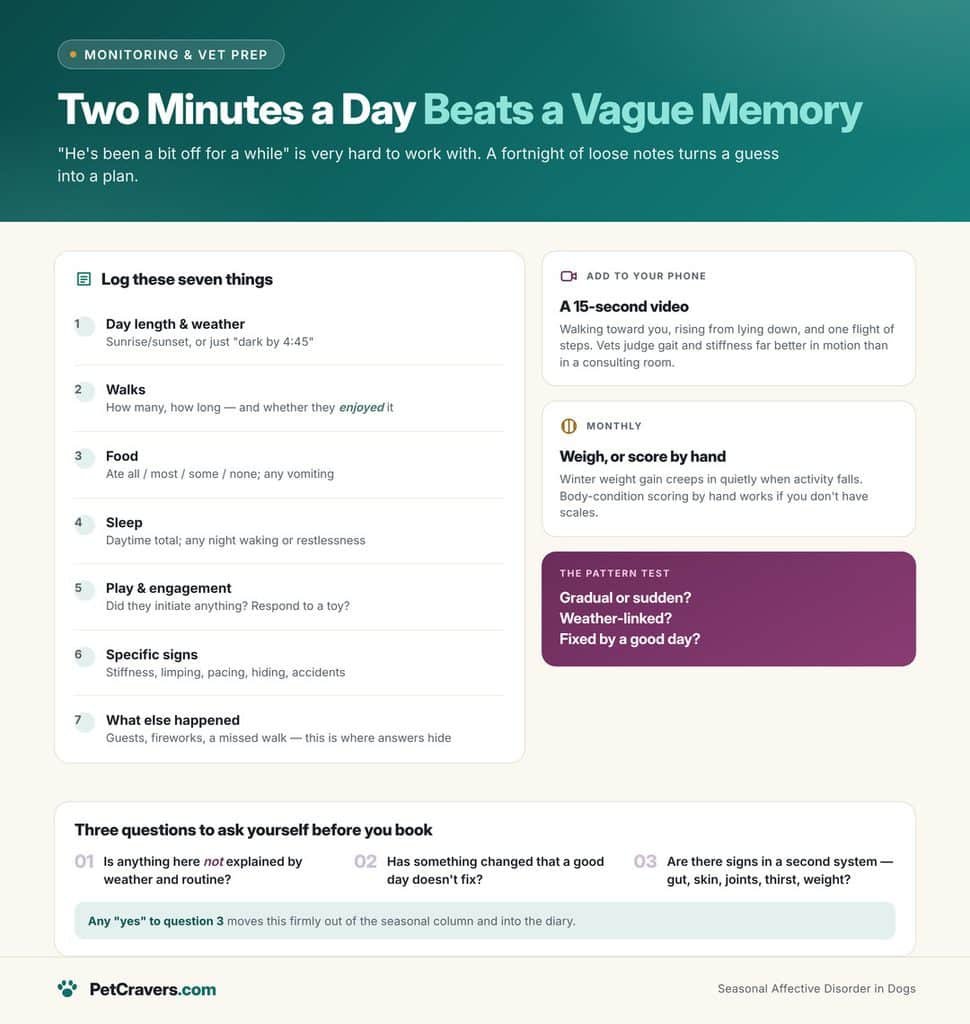
Memory is unreliable, and “he’s been a bit off for a while” is very hard to work with. A fortnight of loose notes is worth more than an hour of recall.
Keep it simple — two minutes a day:
- Date and day length (sunrise/sunset, or just “dark by 4:45”).
- Weather. Dry, wet, windy, cold, hot, or extreme.
- Walks: how many, how long, and — crucially — whether your dog seemed to enjoy it.
- Food: ate all / most / some / none. Any vomiting or diarrhea.
- Sleep: roughly how much in the day; any night waking or restlessness.
- Play and engagement: did they initiate anything? Respond to a toy?
- Specific behaviors: stiffness on rising, reluctance to jump, limping, panting, pacing, hiding, vocalizing, accidents indoors.
- Stools, water intake, and weight if you can weigh them — monthly is enough.
- One line on what else happened that day. Guests, fireworks, a late night, a missed walk. This is where the real explanation usually hides.
Add one thing to your phone: a 10–20 second video of your dog walking toward you, rising from lying down, and going up or down a step. Vets find this genuinely useful — gait and stiffness are much easier to judge in motion than in a consulting room. The 2022 AAHA Pain Management Guidelines specifically emphasise the value of owner-provided observation and video for identifying chronic pain at home (AAHA).
Then ask yourself three questions before you book:
1. Is there anything here that is not explainable by weather and routine?
2. Has anything changed that a good day doesn’t fix?
3. Are there signs in a second system — gut, skin, joints, thirst, breathing, weight?
Any “yes” to question 3 in particular moves this firmly out of the seasonal column.
Practical, Low-Risk Ways to Support Your Dog
Everything in this section is lifestyle support appropriate for a healthy dog. None of it treats a diagnosis, and none of it replaces a vet visit if something is genuinely wrong.
Keep the routine stable
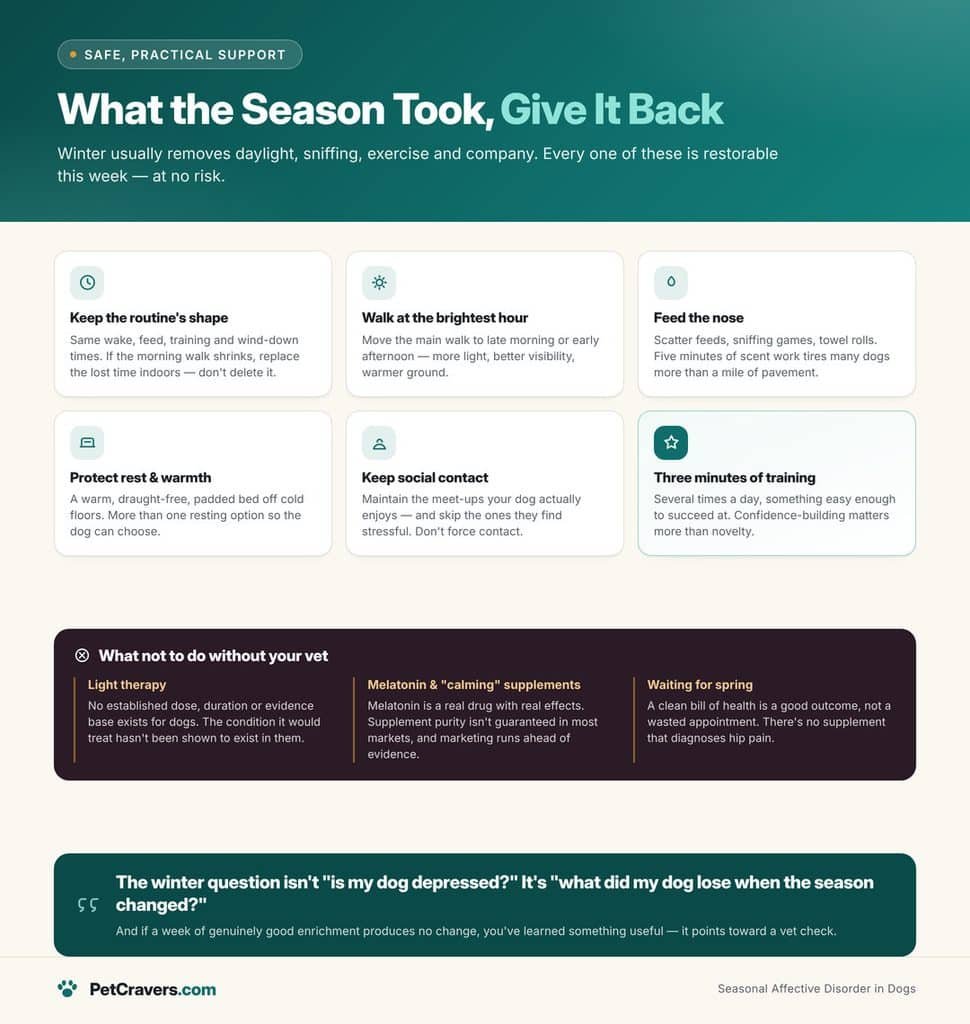
Dogs are creatures of predictability, and winter is when routines quietly erode — later mornings, skipped walks, different mealtimes. Try to hold the shape of the day constant even when the content changes: same wake time, same feeding times, same short training session, same wind-down. If the morning walk has to shrink, replace the lost time with something indoors rather than deleting it.
The Royal Kennel Club’s guidance identifies change to routine, social group, and environment as core drivers of low-mood presentations in dogs — and recommends predictability and confidence-building as the first response (Royal Kennel Club).
Get outside safely, at the brightest hour
Move the main walk to the brightest part of the day — usually late morning to early afternoon — rather than first thing in the dark or last thing at night. You get more natural light, better visibility, and warmer temperatures.
Practical cold-weather care: check paws for ice balling and grit, rinse salt off after walks, shorten walks in severe cold, and consider a coat for thin-coated, small, elderly, or arthritic dogs. In hot climates the logic inverts — walk at dawn and dusk, check pavement temperature with the back of your hand, and watch for heat intolerance, especially in flat-faced dogs.
If it’s genuinely unsafe outdoors, a shorter sniff walk in a sheltered spot beats no walk. Sniffing is not a consolation prize; it’s the main event for a lot of dogs.
Feed the brain, not just the body
Enrichment is the highest-yield intervention in this whole article, because it addresses the most likely mechanism — reduced stimulation — without any risk.
- Scatter feeding and puzzle feeders for part of the daily ration.
- Sniffing games: hide treats around a room and let the nose do the work. Five minutes of scent work tires many dogs more than a mile of pavement.
- Chew and shred outlets: appropriate chews, cardboard to destroy, a towel with treats rolled inside.
- Short training sessions: three to five minutes, several times a day, of something easy enough to succeed at. Confidence-building matters more than novelty.
- “Find it” and cup games on the living room floor when the weather is foul.
The MSD Veterinary Manual notes that environmental enrichment helps protect against cognitive decline in ageing dogs and recommends consistent routines, positive reinforcement, and exercise adapted to the dog’s comfort — a set of principles that serves dogs of every age (MSD Veterinary Manual).
Protect rest and warmth
Dogs sleep a lot anyway — much of the day for a typical adult. The question isn’t the total, it’s whether sleep is restorative. Provide a warm, draught-free, elevated-or-padded bed away from cold floors and radiators, and more than one resting option so the dog can choose. If your dog is restless or vocal at night, that’s a signal to note and report, not to shrug at.
Keep up social contact and training
Company is enrichment. If your dog enjoys other dogs, maintain those meet-ups through winter rather than letting them lapse until spring. If your dog finds other dogs stressful, don’t force it — the goal is contact your dog actually wants.
And keep training going. A dog who is still learning things is still engaged with the world.
Daylight, Lamps, and Lighting: A Careful Word
Because light is central to the human SAD story, owners reasonably ask about light boxes. So let’s be precise.
There is no established protocol, dose, or evidence base for light therapy in dogs. Light therapy in humans is a clinical treatment with defined parameters — typically a 10,000-lux box for around 30–45 minutes each morning — developed and validated for a specific human diagnosis (NIMH). None of that has been translated to or tested in dogs.
Do not start light therapy, or make major changes to your dog’s light exposure, as a treatment without veterinary guidance. This is not excessive caution:
- The condition it would be treating hasn’t been established in dogs.
- The appropriate exposure — duration, intensity, distance, time of day — is unknown for dogs, who have different visual and light-sensing physiology and very different day lengths from humans.
- Bright light can be aversive or uncomfortable for some dogs, and can disrupt sleep if timed badly. A dog can’t tell you it’s too much.
- If the real problem is pain or illness, light therapy delays diagnosis. That’s the biggest risk of all.
What is reasonable without any clinical guidance is much more modest: open the curtains, spend time in the brightest room, sit near a window in the morning, and walk in daylight when you can. These are ordinary good-husbandry choices, not treatment.
One genuinely encouraging data point: in the sled dog study, exercise reduced peak melatonin levels in dogs at both latitudes (Dunlap et al., 2007). That’s a long way from a therapy, but it’s a reminder that a good walk is doing more than burning energy.
If you suspect a light-related issue, raise it with your vet — and if the vet thinks a behavioral specialist is warranted, that’s the right referral route rather than experimentation at home.
Food, Water, and the Supplement Trap
Winter appetite changes are common: some dogs eat more as activity falls, and the weight can pile on quietly over a season. Others eat less. Both are worth measuring rather than eyeballing.
Keep feeding a complete, balanced diet appropriate for your dog’s life stage and body condition. The World Small Animal Veterinary Association’s Global Nutrition Guidelines are the most useful plain-language framework for assessing a diet and body condition, and they’re free (WSAVA). If your dog is less active, their portions may need a modest adjustment — ask your vet rather than guessing, especially for a dog on a therapeutic diet.
Watch water intake. A meaningful increase in thirst is one of the most useful early clues to a medical problem and has nothing to do with the season. Note it and report it.
Avoid supplements and diet changes as a substitute for veterinary care. This is the single most common mistake in this space. Melatonin, omega-3s, “calming” chews, and mood-support powders are widely marketed for seasonal low mood in dogs, and the marketing runs well ahead of the evidence. Melatonin is a real drug with real effects — it’s used clinically in some dermatological and reproductive contexts — and dosing in dogs is not something to derive from a blog or a bottle. Supplements are also unregulated in most markets, so content and purity aren’t guaranteed.
None of that means supplements are always wrong. It means the decision belongs to your vet, with your dog’s history and any other medications in hand. There’s no supplement that diagnoses hip pain.
When to Call Your Vet — and What an Assessment Might Involve
Call your vet if the change is sudden, persistent (more than a couple of weeks without a clear explanation), worsening, or concerning in any way that your instinct flags. Trust that instinct; you know your dog’s baseline better than anyone.
Call promptly — same day if possible — if you see any of these:
- Not eating, or eating markedly less, for more than 24 hours
- Vomiting, diarrhea, or both, especially with lethargy
- Weight loss
- Increased thirst and urination
- Difficulty breathing, coughing, or a new heart murmur suspicion
- Limping, reluctance to rise, jump, or climb stairs
- Collapse, weakness, or disorientation
- Night-time restlessness, pacing, or vocalizing in an older dog
- New aggression, or growling/snapping when touched or moved
- Hiding, trembling, or distress when left alone
- Any sign of pain: guarding a body part, a hunched posture, changes in posture or gait
Emergency — go now — if you see: collapse, labored breathing, a distended abdomen, pale or blue gums, seizures, inability to urinate, or a sudden inability to use the back legs.
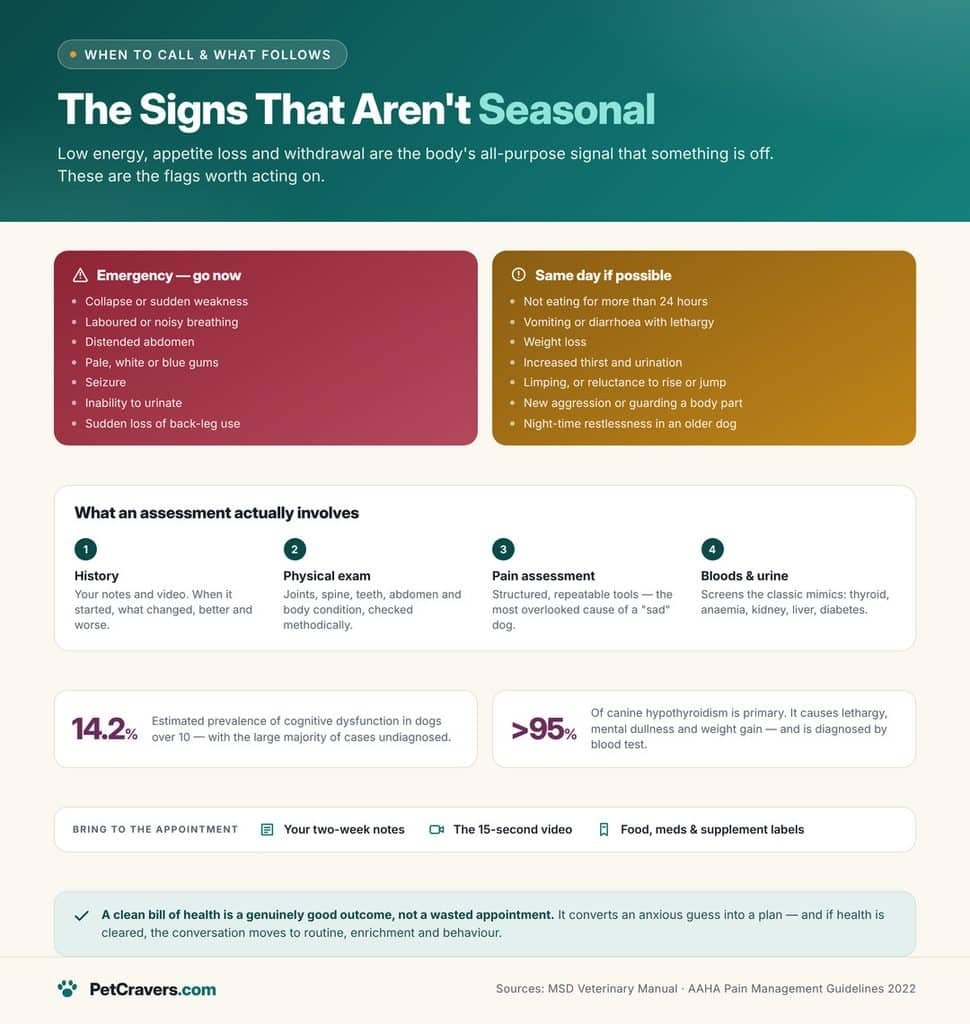
What an assessment may involve. There’s no test for seasonal affective disorder. What your vet will do is look for the things that are testable — which, happily, covers almost every realistic alternative:
1. History. Your notes and video are gold here. When did it start, what changed, what’s better and worse, appetite, water, sleep, stools, behavior at home versus out.
2. Full physical examination, with particular attention to joints, spine, teeth, abdomen, and body condition.
3. Orthopedic and pain assessment. Vets are trained to find pain that owners reasonably miss, and chronic pain is the most commonly overlooked cause of a “sad” dog. The AAHA guidelines describe structured, repeatable pain assessment tools including owner-completed instruments (AAHA).
4. Blood work and urinalysis. A standard panel screens for the classic mimics — hypothyroidism, anemia, kidney and liver disease, diabetes. Hypothyroidism in particular causes lethargy, mental dullness, exercise intolerance, and weight gain, and is diagnosed with blood tests (MSD Veterinary Manual).
5. Neurological and cognitive screening in older dogs. If your dog is senior, your vet may screen for cognitive dysfunction syndrome using the DISHAA framework — disorientation, altered interactions, sleep-wake changes, house soiling, altered activity, and anxiety. This is underdiagnosed: one survey estimated 14.2% prevalence in dogs over 10, with the large majority of cases undiagnosed (MSD Veterinary Manual).
6. A behavior plan, if health is cleared. If everything comes back normal, the conversation shifts to routine, enrichment, and — where relevant — referral to a veterinary behaviorist or accredited behaviorist. The AAHA behavior guidelines set out why behavioral problems deserve the same clinical rigor as physical ones (AAHA).
A clean bill of health is a genuinely good outcome, not a wasted appointment. It converts an anxious guess into a plan.
Myths, Mistakes, and Questions Owners Actually Ask
“My dog definitely has SAD — he does this every single year.”
A repeating annual pattern is genuinely interesting and absolutely worth mentioning to your vet. But annual recurrence is also perfectly compatible with a non-mood explanation: cold weather aggravating arthritis, a recurring fear season (fireworks, storms), a predictable change in your household’s schedule, or a seasonal skin or allergy flare. Recurrence tells you the trigger is seasonal, not that the condition is SAD.
“Dogs get SAD because they have the same brain chemistry as us.”
Dogs and humans do share basic neurochemistry — melatonin, serotonin, and the machinery that regulates them. That’s a reason the question is worth asking. It’s not evidence of a mood disorder, and the leap from “shared hormone” to “shared diagnosis” is exactly where most online articles go wrong.
“A light box worked for me, so I’ll try it on my dog.”
Please don’t, at least not without your vet. There’s no established dose or evidence base for dogs, and the bigger risk is that a treatable illness goes unchecked for another month. Open the curtains and walk in daylight meanwhile.
“He’s just sleeping more because it’s winter.”
Maybe. But “sleeps more” is one of the most common early owner observations in canine hypothyroidism, chronic pain, and cognitive dysfunction. If it’s more than usual for your dog, and it’s persisted past a couple of weeks, get it checked.
“If it’s seasonal, we just wait for spring.”
That’s the mistake this whole article is about. Even if the trigger is seasonal, the fix isn’t passive — it’s maintaining exercise, enrichment, and routine through the dark months. Waiting is how a mild slump becomes a long one.
“He seems sad — should we get antidepressants?”
Medication decisions belong to your vet, and in dogs they’re used for specific diagnosed conditions — often alongside behavior modification, not instead of it. Nobody should be starting psychotropic medication based on a seasonal hunch.
“My dog is eating more in winter. Is that SAD?”
Increased appetite is reported by owners in winter surveys, and there are plausible reasons — lower activity, more treats, more time indoors near food, comfort-feeding by humans. In humans, winter-pattern SAD is associated with carbohydrate craving. In dogs this is not established. Watch the scales; weight gain from a sedentary winter is the more likely culprit.
“Is it worse for certain breeds?”
No breed-based claims are supported here. What varies is individual temperament, age, coat, body condition, existing health, and home environment. A short-coated, arthritic, elderly dog has a rough winter for reasons that have nothing to do with breed character.
“How long should a seasonal dip last?”
There’s no established duration, because there’s no established condition. A practical rule: if a plausible seasonal dip hasn’t improved within two to three weeks of consistent exercise, enrichment, and routine — or if it’s getting worse — that’s your signal to book an appointment.
“Is my dog bored or depressed?”
Honestly, they can look the same, and the initial response is the same: increase exercise, enrichment, and social contact, and see what happens. If a week of genuinely good enrichment produces no change, you’ve learned something useful — and it points toward a vet check.
“Can dogs get summer-pattern SAD too?”
In humans, summer-pattern SAD exists but is much less common. In dogs, nothing is established for either pattern. In hot climates, summer heat genuinely suppresses activity — but that’s a heat and exercise story, not a mood-disorder story.
The Bottom Line: A Simple Action Checklist
If your dog seems flatter this season, here’s the whole article in a list.
This week
☐ Start a two-minute daily note: food, walks, sleep, play, and anything unusual.
☐ Film a 15-second clip of your dog walking and rising from lying down.
☐ Move the main walk to the brightest part of the day.
☐ Add one enrichment activity a day — a scatter feed, a sniffing game, a three-minute training session.
☐ Hold your routine’s shape steady: same wake, feed, and wind-down times.
☐ Check the bed: warm, dry, off cold floors.
Within two weeks
☐ Review your notes for pattern: gradual or sudden? Weather-linked? Fixed by a good day?
☐ Weigh your dog, or body-condition score them by hand.
☐ Count the appetite changes, water changes, and any stiffness or reluctance to jump.
☐ Ask: is anything here not explained by the season?
Call your vet if
☐ The change is sudden, severe, or worsening.
☐ It has persisted beyond two to three weeks despite good enrichment and exercise.
☐ There’s any change in appetite, water intake, weight, or toileting.
☐ There’s any sign of pain or reduced mobility.
☐ Your dog is older and showing new sleep, orientation, or interaction changes.
☐ Your instinct says something is wrong. That counts.
Don’t
☐ Don’t diagnose seasonal affective disorder in your dog.
☐ Don’t start light therapy, supplements, or medication without veterinary guidance.
☐ Don’t wait for spring to rule out pain or illness.
Here’s the reframe that makes all of this easier: the winter question isn’t really “is my dog depressed?” It’s “what did my dog lose when the season changed, and can I give it back?” Usually the answer is daylight, sniffing, exercise, company, and predictability — all things you can restore this week, at no risk, while you keep an eye out for anything that needs a professional.
And if Wren’s story sounds familiar? Her owner did the sensible thing: kept the walks short but daily, moved them to lunchtime, bought a snuffle mat, and had her hips checked. The hips were the answer. The season was the stage.
References and Further Reading
Peer-reviewed research
1. Dunlap KL, Reynolds AJ, Tosini G, Kerr WW, Duffy LK. Seasonal and diurnal melatonin production in exercising sled dogs. Comparative Biochemistry and Physiology Part A. 2007;147(4):863–867. https://pubmed.ncbi.nlm.nih.gov/17379556/ — The key study on seasonal melatonin in dogs. Peer-reviewed physiology journal; the most-cited evidence for canine seasonal biology, and notably not a mood study.
2. Estimated activity levels in dogs at population scale with linear and causal modeling. Frontiers in Veterinary Science. 2025. https://www.frontiersin.org/journals/veterinary-science/articles/10.3389/fvets.2025.1572794/full — Open-access, peer-reviewed; the largest objective dataset on canine activity and season (28,562 dogs, 8.7 million days). Measures movement, not mood.
3. Harvey ND, Moesta A, Kappel S, Wongsaengchan C, Harris H, Craigon PJ, Fureix C. Could greater time spent displaying waking inactivity in the home environment be a marker for a depression-like state in the domestic dog? Animals. 2019;9(7):420. https://pmc.ncbi.nlm.nih.gov/articles/PMC6680786/ — Open-access peer-reviewed study. Its value here is the negative finding: inactivity alone did not demonstrate a depression-like state.
4. Harvey ND, Moesta A, Wongsaengchan C, Harris H, Craigon PJ, Fureix C. Investigating putative depression-like states in the domestic dog. Applied Animal Behaviour Science. 2020;230:105025. https://doi.org/10.1016/j.applanim.2020.105025 — Peer-reviewed; illustrates how hard it is to validate a depression measure in dogs.
5. Wu YT, Luben R, Jones A. Dog ownership supports the maintenance of physical activity during poor weather in older English adults. Journal of Epidemiology and Community Health. 2017. https://pmc.ncbi.nlm.nih.gov/articles/PMC5561362/ — Peer-reviewed, free full text via PubMed Central; the clearest evidence on how weather reshapes dog-walking behavior.
6. A pilot study to evaluate the potential of melatonin implants to control cyclicity in the bitch. Animals. 2023;13(8):1316. https://pmc.ncbi.nlm.nih.gov/articles/PMC10135000/ — Peer-reviewed; a useful counterpoint showing no significant seasonal effect on serum melatonin in that sample.
Veterinary and animal-welfare organizations
7. American Kennel Club. Can Dogs Get Seasonal Affective Disorder? https://www.akc.org/expert-advice/health/can-dogs-get-seasonal-affective-disorder/ — National breed registry with veterinary expert commentary; clear statement that canine SAD is not established.
8. PetMD (veterinarian-written, vet-reviewed). Can Dogs Get Seasonal Depression? https://www.petmd.com/dog/general-health/can-dogs-get-seasonal-depression — Veterinary-reviewed consumer health publisher; confirms the absence of evidence.
9. Royal Kennel Club. Dog depression and canine seasonal affective disorder. https://www.royalkennelclub.com/health-and-dog-care/health-dog-care/health/health-and-care/a-z-of-health-and-care-issues/dog-depression-and-canine-seasonal-affective-disorder/ — Major national kennel club; strong practical guidance on routine, enrichment, and pain as a differential.
10. Merck Veterinary Manual. Disorders of the Thyroid Gland in Dogs. https://www.merckvetmanual.com/dog-owners/hormonal-disorders-of-dogs/disorders-of-the-thyroid-gland-in-dogs — Long-established veterinary reference text; details hypothyroidism as a classic mimic of lethargy.
11. Merck Veterinary Manual. Behavior Problems of Dogs (incl. cognitive dysfunction syndrome and DISHAA). https://www.merckvetmanual.com/behavior/behavior-of-dogs/behavior-problems-of-dogs — Peer-referenced veterinary reference; source for CDS prevalence and enrichment guidance.
12. American Animal Hospital Association. 2022 AAHA Pain Management Guidelines for Dogs and Cats. https://www.aaha.org/resources/2022-aaha-pain-management-guidelines-for-dogs-and-cats/home-3/ — Consensus practice guidelines from a veterinary accrediting body; source for structured pain assessment and owner video.
13. American Animal Hospital Association. 2015 AAHA Canine and Feline Behavior Management Guidelines. https://www.aaha.org/resources/2015-aaha-canine-and-feline-behavior-management-guidelines/ — Consensus guidelines; supports treating behavior as a clinical matter.
14. World Small Animal Veterinary Association. Global Nutrition Guidelines. https://wsava.org/global-guidelines/global-nutrition-guidelines/ — International veterinary association; practical, non-commercial framework for diet and body condition assessment.
15. University of Minnesota. Canine Flank Alopecia. Small and Large Animal Dermatology Handbook, Vol. 2. https://open.lib.umn.edu/animaldermatology2/chapter/canine-flank-alopecia/ — University veterinary teaching resource; the best-documented example of photoperiod-driven canine biology.
Human medical reference (for the definition of SAD)
16. National Institute of Mental Health. Seasonal Affective Disorder. https://www.nimh.nih.gov/health/publications/seasonal-affective-disorder — The authoritative source for the human diagnosis, symptom list, diagnostic criteria, and light therapy parameters referenced above.



Leave a Reply