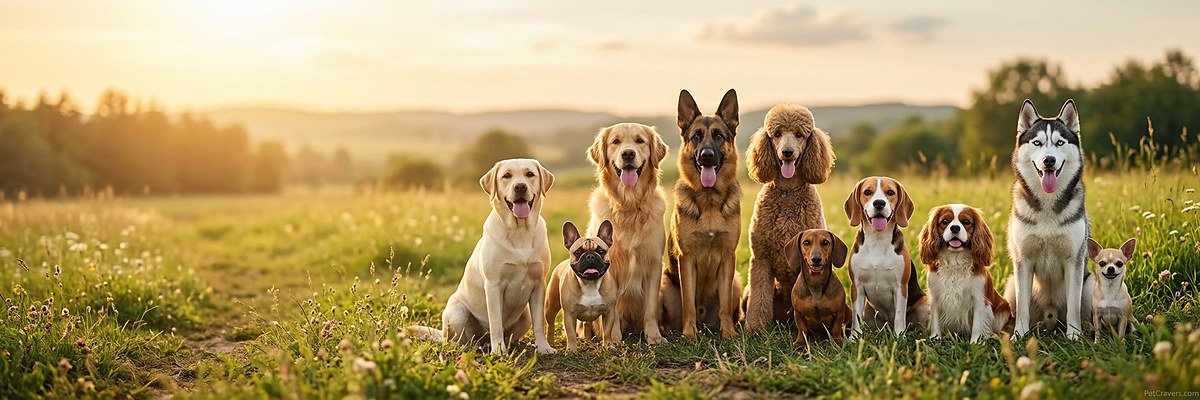
Ask a dozen dog people to name the most popular dog breeds in the world and you’ll get a dozen answers — because no single, official global league table exists. What exists is a patchwork of kennel club registrations, national breed records, adoption trends, search interest and cultural prominence. Assemble the credible pieces, though, and a consistent picture emerges: a handful of breeds stand on podium after podium across continents, while dozens more are adored in some countries and barely registered in others.
This guide covers all 50 breeds at or near the top of that picture. For every one: a snapshot of size, lifespan and grooming, plus an honest read on temperament, exercise, health and the lifestyle the breed genuinely fits — and the caveats most breed lists skip: why “most registered” is not “most owned,” and why popularity says nothing about whether a dog suits your house.
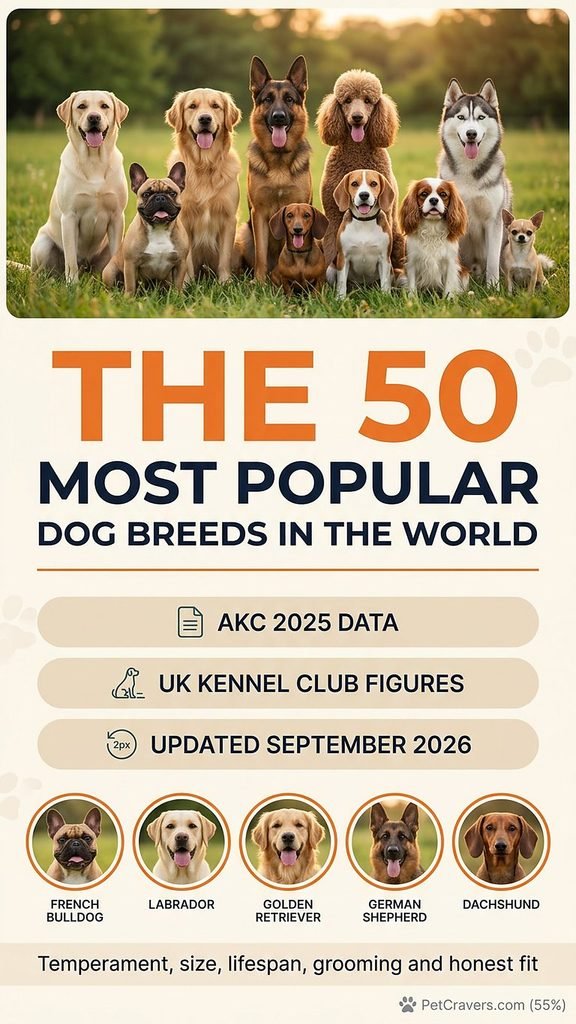
We last updated in September 2026, using American Kennel Club data for 2025 (published 2026) and the most recent Kennel Club (UK) figures.
Quick Answers About the World’s Most Popular Dog Breeds
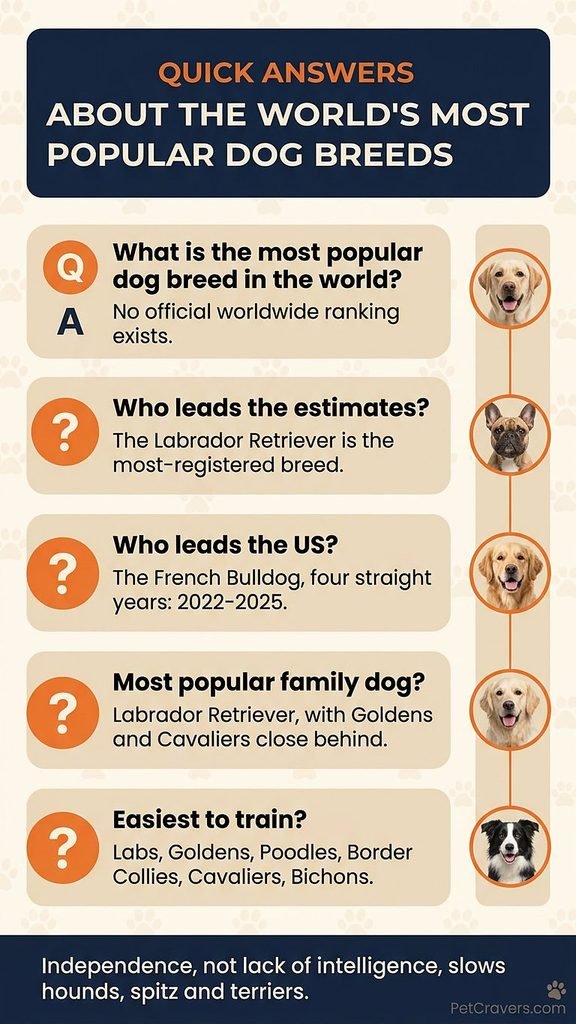
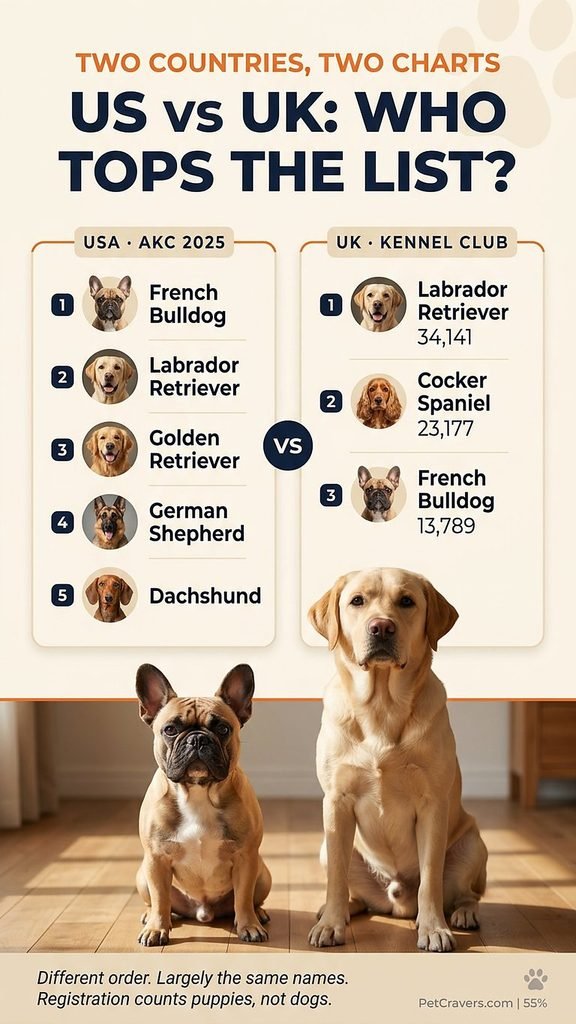
What is the most popular dog breed in the world? There is no official worldwide ranking. The Labrador Retriever is the most-registered breed in the best global estimates and still leads UK registrations, while the French Bulldog has topped the American AKC list for four straight years (2022–2025).
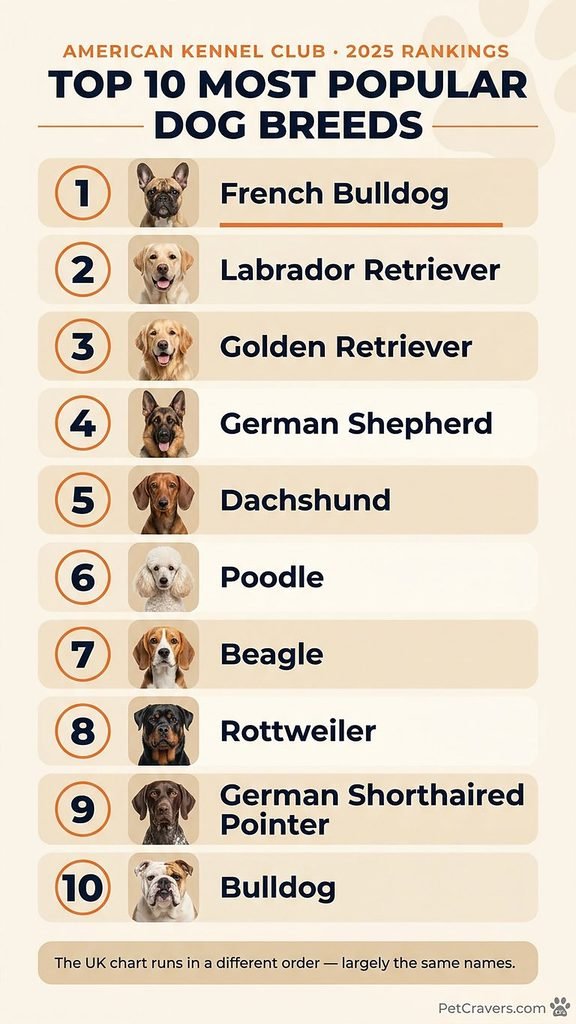
What are the most popular dog breeds? Nearly every national chart opens the same way: French Bulldog, Labrador, Golden Retriever, German Shepherd, Dachshund, Poodle, Beagle, Rottweiler, Bulldog and Boxer, in varying orders.
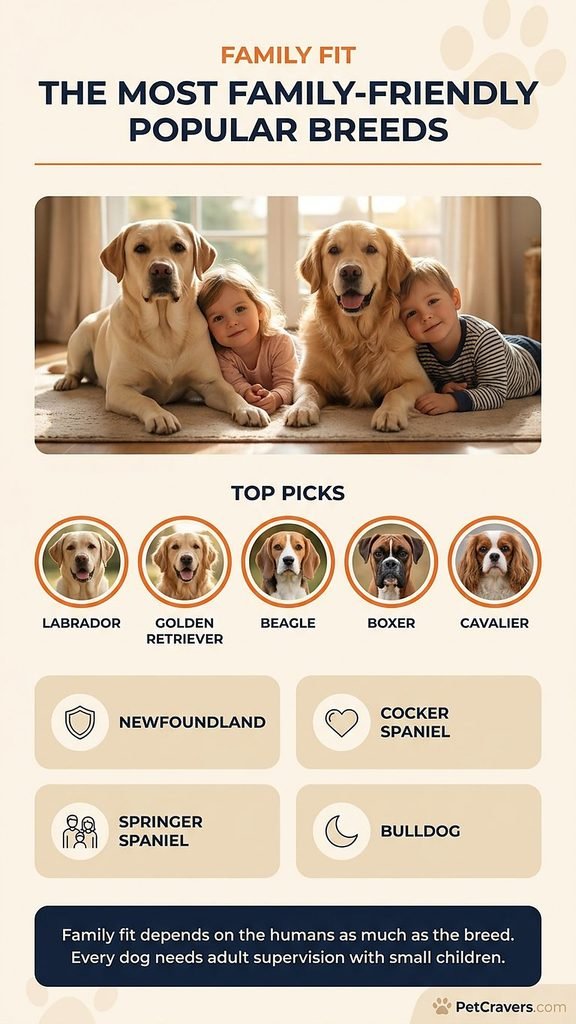
Which is the most popular family dog? The Labrador Retriever, backed by decades of registration data and a reputation for friendliness, with Golden Retrievers and Cavalier King Charles Spaniels close behind.
Which popular breeds are easiest to train? The biddable, food-motivated ones — Labs, Goldens, Poodles, Border Collies, Cavaliers, Bichons. Independence, not lack of intelligence, is what slows hounds, spitz and terriers.
What Makes a Dog Breed Popular?
Breeds get famous through usefulness, fashion and access — and the recipe keeps changing.
Function comes first. The Labrador, Golden Retriever and German Shepherd spent a century proving themselves at jobs before anyone met them as pets; a breed that reliably herds, hunts, rescues or guards earns registry places long before social media exists.
Temperament then meets modern life. The French Bulldog’s climb from 14th most popular AKC breed in 2012 to number one a decade later is the clearest example: small size, modest exercise and an easygoing manner suit city apartments, and the breed hasn’t let go. Urbanization is quietly rewriting popularity charts across the wealthy world.
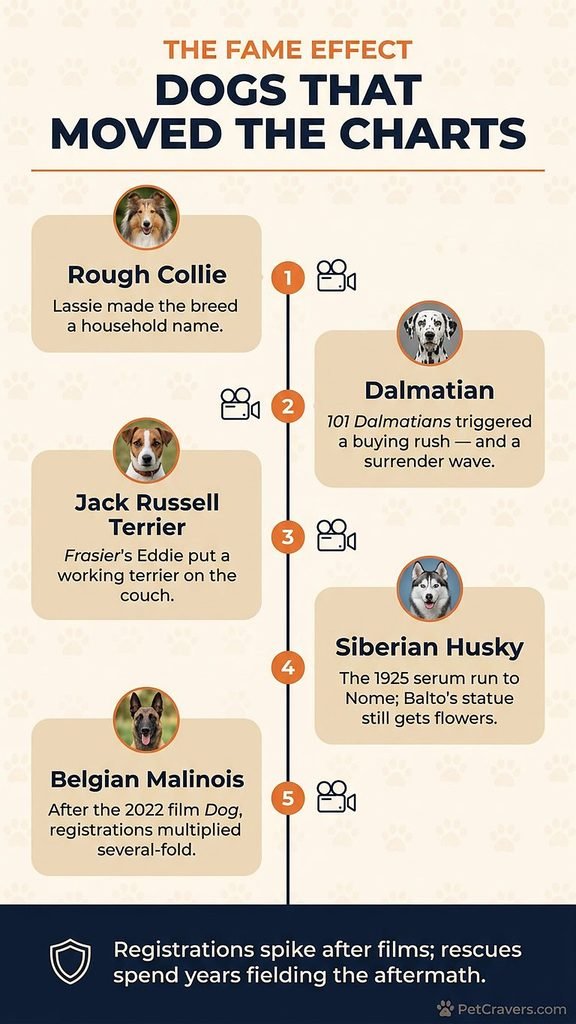
Media is the accelerant. Lassie made the Rough Collie a household name. 101 Dalmatians triggered a buying rush — and, less quoted, a wave of surrenders when those puppies grew into decades-long athletes. Frasier had a Jack Russell on the couch; the 2022 film Dog sent future owners chasing Belgian Malinois. Registrations spike after films; rescues spend years fielding the aftermath.
Availability matters more than buyers admit: where breeders are thick on the ground — Labs in Britain, Shepherds in Germany, Maltese across East Asia — chart presence becomes self-reinforcing.
And some breeds carry cultural weight no Western registry measures. Shibas and Akitas anchor Japanese dog life; the Staffordshire Bull Terrier is called “the family dog of the UK”; Samoyeds matter enormously in Russia. An honest list of popular dog breeds worldwide has to weigh local conviction, not just American and British paperwork.
How “Popular” Is Measured — and Why There’s No Single World Ranking
Worth being transparent, because breed-popularity claims are usually overstated.
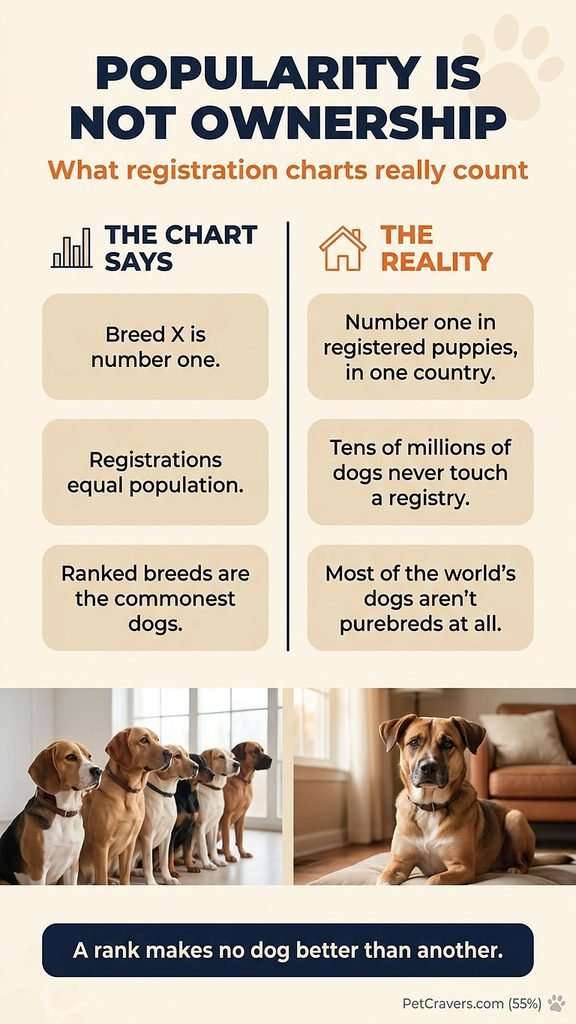
Kennel club registration is the standard yardstick, and it has two blind spots. First, it counts puppies registered with one club in one country — not dogs alive on earth. The AKC, the world’s largest registry of purebred dogs, processes on the order of a few hundred thousand registrations a year, while tens of millions of dogs never touch a registry. Second, most of the world’s dogs aren’t purebreds at all; in many countries the majority are mixed-breed or free-ranging animals on no chart.
Attempts to stitch the world together are rare and dated: a widely cited 2013 study commissioned by the Swedish Kennel Club collected registration data from 25 kennel clubs — more than 2.2 million dogs — and found the Labrador the most-registered breed on Earth, ahead of the German Shepherd and Poodle. The Fédération Cynologique Internationale, umbrella for roughly 90 national kennel clubs, publishes no consolidated worldwide popularity list at all.
So when someone asks “what’s the number one dog breed in the world?”, the truthful answer is: it depends whose paperwork you read — and whether you count dogs at all, or only registered puppies.
How We Selected These 50 Breeds
This is a practical worldwide selection of highly popular, widely recognized breeds — not an exact global ranking, and it shouldn’t be read as one. We drew on the AKC’s 2025 registration rankings; Kennel Club (UK) figures for 2024–2025 (where the Labrador led with roughly 30,000–34,000 registrations a year ahead of the Cocker Spaniel and French Bulldog); the Swedish Kennel Club’s global survey; repeat appearances in Canadian, Australian and Nordic charts; and persistence near the top across decades — plus recent climbs, search interest and cultural presence that capture breeds like the Shiba Inu and Malinois beyond raw registration counts.
Two honest limitations. Shelter systems in many countries report retriever, shepherd and husky crosses among the most surrendered types — breed popularity and rescue abundance are painfully related. And a breed missing here isn’t unpopular somewhere: the Staffordshire Bull Terrier and the Great Pyrenees are both huge locally. The ordering below moves roughly from the most globally registered toward strong regional favorites. No placement is an exact rank — and no rank makes one breed a better dog than another.
The 50 Most Popular Dog Breeds in the World
1. Labrador Retriever
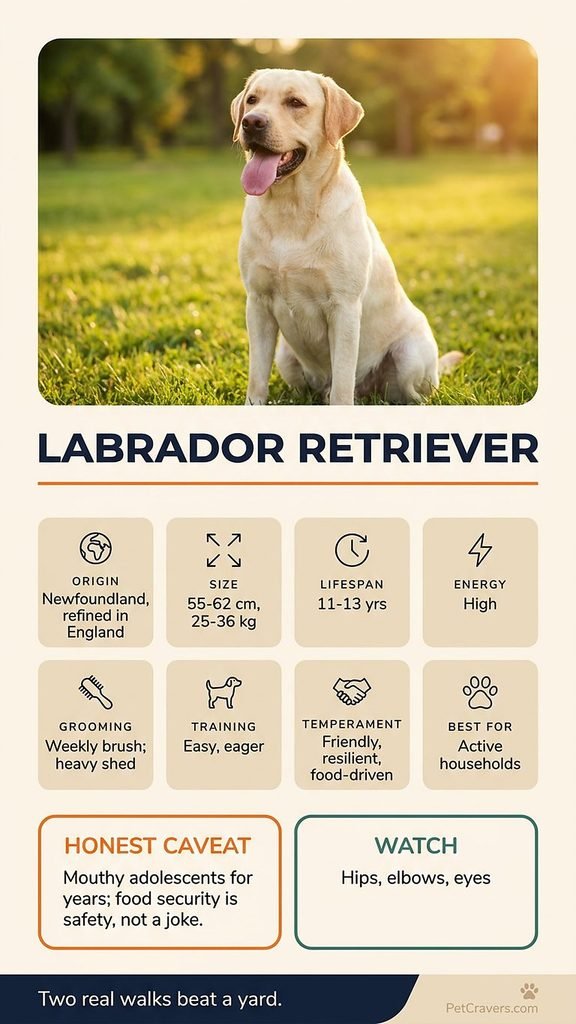
At a glance: Origin: Newfoundland, refined in England · Size: 55–62 cm, 25–36 kg · Lifespan: 11–13 yrs · Energy: High · Grooming: Weekly brush; heavy shed · Training: Easy, eager · Temperament: Friendly, resilient, food-driven
The St. John’s dog of Newfoundland hauled fishing nets in freezing water until English breeders shaped the modern Lab in the 1800s — a working fisher’s dog that grew into the world’s most trusted companion. Assistance and rescue programs still lean on the breed; it held the AKC’s number one spot for 31 straight years (yielding to the Frenchie only in 2022–2025) and remains the UK’s most registered dog.
Sturdy, forgiving and quick to train — the standard first-timer recommendation — though they stay mouthy adolescents for years and will eat anything, so food security is a safety issue, not a joke; UK vet data keeps finding Labs overrepresented among obese dogs. Two real walks beat a yard; watch hips, elbows, eyes. [Internal link: dog weight management guide] For active households that can outsmart the bowl, still the all-rounder to beat.
2. French Bulldog
At a glance: Origin: England and France · Size: 28–33 cm, under 13 kg · Lifespan: 10–12 yrs · Energy: Moderate · Grooming: Minimal; fold wipes · Training: Willing but stubborn · Temperament: Charming, attentive
The Frenchie began as a mini-Bulldog carried north by Nottingham laceworkers and finished as a Paris fashion plate — bat ears embraced in France, rejected by Bulldog purists — a dog bred for company, not work. That’s why the AKC chart flipped: 14th in 2012, number one every year since 2022, with the same flat-faced climb across urban registries worldwide.
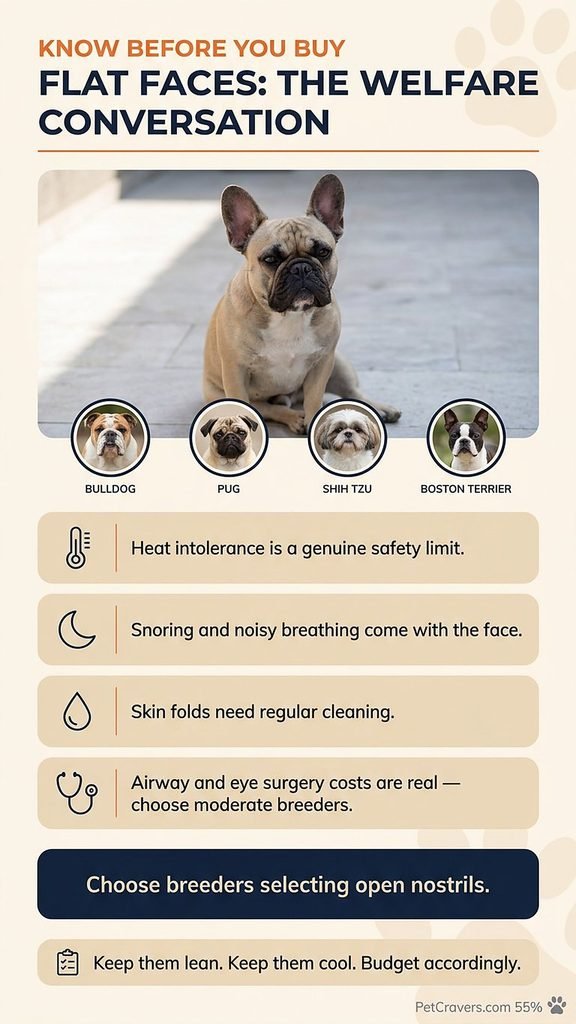
The face is the contract: short muzzles bring snoring, heat intolerance and often noisy breathing, and major UK veterinary-records studies flag elevated disorder risks in flat-faced breeds. The payoff is a low-exercise, adaptable apartment companion that trains for food and wants only to be near you. Keep them lean and cool — and choose breeders selecting open nostrils, because the welfare conversation comes with the purchase.
3. Golden Retriever
At a glance: Origin: Scottish Highlands · Size: 51–61 cm, 25–34 kg · Lifespan: 10–12 yrs · Energy: High · Grooming: Brush 2–3x/week; blows seasonally · Training: Outstanding · Temperament: Warm, tolerant, biddable
Lord Tweedmouth bred a yellow retriever named Nous to a Tweed Water Spaniel at Guisachan in the 1860s — a soft-mouthed gundog built to carry game undamaged, the soft mouth surviving as the soft temperament that now anchors guide-dog, therapy and search work worldwide.
The most recommended “gentle with kids” large dog and wonderfully trainable: food-motivated, handler-obsessed, forgiving of honest mistakes — but puppy-goofy and mouthy for years, with zero stranger anxiety, so a companion, never a guard. Feathering mats without brushing, and the coat blows twice a year. The sad asterisk: cancer is unusually prevalent in the breed, making health-tested parents and yearly vet checks non-negotiable. If you want a dog that greets everyone like a long-lost friend, this is the benchmark.
4. German Shepherd
At a glance: Origin: Germany · Size: 55–65 cm, 22–40 kg · Lifespan: 7–10 yrs · Energy: High · Grooming: Weekly; sheds an ocean · Training: Excellent, needs purpose · Temperament: Confident, loyal, alert
Max von Stephanitz codified the breed from 1899 on one blunt principle — utility is the standard — and German Shepherds went from Thuringian sheepdogs to the world’s default police, military and rescue dog within two decades, with Rin Tin Tin handling the cinema. In the leading multi-country registration survey, only the Labrador out-registers them.
A well-bred GSD bonds ferociously and works for praise like other dogs work for steak — intensity that cuts both ways: without jobs and constant socialization they turn suspicious or destructively bored, so [Internal link: puppy socialization guide] is safety-critical homework, not enrichment. Health is the hard talk: hips, elbows, degenerative myelopathy, bloat — and “show” lines with sloped toplines carry more orthopedic risk than working lines, so buy by performance record. A partner with a job, not a couch with a tough look.
5. Poodle
At a glance: Origin: Germany/France · Size: Toy to Standard, 2–32 kg · Lifespan: 10–18 yrs by variety · Energy: Medium-high · Grooming: Clip every 4–6 weeks · Training: Among the best · Temperament: Brilliant, proud, athletic
Everyone assumes the Poodle is a French parlor dog; it’s a German water hunter France polished into refinement — the famous clip is functional heritage, joints trimmed for swimming, chest left warm in duck marshes — and its curly, low-shedding coat made it the original “hair, not fur” choice. In the leading global registration study, Poodles rank among the world’s three most-registered breeds.
The caricature does them wrong: these are athletic, retriever-smart dogs who shine in obedience and go snappy when bored — exercise and training, not ribbons. The coat is the contract: no shed, but matting within weeks without combing and clipping. Health varies by size — patellas and eyes in toys, bloat and Addison’s in standards — from breeders who run the recommended tests. The smartest coat you’ll ever own, in a blueprint that fits a Paris studio or a duck blind.
6. Dachshund
At a glance: Origin: Germany · Size: 13–23 cm; mini 4–5 kg, standard up to 9 kg · Lifespan: 12–16 yrs · Energy: Medium · Grooming: Smooth minimal; long/wire brushed · Training: Clever, willful · Temperament: Bold, nosy, devoted
The “badger dog” is exactly its name: bred to go down holes after badger, with a hatchet chest for digging and a bark engineered to echo up a burrow. Queen Victoria’s enthusiasm globalized the type; the modern boom made it 5th at the AKC for 2025 and 4th in UK registrations as the miniature smooth-haired variety.
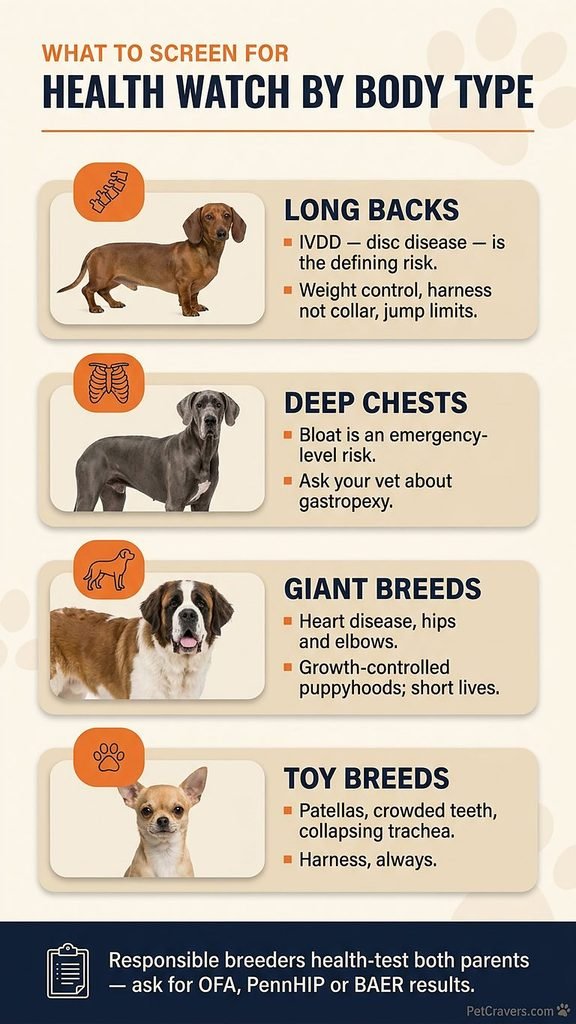
Everything else surprises first-timers: brave to the point of recklessness with strangers and bigger dogs, sharp with grabby children, diggers and burrowers by instinct — trained best with food, patience and short sessions. The long back sets the ownership theme: IVDD (disc disease) is the breed’s defining risk, so weight control, harness-not-collar and jump limits are medical decisions. Lifespans run gloriously long. The fit: adults-led homes wanting enormous personality, low-slung and loud.
7. Beagle
At a glance: Origin: England · Size: 33–40 cm, 9–14 kg · Lifespan: 10–15 yrs · Energy: High, nose-led · Grooming: Very low · Training: Food-motivated, scent-distracted · Temperament: Merry, pack-oriented
Beagles descend from centuries-old “grounding” hounds that ran rabbit on foot; the compact version was fixed in 1830s England, small enough to ride in a farmer’s saddle pocket. That nose explains the whole dog, and the cheerful, sturdy temperament keeps the breed in global top-tens — 7th at the AKC for 2025, and a US top-five staple through much of the 2000s and 2010s.
Rarely aggressive, superb with kids and other dogs (pack life is their nature), coat care-free, and so food-motivated they train beautifully — the same trait that builds obesity. The reality check: a bay howl that carries, escape artistry, and recall that is a life project, not a finished skill — secure fencing mandatory. USDA “Beagle Brigade” hounds sniff contraband in arrivals halls worldwide; the nose is a tool, not a flaw. Health is modest: hips, eyes, epilepsy in some lines. The fit: active families who accept selective hearing.
8. Yorkshire Terrier
At a glance: Origin: Yorkshire and Lancashire, England · Size: 18–20 cm, up to 3.2 kg · Lifespan: 11–15 yrs · Energy: Medium-high · Grooming: Daily if long; clips otherwise · Training: Bright, bossy · Temperament: Feisty, affectionate
The Yorkie is a mill dog in a silk coat: Scottish weavers brought the old black-and-tan terrier into Victorian Yorkshire, factory-floor ratting refined it, and parlor royalty adopted the result almost overnight. It remains a global toy heavyweight: 13th at the AKC for 2025 after three decades in the US top fifteen.
Don’t mistake the bow for the breed: true terriers — bold, loud, quick to challenge dogs ten times their size, sharp if handled clumsily — so they suit older, respectful children, not toddlers. They learn fast when paid small and often; early rules about barking and handling save a decade. The show coat tangles constantly (pet clips are standard) and tiny jaws need daily tooth-brushing. Skip “teacup” marketing — it’s fragility, not a variety. A pocket terrier, not a handbag.
9. Bulldog
At a glance: Origin: England · Size: 31–40 cm, 18–25 kg · Lifespan: 8–10 yrs · Energy: Low · Grooming: Fold wipes · Training: Slow, food-driven · Temperament: Dignified, placid, stubborn
The Bulldog is Britain’s most improbable reinvention: a baiting dog made obsolete by the 1835 ban on bull-baiting, then deliberately re-bred over a century into a sofa — a fighter converted into a symbol of calm. The paradox still sells: regimental mascots, university crests, Churchill — and a 10th-place AKC finish for 2025 after sitting 5th as recently as 2019–2020.
What lists skip: the conformation carries welfare costs. A 2021 UK veterinary-records study of more than 2,000 English Bulldogs found markedly elevated risks across dozens of disorders — breathing, skin, eye, birthing, joint — and a Norwegian court ruled in 2015 that breeding certain pet bulldogs breached animal welfare law. In return you get a courageous, gentle, low-exercise companion that adores its people, with snoring, heat sensitivity and a shorter life on the invoice. Buy for function over extremes, and budget accordingly.
10. Rottweiler
At a glance: Origin: Germany · Size: 56–68 cm, 35–60 kg · Lifespan: 8–11 yrs · Energy: Medium-high · Grooming: Very low · Training: Very good with firm fairness · Temperament: Steady, confident, devoted
Rottweilers take their name from Rottweil, a Roman-descended market town in Swabia where big drover dogs drove cattle and guarded the money belts sewn into their collars. The breed nearly vanished with the cattle drives, was rebuilt as a police dog in the early 1900s, and rode 1990s hype into superstardom and reputation trouble at once — now 8th at the AKC, a registration staple from Berlin to São Paulo.
A well-raised Rottie is a calm, goofy, shadow-loyal family dog — velvet over granite — deeply biddable with consistent leadership. The honesty continues: a powerfully built guardian needs lifelong structure and training, can turn territorial without it, and is the wrong pick for owners who think “protective” is a feature that substitutes for work. Health: hips, elbows, aortic valve disease, bloat. The fit: one-dog households with room, time and a trainer on speed dial.
11. Boxer
At a glance: Origin: Munich, Germany · Size: 53–63 cm, 25–32 kg · Lifespan: 10–12 yrs · Energy: Very high · Grooming: Minimal · Training: Eager, excitable · Temperament: Playful, kid-patient, clown-prone
The Boxer descends from the Bullenbeisser, the big “catch dog” of German hunts, bred down in Munich until someone noticed the dogs boxed with their front paws when playing — an unusually honest name. GIs brought them home from both world wars and America never let go: never out of the AKC top twenty (18th for 2025), still adored in Germany and Brazil.
Boxers stay puppies deliberately — wiggly, mouthy, jumpily affectionate, famously tolerant of children, with 70 lb of enthusiasm to prove it, so manners start day one and daily vigorous exercise is the entry fee. Short muzzles cap summer intensity. Health: cardiomyopathy is the breed’s signature, plus cancers, hips and white-coat deafness. The fit: sturdy, active families who plan for the heart, in every sense.
12. Cavalier King Charles Spaniel
At a glance: Origin: England · Size: 30–33 cm, 5.5–8 kg · Lifespan: 9–12 yrs · Energy: Medium · Grooming: Several brushes a week · Training: Very good, soft · Temperament: Gentle, people-absorbed
Bred to recreate the toy spaniels painted beside King Charles II — whose Puritans banned his Cavaliers from Parliament, the ultimate dog-owner flex — the modern breed was rebuilt in 1920s England and has climbed ever since: 12th at the AKC for 2025 and a perennial UK top-tenner, adored worldwide as the apartment dog with a spaniel’s heart.
Few dogs are easier to live with: they greet everyone, adapt to town or country, and work for a kind word — they’re soft, so harshness backfires — making them among the best-behaved small breeds around considerate children. The health ledger is heavier than the cuddle: most develop mitral valve disease with age, and the breed is the poster child for syringomyelia, a painful skull-shape condition; UK clubs screen both, and “have the parents been screened?” should decide your breeder.
13. Siberian Husky
At a glance: Origin: Chukchi Peninsula, Siberia · Size: 50–60 cm, 16–27 kg · Lifespan: 12–14 yrs · Energy: Extreme · Grooming: Weekly; twice-yearly blow · Training: Intelligent, unimpressed · Temperament: Outgoing, mischievous, theatrical
The Husky is the Chukchi people’s transport system — built to run light sleds fast and far across Siberian ice on minimal food — then a global icon after the 1925 serum run to Nome turned sled-dog teams into household names; Balto’s Central Park statue still gets flowers. The breed is a perennial AKC top-fifteen fixture and one of the most recognizable dogs on earth.
Hard mode is the breed: endurance-bred and self-reliant, Huskies need hours of real activity, howl like opera, dig foundations, greet burglars warmly, and treat recall as a suggestion — assume any fence you don’t inspect is already defeated. Friendly to a fault: a companion, never a guard. Grooming is easy between the twice-yearly undercoat floods; health is generally robust. The fit: experienced, active owners with cold-ish climates and humor about drama.
14. Great Dane
At a glance: Origin: Germany (from bull-baiting stock) · Size: up to 90 cm, 45–75 kg · Lifespan: 7–10 yrs · Energy: Medium · Grooming: Very low, slobby · Training: Good, gentle handlers · Temperament: Friendly giant, low aggression
Despite the name, this is Germany’s dog — the Deutsche Dogge, a boar- and stag-hunting mastiff that traded the hunt for noble courts and eventually couches; “Great Dane” rode Danish trade routes into English. Temperament surveys consistently rank it among the least aggressive breeds, and its Guinness tallest-dog records are a standing party trick.
Living with one is physics: 150 lb convinced it weighs 40, tail sweeps that clear tables, and a lifespan that breaks hearts before ten. Exercise needs are lower than the size implies — two walks and a couch, apartment-friendly by attitude — but bloat is an emergency-level risk worth a gastropexy conversation, dilated cardiomyopathy runs the breed, and puppies must avoid over-exercise while growing. The world’s softest giant, rented far too briefly.
15. Doberman Pinscher
At a glance: Origin: Apolda, Thuringia (Germany) · Size: 61–72 cm, 30–45 kg · Lifespan: 10–12 yrs · Energy: High · Grooming: Minimal · Training: Outstanding · Temperament: Loyal, alert, velcro-brutal
A tax collector invented the Doberman: Karl Friedrich Louis Dobermann needed a bodyguard while counting church money in 1880s Thuringia, bred one from shepherd and butcher-dog lines, and his town named the result. Police and war-dog careers followed; the breed became the planet’s most professional-looking shadow — 15th at the AKC for 2025.
Reputation versus reality: well-bred Dobes are tactile, goofy, sometimes slobbery velcro dogs whose guardian vigilance needs channeling through structured training rather than suppression — and whose boredom becomes architecture-adjacent mischief, so long-alone households should look elsewhere. Health is the hard conversation: dilated cardiomyopathy is a leading killer, so echocardiogram screening of the parents matters, alongside Wobbler syndrome and hips. Grooming: a two-minute wipe. They hate the cold and love you excessively.
16. Shih Tzu
At a glance: Origin: Tibet and imperial China · Size: 20–28 cm, 4–7 kg · Lifespan: 10–16 yrs · Energy: Low-medium · Grooming: Daily comb or regular clips · Training: Willing, slow house-training · Temperament: Affectionate, confident, cheerful
For centuries this was a Forbidden City resident: Tibet’s “lion dogs,” bred to resemble the Buddhist guardian lion and gifted to Chinese emperors. The breed nearly vanished in 1949, survived in a few imperial lines, and became the West’s gentleman of the lap — one of the world’s most popular companion breeds, with a particularly devoted following across Asia.
One job, performed superbly for a millennium: pleasant company. Shih Tzus are cheerful with strangers, sturdy for a toy, good with considerate kids. The face is the maintenance item — flat muzzles mean snoring and heat sensitivity, big eyes collect staining, the flowing coat demands daily combing unless you live with a short clip — while house-training tests patience like few breeds. Teeth in crowded jaws need brushing as medicine, not vanity. The fit: calm households with a grooming routine and a taste for serenity.
17. Border Collie
At a glance: Origin: Anglo-Scottish border · Size: 46–56 cm, 14–20 kg · Lifespan: 12–15 yrs · Energy: Off the charts · Grooming: Weekly-plus · Training: The benchmark · Temperament: Intense, innovative, work-hungry
The sheepdog of the Scottish margins, still measured against Old Hemp — born 1893, the dog whose quiet, crouching “eye” on stock set the template for every trial dog since. When researchers wrote the most famous dog-cognition papers of recent decades around Chaser, a collie who recognized over 1,000 object names, they chose this breed because none could keep up.
The warning label is engineering, not marketing: without a job, a collie invents one — motion sensitivity, ball obsession, heel-nipping kids — and extra walking alone can upgrade the problem; they need structured training and sniff-and-think work daily, and their sensitivity means games beat commands. Health: hips, collie eye anomaly, epilepsy, MDR1. Magnificent for active, dog-savvy people; beginners should read [Internal link: dog training fundamentals] — twice — before shortlisting.
18. Australian Shepherd
At a glance: Origin: US West, despite the name · Size: 46–58 cm, 16–32 kg · Lifespan: 12–15 yrs · Energy: Very high · Grooming: Weekly; seasonal blow · Training: Excellent · Temperament: Smart, bouncy, velcro
America’s dog with a trans-Pacific résumé: Basque and Australian shepherds brought working dogs west during the gold-rush era, ranches bred them up, and the name honored the sheep they came with. Rodeo, search work and therapy followed; the 2020s made it a star — from the mid-30s to 14th at the AKC for 2025, with the same climb in the UK and Canada.
Ranch-dog package: athletic, clever, velcro-attached (they follow you to the mailbox and then the bathroom), loud when excited, liable to herd anything that moves — small children and cats included. They need daily exercise and a puzzle; without both, they commit creative crimes. Health: eyes, epilepsy, hips, MDR1 — and double-merle breedings that produce blind or deaf puppies are a litmus test for breeder seriousness. The fit: outdoorsy, dog-experienced families.
19. Pug
At a glance: Origin: China · Size: 25–28 cm, 6–8 kg · Lifespan: 13–15 yrs · Energy: Low-medium · Grooming: Fold wipes · Training: Food-driven · Temperament: Cheery, comedic, people-first
Pugs are imperial China’s curl-tailed lap dogs, shipped west by Dutch traders in the 1600s — breed lore credits a pug named Pompey with warning William of Orange of a night attack — and Georgian England made them fashion before the meme era returned them to the global top twelve, once number one in the UK.
The personality is the product: sturdy, clownish, room-reading empaths, good with kids because they’re rubbery rather than fragile. The flat face sets the ceiling — heat and breathlessness are genuine safety limits, folds need regular cleaning, eyes sit exposed — and their obesity habit is real, so meals get measured. The welfare scrutiny all short-nosed breeds face is equally real: seek more open-nosed, moderate breeders. Snorts, snores, and a shadow on the couch — kept cool and lean, a perfect deal.
20. Chihuahua
At a glance: Origin: Mexico · Size: 13–20 cm, under 2.7 kg · Lifespan: 14–16 yrs · Energy: Medium, in bursts · Grooming: Low (smooth); moderate (long) · Training: Smart, selective · Temperament: Devoted, fearless
The Chihuahua descends from the Techichi kept across pre-Columbian Mexico and takes its name from the state where American traders met them in the 1850s; AKC registration opened in 1908 and pop-culture immortality followed — Hilton handbags, Taco Bell’s Gidget — keeping the breed a fixture of global toy charts and a longtime favorite in its home country.
Smallness is the entire management plan: terrier-scale confidence in teacup-scale bodies means they challenge dogs ten times their weight (never loose with big dogs), bark at everything, bond fiercely — often to one person — and need patience with house-training. Health: patellas, teeth, trachea (harness, always), hearts in age. The fit: calm homes without toddlers, where the dog is chaperoned and trained, not carried as jewelry. A fifteen-year shadow that sincerely believes it is a guard dog.
21. Miniature Schnauzer
At a glance: Origin: Germany · Size: 30–36 cm, 5–9 kg · Lifespan: 12–15 yrs · Energy: Medium-high · Grooming: Clips or stripping every 6–8 weeks · Training: Good, food-driven · Temperament: Alert, playful, watchdog-ish
Farm Germany built the Miniature Schnauzer the way most honest breeds happen: ratter terriers crossed with wire-haired pinschers, sized down for barns, standardized in 1880s Germany (Schnauze means “muzzle” — the beard is the brand). Now 17th at the AKC for 2025, it stays a registration staple from the Netherlands to Japan.
Schnauzers pack a real watchdog into midweight lumber — a deep bark for doorbells, then a happy family dog once the all-clear sounds — and they’re famously near-clean and low-shedding, the apartment dweller’s bargain. The wire coat demands clipping or hand-stripping on schedule. Health: pancreatitis and blood fats are the breed’s real vulnerability (feed lean, refuse table scraps), plus bladder stones and eyes. A brisk walk and games daily. Good fit: tidy households wanting almost-terrier fun with fewer terrier problems.
22. Cane Corso
At a glance: Origin: Italy · Size: 60–70 cm, 40–50 kg · Lifespan: 9–12 yrs · Energy: Medium-high · Grooming: Minimal · Training: Needs experience · Temperament: Family-devoted, guarded, clever
The Corso descends from Rome’s canis pugnax and spent two thousand years as a southern Italian farm all-rounder — cattle driver, boar holder, homestead guardian. Mechanized farming nearly ended the breed; Italian enthusiasts, notably Paolo Breber, rebuilt it from a few surviving lines in the 1970s, and its modern climb is one of the steepest anywhere: 11th at the AKC for 2025, up roughly thirty places in under a decade.
This is a powerful, thinking guardian that reads your rules and tests them: first-year obedience is not negotiable, socialization must be continuous, and 50 kg plus mouth makes it a poor match for inexperience. Health: hips, eyelids, deep-chest bloat (ask about gastropexy). Realistic fit: rural or suburban handlers with large-dog history and a plan. Skip it if you’re buying a statement — the dog will audit you personally.
23. Pembroke Welsh Corgi
At a glance: Origin: Pembrokeshire, Wales · Size: 25–30 cm, up to 14 kg · Lifespan: 12–13 yrs · Energy: High · Grooming: Weekly; enormous spring shed · Training: Very good, opinionated · Temperament: Smart, sassy, fearless
Welsh folklore said fairies rode the Corgis — the “saddle mark” on many shoulders is the supposed evidence — while the practical truth is Pembrokeshire cattle work: a low, fast heeler bred to duck hooves. The craze began in 1944, when Princess Elizabeth received a corgi named Susan; the late Queen kept more than thirty across her reign, and the breed spiked to 11th at the AKC in 2020–21, still 16th for 2025.
Do not let the short legs fool you: Corgis have a working engine and a chatterbox’s lungs — they’ll try to move children, bark at events, and need early rules on nipping. The spine dictates the rest: weight control, jump limits and ramps are disc-disease prevention, not fussiness; hips and prcd-PRA (DNA-testable) belong in the breeder conversation. Clever, funny, compact — a small dog with big-dog demands; read the label before you buy the legend.
24. Bernese Mountain Dog
At a glance: Origin: Swiss Alps (Burgdorf region) · Size: 64–70 cm, 36–52 kg · Lifespan: 7–10 yrs · Energy: Medium · Grooming: Several brushes a week · Training: Willing, gentle · Temperament: Calm, people-pleasing
The tricolor Dürrbächler — named for the toll gate near Burgdorf where the type was first shown — pulled milk carts, drove cattle to market and guarded Swiss barnyards until show promotion rescued it from a population crash in the early 1900s. A century on, it’s the world’s most famous alpine giant: in the AKC top twenty for 2025 and a perennial favorite across Europe and Australia.
A Bernese is the quiet end of giant-hood: dog-friendly, child-tolerant, more furniture than athlete — one of the few huge breeds that genuinely thrives in suburban calm. The arithmetic is brutal: 7–10 years, with cancer the leading cause of death, the worst lifespan-to-love ratio among popular breeds. Add hips and elbows to screen, grooming diligence, giant-scale bills. If you have a fenced yard and the courage to plan the goodbye on day one, few dogs repay a decade so gently.
25. Pomeranian
At a glance: Origin: Pomerania (Baltic coast) · Size: 17–22 cm, 1.9–3.5 kg · Lifespan: 12–15 yrs · Energy: Medium-high · Grooming: Brush 2–3x/week · Training: Bright, bossy · Temperament: Fox-alert, bold, talkative
Every Pom is a spitz that shrank: bred down in Pomerania, then supercharged by Queen Victoria, who imported cream “Pomms” in the 1880s, showed them obsessively, and set the fashion for ever-smaller dogs (Marie Antoinette’s Pomeranian, Welcome, famously shared her last days). For 2025 the breed entered the AKC top twenty for the first time — 19th — with enormous followings in Japan and China.
Poms are tiny sled dogs in fur coats: alert, athletic, quick learners who perform for an audience — and among the chattier small breeds, so early bark-training is a survival skill for apartments. The double coat needs brushing several times a week, and casual shaving can permanently ruin it. Health: collapsing trachea (harness, always), patellas, hearts in age; their boldness outranks their size, so supervise big-dog greetings. Showmanship in a teapot — with the training budget to back it.
26. Shiba Inu
At a glance: Origin: Japan · Size: 35–41 cm, 7–11 kg · Lifespan: 13–15 yrs · Energy: Medium-high · Grooming: Weekly; legendary spring shed · Training: Independent · Temperament: Clean, cat-like, self-possessed
The Shiba is one of six ancient Japanese breeds — a compact mountain hunter nearly lost after World War II, rebuilt from three bloodlines and declared a national treasure. Its global conquest came via the internet (the “doge” era) plus sheer competence: a perennial top-five breed in its home Japan, and one of the biggest risers across Western registries through the 2010s and 2020s.
First-timers underestimate the wiring: Shibas are famously clean and quiet — self-grooming, early house-training — and famously independent, with recall that exists only when the dog endorses the request, real resource-guarding to manage, and the infamous “Shiba scream” as standard audio. This is a primitive breed that weighs your requests rather than defaulting to yes; secure fencing is non-negotiable. Health is strong: eyes, patellas, skin allergies in some lines. The fit: calm, experienced adults who want dignity, not deference — adopt a Shiba; don’t own one.
27. Maltese
At a glance: Origin: Central Mediterranean · Size: 19–25 cm, under 3.6 kg · Lifespan: 12–15 yrs · Energy: Medium · Grooming: Daily comb (long) or regular clips · Training: Smart, soft · Temperament: Gay, fearless, velcro
Strabo called them the dogs of Malta, and the little white “Roman lady’s dog” has been status furniture for 2,500 years — painted on Renaissance laps, bred as living jewellery — before its single silky coat (no undercoat, minimal shedding) made it the modern allergen-conscious classic. The breed is a perennial top-three registration in Japan and Korea, and a top-tier favorite across the Americas.
The surprise: Malteses aren’t sleepy ornaments — they’re sturdy, curious little watchdogs who learn tricks fast when bribed properly. They bond hard, so separation distress and picky eating creep in when they’re treated like porcelain; routines, floor time and polite handling keep them grounded. Grooming is the tax: daily combing or regular clips plus tear-stain wiping. Health: teeth (small jaws crowd fast), patellas, rarer liver shunts — buy from tested breeders. A long-lived, low-shedding companion with actual personality.
28. Boston Terrier
At a glance: Origin: Boston, Massachusetts · Size: 38–43 cm, 5–11 kg · Lifespan: 11–13 yrs · Energy: Medium · Grooming: Minimal · Training: Willing, sensitive · Temperament: Gentlemanly, sociable, comical
The Boston Terrier is the rare breed with a city on its birth certificate: descended from a dog known as Judge — a seal-point bulldog-terrier of the 1870s — refined by Boston fanciers into the tuxedoed “American Gentleman,” and the first US-developed breed admitted to the AKC stud book (1893). Its size and manners have kept it a perennial shortlist pick for city owners worldwide ever since.
Bostons are genuinely funny dogs: expressive, attuned, eager to please, among the best-mannered small breeds in company when socialized from week one. The short muzzle brings a mild version of the flat-face checklist — heat caution, snoring, poke-prone eyes — plus patellas and cataracts in age. Moderate energy (walks plus indoor games), a bark that trains down, sturdy enough for considerate kids. Comedy with manners for urban families — just don’t overheat the tuxedo.
29. German Shorthaired Pointer
At a glance: Origin: Germany · Size: 53–66 cm, 20–32 kg · Lifespan: 10–12 yrs · Energy: Extreme · Grooming: Very low · Training: Excellent · Temperament: Sunny, driven, always on
Bred in nineteenth-century Germany as the entire hunt in one dog — point, trail, retrieve, swim — the “shorty” proved versatility beats specialization, reached America in the 1920s–30s, and quietly conquered active suburbia: 9th at the AKC for 2025 and just as established among Nordic, Canadian and British hunters.
The fine print: a young GSP wants roughly two hours of real activity — running, swimming, sniffing jobs — daily for a decade, and garden laps don’t count. Bred to hunt with people, they’re cooperative, food-crazy students with theatrical mouths and zero interest in being left out. Health: hips, heart and eyes in screened lines; measured feeding and bloat awareness. The honest fit: households that already run, paddle or hike. A marriage with an engine — borrow a friend’s GSP for a weekend first.
30. Australian Cattle Dog
At a glance: Origin: Australia · Size: 43–51 cm, 15–22 kg · Lifespan: 12–16 yrs · Energy: Extreme · Grooming: Very low · Training: Brilliant, wary · Temperament: Tough, loyal, one-family
When settlers needed a dog that could drive cattle hundreds of miles through outback heat, New South Wales breeder Thomas Hall crossed blue merle Collies with local dingoes in the 1840s — the “Halls Heeler” that became the Blue Cattle Dog, Australia’s own. The durability is legend: Bluey, a Victorian stock dog, reportedly lived to 29, among the longest verified canine lifespans on record.
Compact, muscular, teeth-forward, Cattle Dogs herd anything that moves (heels included), guard their family and warm to strangers slowly. They need a genuine physical job — running, herding trials, an actual farm — or boredom becomes engineering against your fences and ankles. Health: merle-associated deafness and eye conditions, hips; screen breeders. Grooming: wash and wear. Rural families and serious sports people, not apartment starters — potentially a fifteen-year commitment at full speed, the best deal in dog ownership if you can afford the running.
31. Jack Russell Terrier
At a glance: Origin: England · Weight: 6–8 kg · Lifespan: 12–16 yrs · Energy: Very high · Grooming: Low · Training: Clever, self-directed · Temperament: Fearless, tireless
The Reverend John Russell started breeding white working terriers at Oxford in the 1810s so his foxes would have followers willing to go to ground — an underground job requiring a dog that thinks alone, at speed, in the dark. That brief still ships in every Jack Russell (the Parson Russell is its recognized show-ring cousin in many registries), and Frasier’s Eddie taught a generation what lives on a small dog’s couch.
Russells are among the most athletic dogs at any size: five-foot jumps, mechanical digging, squirrels classified as personal enemies. Engaged families with older kids adore them; sedentary households don’t survive them. Boldness overrides self-preservation around big dogs, so greetings need chaperones, and “stubborn” is really “better idea.” Health: lens luxation and a breed-linked ataxia — DNA tests exist — plus patellas. Best for: hikers, agility people and homes with a sense of humor about furniture-scale chaos.
32. Brittany
At a glance: Origin: Brittany, France · Weight: 14–18 kg · Lifespan: 12–14 yrs · Energy: High · Grooming: Weekly brushing; ear checks · Training: Very good, soft · Temperament: Bright, cheerful, shadow
The only major pointing breed that started as a commoner’s dog — breeders in northwestern France wanted a medium, biddable bird dog that would hunt all day, point for the net, and still live indoors — the Brittany remains a French institution with devoted followings in the UK, Canada and Australia. The orange-and-liver coat and natural short tail make it unmistakable in the field.
Brittanys are the friendliest temperament on many lists: handler-obsessed, trainable with encouragement, visibly hurt by harshness, and so tightly bonded that lonely households invite separation distress. Give them real daily exercise and sniffing work and they’re angelic at home, superb with kids and other dogs. Health: hips, epilepsy and cataracts — screened parents, please. The fit: active families wanting a compact gundog with a lap obsession. The happiest engine here; it runs on closeness.
33. Weimaraner
At a glance: Origin: Weimar, Thuringia (Germany) · Weight: 25–40 kg · Lifespan: 10–13 yrs · Energy: Very high · Grooming: Minimal · Training: Smart, outsmarts you · Temperament: Velcro, dramatic
The “Gray Ghost” was refined by Weimar’s grand dukes as aristocracy’s big-game and bird dog — silver-coated, fast, kept from commoners for generations — before the twentieth century democratized it. Postwar America made it famous twice over: General Eisenhower’s Weim Heidi starred in the 1950s press, and a brief suburban craze settled into a devoted global following.
Weimarans combine a pointer’s engine, a sighthound’s speed and a shadow’s cling: mileage plus training games daily, because a tired Weim is serene furniture and a bored one is a demolition contractor with taste. Because breeding selected for constant togetherness, genuine separation distress is the real challenge — see [Internal link: dog separation anxiety guide]. Health: bloat (discuss gastropexy), growing-puppy joints. The fit: someone home often, or a second dog. They will commit fully; you have to commit back.
34. Basset Hound
At a glance: Origin: France, refined in England · Weight: 20–30 kg · Lifespan: 10–12 yrs · Energy: Low-medium · Grooming: Weekly brush; ear checks · Training: Food yes, recall maybe · Temperament: Amiable, stubborn
Basset-type hounds were cold-hunting specialists of French aristocratic packs — “basset” means low — and Victorian England fixed the show version of this absurd, perfect design: a nose with legs, ears that sweep ground scent up to the face, a bay that carries across valleys. Sixties America made the Basset a pop icon as the Hush Puppies mascot — a shoe-dog crossover that genuinely moved registration numbers.
A Basset on scent is functionally deaf — secure fencing, leash discipline and tracking games replace obedience fantasies. The pluses are generous: wonderfully gentle with children and dogs, an easy couch companion when exercised. Maintenance is structural: obesity doubles back problems, ears need weekly inspection, and glaucoma and disc disease are the true health headlines. Grooming light, patience required. Realistic fit: households that value character over compliance — a low rider with a soulful, unmovable will.
35. Cocker Spaniel
At a glance: Origin: England (American and English versions) · Weight: 9–16 kg · Lifespan: 11–15 yrs · Energy: Medium-high · Grooming: High — clipping, feathers, ears · Training: Very good, sensitive · Temperament: Merry, soft-hearted
Named for the woodcock it specialized in flushing, the Cocker began as Britain’s gundog of the common hunter — gentle enough to handle, sharp enough for cover — and split in the twentieth century as American fanciers refined a smaller show type. In Britain it remains a national institution: the second most registered breed in recent Kennel Club data, over 23,000 puppies in one year.
Cockers are emotional athletes: biddable, eager, trainable with kindness and wilted by harshness, famously good with kids — and genuinely happy in suburbia if walked daily, because this is a hunting dog, not a hair accessory. The beauty is the bill: brushing several times a week, clipping cycles, and weekly ear checks, since infections are the breed’s number-one vet visit. Eyes and hips should be screened in parents; they fatten without effort. The merry heart of the spaniel world, priced in combs.
36. English Springer Spaniel
At a glance: Origin: England · Weight: 18–25 kg · Lifespan: 10–14 yrs · Energy: High · Grooming: Brushing plus clipping · Training: Excellent · Temperament: Optimistic, tail-first
The “springer” earned its name springing — flushing — birds into flight, a net-era gundog craft that made it the shooting field’s workhorse; show and field lines diverged over the last century (field-bred dogs are lighter, faster, wilder). Quietly, it’s a global steady: thousands of UK registrations every year, strong charts across the Nordics and the Netherlands, and a standard pick for airport detection work worldwide.
Springers are among the most biddable breeds alive: eager, affectionate, trainable to a high polish by ordinary owners — which makes them wonderful family dogs and lousy candidates for being left out of family life. Field lines need real daily work; show lines are calmer but still gundogs at heart. Clipping and feather care are a subscription; ask about hips, PRA (DNA test available) and screened lines. Britain’s dependable second favorite — and one of the best pet temperaments in the gundog world, if you’ll use it.
37. Alaskan Malamute
At a glance: Origin: Alaska (Mahlemut people) · Weight: 34–50 kg · Lifespan: 10–14 yrs · Energy: High · Grooming: Weekly; colossal spring shed · Training: Intelligent, independent · Temperament: Friendly, proud
The Malamute is North America’s freight train, bred by the Mahlemut Inupiat to haul heavy loads slowly across Arctic ice — stronger and slower than the racing Husky — then the dog of gold-rush freighters and Antarctic hauling teams — and Alaska’s official state dog since 2010. Registration strength runs from Russia and Scandinavia to Australia and the US, powered by an internet in love with the face.
The standard’s own spoiler: Malamutes are famously bad guard dogs — they’ll help carry out the TV — and their independence is Arctic-designed, bred to weigh harness decisions without a human at the line. So: diggers, howlers, and 50 kg of opinion; leash manners and obedience start week one because you cannot bluff them later. Health: hips, thyroid, a screened chondrodysplasia variant. Realistic fit: rural owners in real winters with large-dog sense. A Husky’s personality in a bear’s body — worth every flake of snow.
38. Newfoundland
At a glance: Origin: Newfoundland, Canada · Weight: 45–68 kg · Lifespan: 8–10 yrs · Energy: Medium-low · Grooming: Several brushes a week · Training: Good, gentle · Temperament: Sweet, patient, water-obsessed
Canada’s black water-horse pulled loaded nets, hauled carts and swam beside fishermen with webbed feet and a weatherproof double coat, and centuries of lifesaving at sea turned the breed into the ocean’s own lifeguard. Nearly wiped out by nineteenth-century Canadian dog taxes, it was preserved by fanciers on both sides of the Atlantic into today’s gentle giant.
The family reputation is deserved: famously tolerant, soft-mouthed, nearly unfightable — the giant behaviorists most often cite for patience with children. The bill is everything else: a heavy coat needing several brushings weekly, seasonal shedding you can sweep, drool as household policy, and a short life. Health: dilated cardiomyopathy (screen parents), hips, elbows, cystinuria (a DNA test exists), bloat. 130-plus lb requires day-one leash and door manners — safety, not obedience trophies. The gentlest heart on this list, priced in fur and years.
39. Saint Bernard
At a glance: Origin: Great St Bernard Hospice, Alps · Weight: 50–80 kg · Lifespan: 8–10 yrs · Energy: Low-medium · Grooming: Brushing; drool logistics · Training: Willing, ponderous · Temperament: Serene, loving
The monks of the Great St Bernard pass kept big guardian-dogs from the 1600s to work the snow route between Switzerland and Italy, and the hospice kennels produced the breed’s defining hero: Barry, credited with saving more than forty lives between 1800 and 1812, now preserved in Bern’s natural history museum. The brandy barrel is a painting myth — the dogs did the finding; the monks did the tea.
Modern St Bernards are the calm extreme of giant-kind: low-drive, patient with household chaos, a 180-lb lap-dog delusion that knocks over lamps while apologizing. Drool is structural; grooming is twice-weekly plus shed seasons; health is the deep-chest greatest hits — bloat (ask about preventive gastropexy), heart disease, hips and elbows — under a decade of it. Suburban life works if heat and stairs are managed. The world’s calmest eighty kilos: you’ll pay for the serenity in fur and time, and still call it cheap.
40. Shar Pei
At a glance: Origin: Guangdong, China · Weight: 18–30 kg · Lifespan: 8–12 yrs · Energy: Medium · Grooming: Minimal coat; fold checks · Training: Independent · Temperament: Dignified, family-loyal, stranger-cold
China’s wrinkled farm guardian is among the oldest breeds by art evidence — Shar-Pei-like dogs appear on Han-era pottery, suggesting a type two millennia old — bred as watchdog, hunter and all-purpose homestead dog with loose skin said to give attackers’ jaws nothing to grip. When mid-century China taxed the breed toward extinction, Hong Kong breeder Matgo Law’s 1970s plea shipped hundreds of dogs to America, and the 1980s–90s boom made wrinkles mainstream.
Ownership reality: clean, quiet, cat-like at home, one-person-loyal — and genuinely aloof with strangers, testy with other dogs, allergic to pointless tasks, which demands early, constant, adult-only socialization. The defining health issue is familial “Shar-Pei fever,” an autoinflammatory syndrome, plus skin, eye and hip concerns; heat isn’t their sport. Modern breeding pulling faces out of eyes has cut surgery rates. The fit: experienced owners who respect a dog that keeps its own counsel.
41. Akita
At a glance: Origin: Akita prefecture, Japan · Size: 61–71 cm; 32–59 kg · Lifespan: 10–13 years · Energy: Medium-high · Grooming: Weekly-plus; heavy blow · Training: Proud, purposeful · Temperament: Dignified, quietly affectionate
The Akita was the mountain dog of northern Japan’s matagi hunters — bred to corner bear — and a feudal status symbol whose world fame rests on loyalty itself: Hachikō, who waited at Shibuya Station for a master who had died, has guarded that exit since 1934. Helen Keller brought the first to America in 1937; postwar GIs seeded the heavier American Akita, now a separate breed everywhere outside North America.
Akitas are famously clean, quiet, cat-fastidious at home — and uncompromising with strangers, other dogs (especially same-sex) and anyone expecting automatic obedience. They weigh requests rather than filling them, so structured training, managed introductions, and homes without small children are the safety plan. Health: autoimmune thyroiditis, immune-mediated blood and skin disease, hips, eyes. The fit: mature, experienced owners who respect a guardian’s autonomy. Profound devotion — in a very small, very serious circle.
42. Chow Chow
At a glance: Origin: China · Size: 43–56 cm; 20–32 kg · Lifespan: 11–13 years · Energy: Low-medium · Grooming: Several brushes a week · Training: Intelligent, uninterested · Temperament: Aloof, one-or-two-person
Chow-like figures — heavy heads, curled tails — appear in Chinese art roughly two thousand years old; the breed worked as a northern Chinese all-rounder before traders carried “chow” cargo west and mid-century America made it a top-ten craze. The blue-black tongue and scissored gait make it one of the most genetically distinctive dogs alive: a living artifact wearing a mane.
Chows get sold as fluffy forgiveness. They aren’t: reserved with strangers, indifferent to other dogs, suspicious of handling, loyal to their people the way a cat is — selectively. Without continuous, respectful socialization, wariness hardens into reactivity, and the breed’s bite statistics reflect exactly that mismatch of novice and fluff. Health: entropion, hips and elbows, patellas, thyroid, heat intolerance under all that wool; grooming is a weekly ritual and shed season is a weather event. The fit: adults-only, dog-experienced homes. A museum piece that expects to be treated like one.
43. Dalmatian
At a glance: Origin: Dalmatia/England · Size: 48–61 cm; 20–32 kg · Lifespan: 11–14 years · Energy: Extreme · Grooming: Minimal — total shed · Training: Smart, mischievous · Temperament: Outgoing, clown-prone
The Dalmatian’s real job was the stagecoach: bred along the Adriatic coast and refined in England as a “coach dog” that trotted miles beside horse-drawn rigs, calming and guarding the horses — the root of the firehouse-mascot tradition. Then Disney: both 101 Dalmatians films triggered purchase surges — and, welfare groups documented, matching surrender waves when puppies grew into decades-long athletes.
That’s the useful part. Dalmatians are endurance runners in tuxedo paint: an hour-plus of daily running (not walking), a long, testing adolescence, same-sex drama to manage, and wanderlust when bored. Done right — exercised, included, trained — they’re expressive, playful, superb family athletes for sporty homes. Health is distinctive: unique urate metabolism (stone risk: water, diet) and above-average congenital deafness, which is why serious breeders BAER-test every puppy. Buy for the life, not the movie.
44. Samoyed
At a glance: Origin: Siberia (Samoyedic peoples) · Size: 48–60 cm; 16–30 kg · Lifespan: 12–14 years · Energy: High · Grooming: 2–3 brushes a week; epic blow · Training: Smart, stubborn · Temperament: Joyful, people-addicted
The Samoyed was the Arctic’s family dog: bred by Siberia’s Samoyede people to herd reindeer, pull sleds and sleep inside the tent as a heated blanket — the famous “Sammy smile” is the face of a dog raised face-to-face with children. Polar expeditions ran on Samoyed teams (Amundsen’s among them), and the breed remains a registration powerhouse across Russia, Japan and Australia.
The smile is not submission: Samoyeds are working spitz dogs — howlers with opinions, escape artists, sofa-chewers when bored, and guard dogs only if the stranger looks lost. Pack-bred, they genuinely suffer in isolation; company, daily exercise and training games are the routine. The coat is the contract: brushing three times weekly minimum, full blow twice a year, no shaving — it insulates both directions. Health: hips, eyes, an unusual diabetes risk, kidney disease in some lines (screen breeders). A joyful, devoted decade — plus a vacuum.
45. Whippet
At a glance: Origin: England · Size: 44–51 cm; 9–16 kg · Lifespan: 12–15 years · Energy: Sprint-and-sleep · Grooming: Nearly none · Training: Gentle, food-driven · Temperament: Quiet, affectionate
The Whippet is the racehorse of the English working poor: bred in mill-country to course hares and straight-race on lures, it kept sighthound engineering — 35 mph in an 11-kg frame — without the Greyhound’s space bill. A dog that sleeps nearly all day, weighs nothing on the leash, and needs brief safe gallops to be perfect: arguably the ideal modern companion, with Kennel Club (UK) registrations trending steadily upward through the 2020s.
Two truths to own: a Whippet sees movement as physics homework (fenced fields, leashed streets, recall trained for emergencies only), and thin-skinned, low-fat sighthounds need winter coats, soft beds, and vets who dose carefully under anesthesia — harshness, indoor and out, just shuts them down. Otherwise: famously silent indoors, easy with kids and dogs, health a short list (heart in some lines, teeth, eyes). The best-kept secret in dog ownership — do let them run; that’s the deal.
46. West Highland White Terrier
At a glance: Origin: Scotland · Size: 23–28 cm; 7–9 kg · Lifespan: 12–16 years · Energy: Medium-high · Grooming: Brushing plus clipping/stripping cycles · Training: Independent · Temperament: Bright, brave, busy
Breed tradition credits Colonel Edward Malcolm of Poltalloch with a brutal product decision: after accidentally shooting a reddish terrier he’d mistaken for a fox, he bred only white ones so it couldn’t recur. Whether exact or folklore, white terriers of Argyll were fixed as the West Highland White Terrier in the 1890s and became a British institution — a UK top-five registration for years.
The plush is the bait; this is a bolt-to-ground terrier — bold, tenacious, a digger, a chaser, a dog that decides for itself and must be out-negotiated with games and food rather than out-muscled. Recall takes lifelong work; small pets need household policy; grabby toddlers need redirecting. Health headline: atopy (itchy allergies) is the breed’s signature; hips, jaw and liver issues less commonly. Weekly brushing and grooming cycles are mandatory. For owners who want a sturdy, sunny, self-possessed terrier with full opinions on everything.
47. Scottish Terrier
At a glance: Origin: Scotland · Size: 25 cm; 8.5–10 kg · Lifespan: 11–13 years · Energy: Medium · Grooming: Stripping or clipping; beard upkeep · Training: Focused, not obedient · Temperament: Independent, dignified
Small black terriers of the Scottish lowlands were written up by the 1500s and standardized under Victorian obsession with all things Highland, bred to go to ground after fox and badger. Presidential gravitas followed: Franklin Roosevelt’s Scottie Fala was so beloved that FDR paused a 1944 campaign speech to defend the dog against his own critics.
Scotties suit calm homes: one-person-leaning, quiet until they bark news, prey-driven with small animals, and structurally independent — terriers bred to think alone underground do not take direction well, so leash discipline and early introductions are the syllabus. Grooming: a wiry coat on a stripping/clipping cycle, plus beard management. Health honestly: von Willebrand disease and “Scottie cramp” exist, jaw disease strikes some puppies — and the real headline is a markedly elevated bladder-cancer risk; learn the early signs and choose screened lines. A small dog with a large dog’s temperament.
48. Bichon Frise
At a glance: Origin: Canary Islands / Mediterranean · Size: 23–30 cm; 3–5.5 kg · Lifespan: 12–15 years · Energy: Medium · Grooming: Every-other-day brush plus monthly clipping · Training: Very good — a performer · Temperament: Playful, sociable
French and Italian nobility kept the Bichon as living luxury; when the revolution ended the aristocracy, the dogs went to work — street performers and circuses trained them to dance and theatrically swoon, which is why the modern Bichon still plays to the back row. Rebuilt in France and Belgium in the 20th century and AKC-recognized by the 1970s, it became a global allergen-conscious favorite.
The temperament is the product: cheerful with everyone, unaggressive, sturdy for a toy, smart enough to learn anything if applause is involved — arguably the easiest small breed to train, which is precisely why owners relax and skip the manners work they still owe. They assume strangers are friends (zero guard function), and they groom forever: combing every other day, monthly clips, tear-stain wiping. Health: patellas, bladder stones, eyes, skin allergies. Realistic fit: families wanting a happy, low-drama clown who stays a puppy with you. You’re the audience; it never lost the habit.
49. Vizsla
At a glance: Origin: Hungary · Size: 53–64 cm; 20–30 kg · Lifespan: 12–14 years · Energy: Very high · Grooming: Nearly none · Training: Excellent, soft · Temperament: Velcro, cheerful, sensitive
The Vizsla is Hungary’s national pointer, ancestry traced to the Magyars’ own hunting dogs of the early Middle Ages, refined into a rust-gold, soft-mouthed all-rounder the nobility prized and poachers couldn’t afford. The modern global story is post-1956: refugees fleeing after the Hungarian revolution carried the dogs west, gun-dog people fell in love, and the breed became one of the fastest climbers on modern American registries.
Everything in the Vizsla is built for closeness — they hunt at a sprint, then dine under your arm. “Velcro dog” is diagnostic, not affectionate: isolated or yard-only lives reliably tip them into genuine separation distress, so this is an in-the-house, people-present breed. Training is a joy: eager, food-crazy, soft under harshness, wonderful with kids and dogs, mouthy adolescents like all gundogs. Health: hips, heart screening, epilepsy; measured feeding. Grooming: a chamois cloth. The breed that loves you loudest also runs fastest — make sure your life can answer both.
50. Belgian Malinois
At a glance: Origin: Mechelen (Malines), Belgium · Size: 56–66 cm; 18–34 kg · Lifespan: 12–14 years · Energy: Extreme · Grooming: Weekly · Training: Elite — with experts · Temperament: Intense, driven, laser-attached
Belgium produced one breed in four coats; the fawn Malinois — developed around the town of Malines by the 1890s, selected purely for work ethic — became the planet’s professional dog: police K-9 on every continent, the dog that went in with Navy SEALs in 2011 — and, after the 2022 film Dog, a civilian obsession whose AKC registrations multiplied several-fold over a decade.
Here is the caution the movie skips: the breed is a shepherd-type with almost no off-switch — enormous drive, mouthiness, motion sensitivity, a genuine need for a job — and rescues report steady flows of surrendered pet Malinois. In the right hands they may be the most brilliant, trainable, bond-for-life dog alive, with fewer of the German Shepherd’s orthopedic dramas (still screen hips, elbows, eyes). Realistic fit: sport and working homes, and essentially no one else. The world’s best working dog is a beginner’s mistake.
Comparing the Breeds: Finding Your Match
Registration charts can’t tell you which dog fits your life. These groupings re-sort the 50 by the questions people actually ask — with the standing caveat that individual dogs vary, and a well-raised dog of a “harder” breed beats a neglected “easy” one every time.
Popular Small Dog Breeds
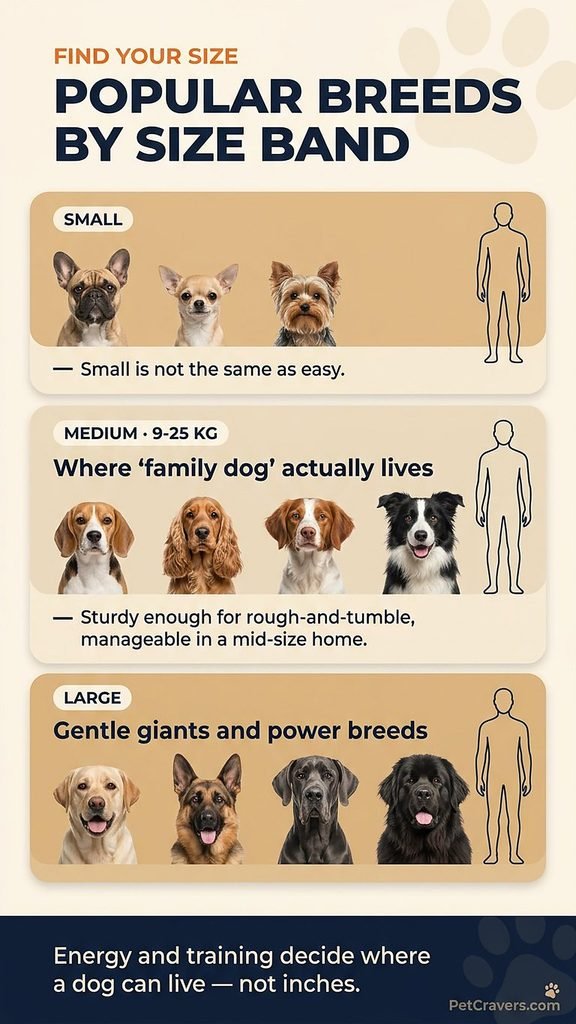
Small is not the same as easy. The calm, companionable cluster — Cavalier, Boston Terrier, Pug, French Bulldog, Shih Tzu, Bichon, Maltese and the improbable Whippet — suits apartment life best. The big-personality cluster — Chihuahua, Yorkshire Terrier, Pomeranian, Dachshund, Jack Russell, Westie, Scottish Terrier — is bold, barky and needs firm rules precisely because nobody enforces them on a 4-kg dog. Then come the athletes in miniature (Beagle, Miniature Schnauzer, Shiba Inu), whose exercise bills ignore their size; flat-faced picks trade stairs for heat caution.
Popular Medium-Sized Dog Breeds
The 9–25 kg band is where “family dog” actually lives: Beagle, Cocker, English Springer, Brittany, Dalmatian, Vizsla, Boxer, Border Collie, Australian Shepherd and Poodle. Sturdy enough for rough-and-tumble, manageable in a mid-size car and home. Spaniels and pointers are the most biddable all-rounders, the Beagle answers to its nose, the collies answer to the job — and mediums eat and medicate more cheaply than giants over a decade. If you want one dog for hiking and homework supervision, this is where most of the world’s popular breeds live.
Popular Large Dog Breeds
Three flavors here. Social giants (Labrador, Golden Retriever, Newfoundland, Saint Bernard, Great Dane, Bernese): tolerant, gentle, needing space and strength-based manners. Power breeds (German Shepherd, Rottweiler, Doberman, Cane Corso, Akita, Chow Chow): brilliant guardians whose reputations are made or broken by their owners’ consistency. Deep-chested breeds share bloat risk; giants need growth-controlled puppyhoods. And “big dogs can’t live in apartments” is backwards — a tired Great Dane out-naps a terrier. Energy and training decide where a dog can live, not inches.
Popular Dog Breeds for Families
The charts keep circling the same tolerant, sturdy names: Labrador and Golden Retrievers lead worldwide, followed by Beagle, Boxer, Cavalier, Bulldog, Newfoundland, Cocker and Springer Spaniels — dogs that recover from clumsy love instead of storing a grudge. The missing footnote: family fit depends on the humans as much as the breed — supervision of young children, dog manners taught to kids, temperament matched to household noise. A shy dog of any “family breed” can struggle; a bombproof shelter retriever cross may be the safest pick you’ll ever meet. [Internal link: children and dogs — raising them together]
Popular Dog Breeds for First-Time Owners
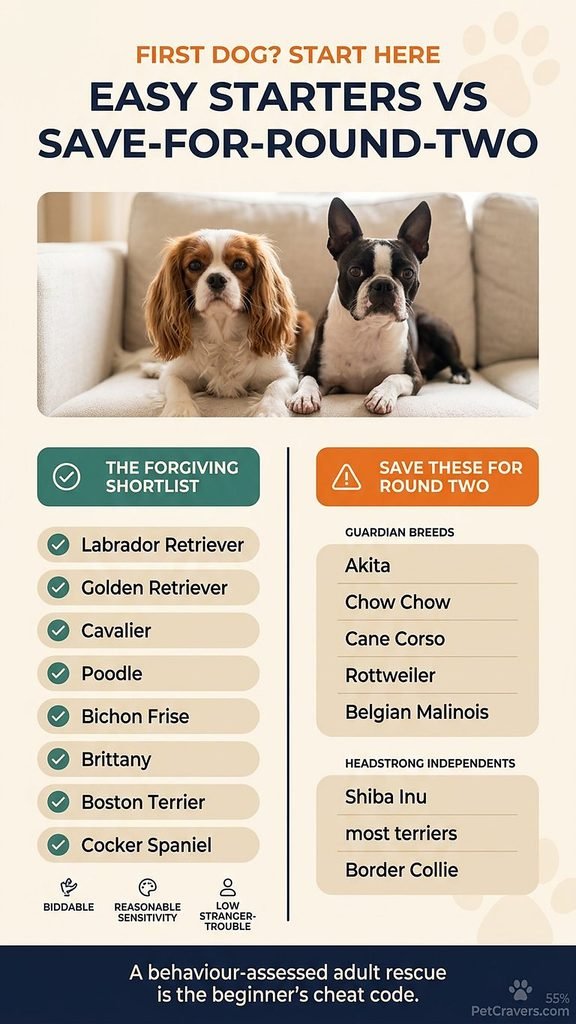
The forgiving shortlist: Labrador Retriever, Golden Retriever, Cavalier, Poodle, Bichon Frise, Brittany, Boston Terrier, Cocker Spaniel. They share three traits that matter more than charm: biddability, reasonable sensitivity, and sociability that keeps stranger-trouble low. Leave the guardian breeds — Akita, Chow Chow, Cane Corso, Rottweiler, Belgian Malinois — and headstrong independents (Shiba, most terriers, Border Collie) for round two: their size and suspicion punish inconsistency fast. Puppies amplify inexperience — a behavior-assessed adult rescue is the beginner’s cheat code. [Internal link: beginner dog training guide]
Popular Low-Grooming Dog Breeds
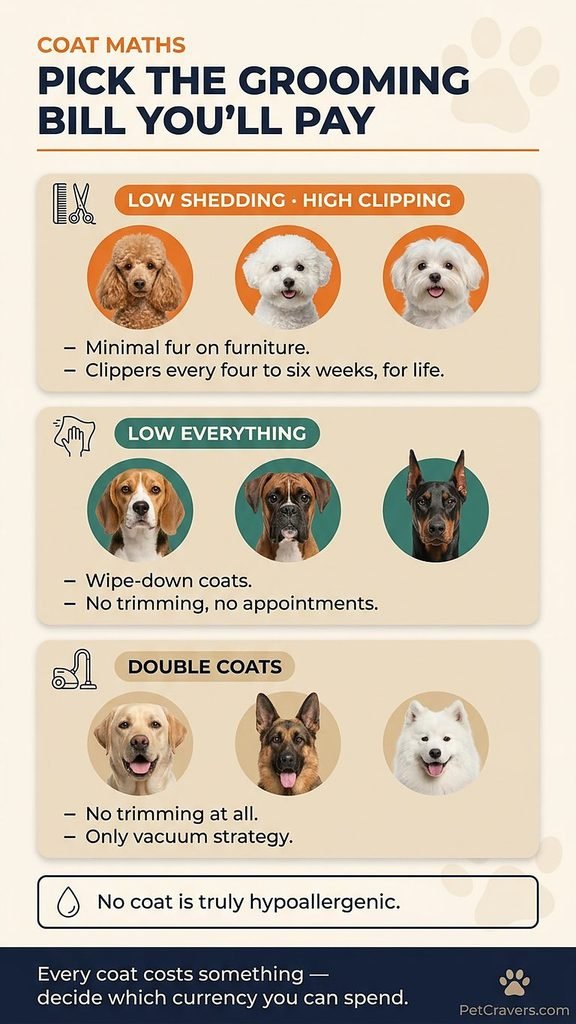
Separate the two meanings of “low-maintenance.” Low shedding, high clipping: Poodle, Bichon, Yorkie, Maltese, Shih Tzu, Miniature Schnauzer — minimal fur on furniture, but every-other-day combing and clippers every four to six weeks, a standing appointment for life (and no coat is truly hypoallergenic). Low everything: Beagle, Boxer, Boston, Bulldog, Pug, Doberman, Vizsla, Weimaraner, Great Dane, Whippet, Rottweiler, smooth Dachshund — wipe-down coats. The double-coated middle — Labrador, Golden, German Shepherd, Husky, Samoyed, Malamute — needs no trimming, only vacuum strategy. Pick your constraint, then the dog.
Popular High-Energy Dog Breeds
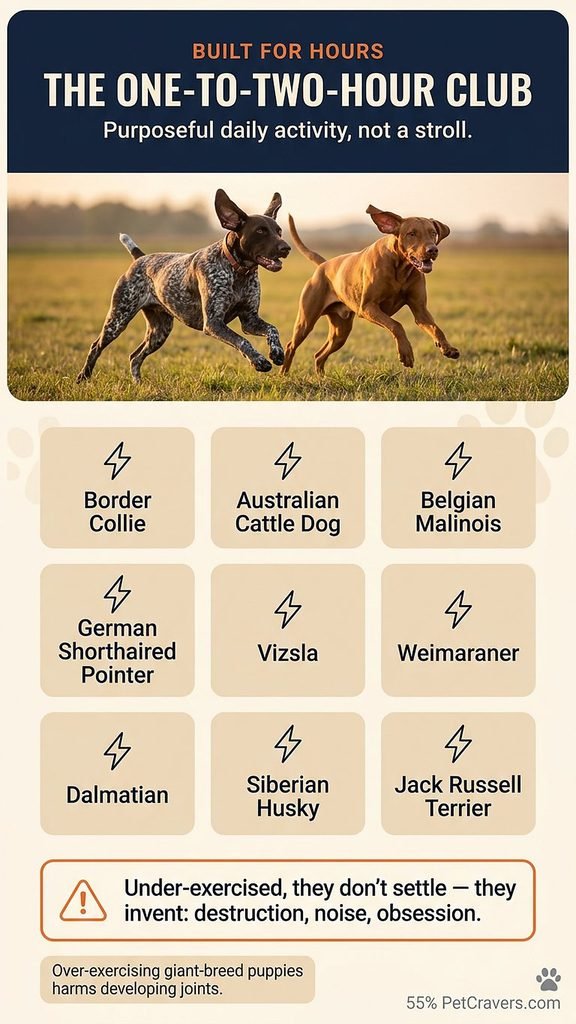
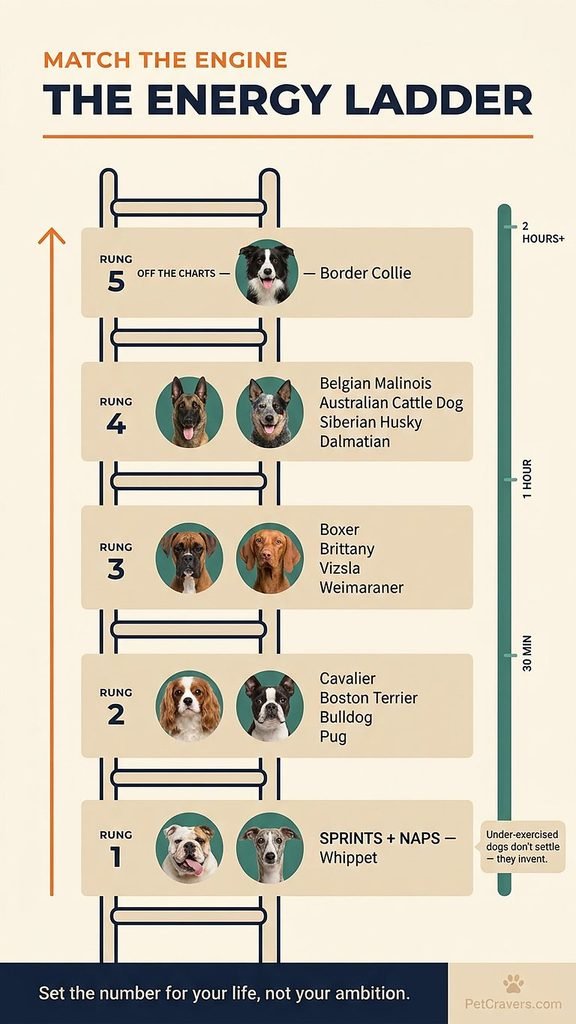
Built for hours of daily labor: Belgian Malinois, Border Collie, Australian Cattle Dog, German Shorthaired Pointer, Vizsla, Weimaraner, Dalmatian, Jack Russell, Siberian Husky, Alaskan Malamute, Boxer, Brittany, English Springer. Under-exercised, they don’t “settle” — they invent: destruction, noise, obsession. Plan for an hour-plus of real activity plus training in the adult dog (over-exercising giant puppies harms developing joints). The upside: these are the fastest-learning, most enthusiastic partners for households that run, hike, paddle and train. If your realistic baseline is thirty minutes, a Cavalier, Bichon, Boston or Whippet will love your life harder than a Malinois could ever let you.
Popular Companion Dog Breeds
Breeds whose original job was simply being with you now lead the urban charts worldwide: French Bulldog, Pug, Boston Terrier, Cavalier, Shih Tzu, Maltese, Pomeranian, Chihuahua, Bichon, Yorkshire Terrier. Shared gifts: adaptability, affection, closeness — they prefer your company to your agenda. Shared shadows: fragility around small children, bark habits, separation distress when ignored, anatomy with invoices (flat faces, tiny joints, crowded teeth). Toy breeds also get away with behavior nobody tolerates in a Lab — which is how “yappy” happens. [Internal link: dog bonding and attachment]
Popular Working and Sporting Breeds
The global top tens are a working-dog highlight reel, because function-selected breeds tend to be robust, trainable and engaged. The working side — German Shepherd, Rottweiler, Doberman, Boxer, Cane Corso, Great Dane, Bernese, Newfoundland, Saint Bernard, Akita, Chow — supplies guard, rescue, draft and service talent, and asks for purpose and respect in return. The sporting/gundog side — Labrador, Golden, Poodle, Cocker, Springer, Brittany, GSP, Weimaraner, Vizsla — supplies the world’s most dependable pet temperaments: cooperative, people-focused, with exercise as the entry fee. The herding overlap (Border Collie, Aussie, Corgi, Australian Cattle Dog, Malinois) adds brilliance at the cost of motion-sensitivity. If you want a dog that does something — obedience, tracking, dock diving, herding trials — start with the working groups. [Internal link: canine sports and enrichment guide]
All 50 Breeds at a Glance: Comparison Table
Ranges are typical for the breed, not law. “Energy” describes adult maintenance needs, not puppy chaos. “Trainability” means how readily the breed cooperates with a normal owner — a different question from raw intelligence.
| Breed | Origin | Size & Weight | Lifespan | Energy | Grooming | Trainability | Best Known For |
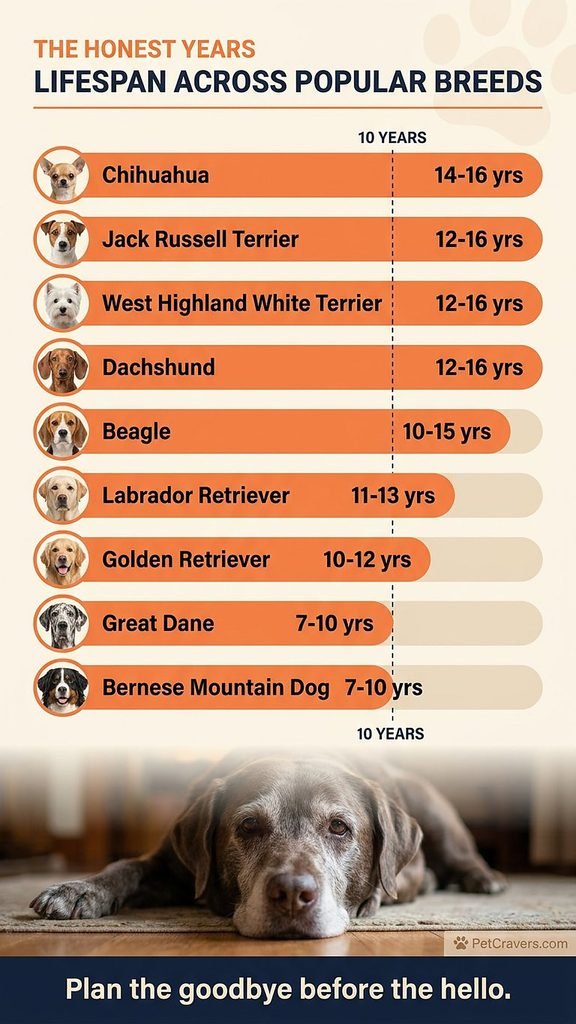
| Labrador Retriever | Canada/England | 55–62 cm; 25–36 kg | 11–13 yrs | High | Weekly brush; sheds | Eager, easy | The world’s all-round family dog |
| French Bulldog | England/France | 28–33 cm; under 13 kg | 10–12 yrs | Low-med | Minimal; folds | Willing, stubborn | Apartment charisma; AKC #1 |
| Golden Retriever | Scotland | 51–61 cm; 25–34 kg | 10–12 yrs | High | Brush 2–3x/week | Excellent | Gentleness; service work |
| German Shepherd | Germany | 55–65 cm; 22–40 kg | 7–10 yrs | High | Weekly; heavy shed | Excellent | Police, military, loyalty |
| Poodle | Germany/France | Toy to 45+ cm; 2.5–32 kg | 10–18 yrs | Med-high | Frequent clipping | Outstanding | Brains plus low-shed coat |
| Dachshund | Germany | 13–23 cm; 4–9 kg | 12–16 yrs | Medium | Low to moderate | Willful | Badger courage; long life |
| Beagle | England | 33–40 cm; 9–14 kg | 10–15 yrs | Med-high | Very low | Food-motivated | Nose power; merry nature |
| Bulldog | England | 31–40 cm; 18–25 kg | 8–10 yrs | Low | Fold wipes | Slow, stubborn | Calm dignity; UK icon |
| Rottweiler | Germany | 56–68 cm; 35–60 kg | 8–11 yrs | Med-high | Very low | Very good | Guardian confidence |
| Boxer | Germany | 53–63 cm; 25–32 kg | 10–12 yrs | Very high | Minimal | Eager, excitable | Kid-friendly clown energy |
| Yorkshire Terrier | England | 18–20 cm; under 3.2 kg | 11–15 yrs | Medium | High (coat) | Bright, bossy | Silk coat, terrier soul |
| Cavalier King Charles | England | 30–33 cm; 5.5–8 kg | 9–12 yrs | Medium | Moderate brushing | Very good | Adaptability; sweet temper |
| Siberian Husky | Siberia | 50–60 cm; 16–27 kg | 12–14 yrs | Extreme | Weekly; coat blow | Independent | Sled genes; dramatic escapes |
| Great Dane | Germany | up to 90 cm; 45–75 kg | 7–10 yrs | Medium | Very low | Good, gentle | Gentle-giant size |
| Doberman Pinscher | Germany | 61–72 cm; 30–45 kg | 10–12 yrs | High | Minimal | Outstanding | Devoted, sleek guardian |
| Shih Tzu | Tibet/China | 20–28 cm; 4–7 kg | 10–16 yrs | Low-med | Daily comb or clip | Willing | Affectionate imperial history |
| Border Collie | Britain’s borders | 46–56 cm; 14–20 kg | 12–15 yrs | Off the charts | Weekly | The benchmark | Highest trainability alive |
| Australian Shepherd | US West | 46–58 cm; 16–32 kg | 12–15 yrs | Very high | Weekly | Excellent | Ranch energy; merle beauty |
| Pug | China | 25–28 cm; 6–8 kg | 13–15 yrs | Low-med | Fold wipes | Food-driven | Comedy; empathy; snore |
| Chihuahua | Mexico | 13–20 cm; under 2.7 kg | 14–16 yrs | Medium | Very low | Smart, selective | Smallest; long-lived |
| Miniature Schnauzer | Germany | 30–36 cm; 5–9 kg | 12–15 yrs | Med-high | Clips/stripping | Good | Bearded watchdog; clean coat |
| Cane Corso | Italy | 60–70 cm; 40–50 kg | 9–12 yrs | Med-high | Minimal | Needs experience | The modern guardian riser |
| Pembroke Welsh Corgi | Wales | 25–30 cm; up to 14 kg | 12–13 yrs | High | Weekly; sheds | Very good | Royal heeler; fox-face sass |
| Bernese Mountain Dog | Switzerland | 64–70 cm; 36–52 kg | 7–10 yrs | Medium | Several brushes/week | Willing | Calm giant; short time |
| Pomeranian | Germany/Poland | 17–22 cm; 1.9–3.5 kg | 12–15 yrs | Medium | Brush 2–3x/week | Bright, bossy | Spitz sparkle, miniature |
| Shiba Inu | Japan | 35–41 cm; 7–11 kg | 13–15 yrs | Med-high | Weekly | Independent | Clean, cat-like originality |
| Maltese | Mediterranean | 19–25 cm; under 3.6 kg | 12–15 yrs | Medium | Daily comb/clip | Smart, soft | Ancient silk companion |
| Boston Terrier | USA (Boston) | 38–43 cm; 5–11 kg | 11–13 yrs | Medium | Minimal | Willing | The “American Gentleman” |
| German Shorthaired Pointer | Germany | 53–66 cm; 20–32 kg | 10–12 yrs | Extreme | Very low | Excellent | All-around hunting athlete |
| Australian Cattle Dog | Australia | 43–51 cm; 15–22 kg | 12–16 yrs | Extreme | Very low | Brilliant, wary | Outback toughness; longevity |
| Jack Russell Terrier | England | 25–38 cm; 6–8 kg | 12–16 yrs | Very high | Low | Clever, self-willed | Terrier rocket fuel |
| Brittany | France | 44–52 cm; 14–18 kg | 12–14 yrs | High | Moderate | Very good, soft | Sunny versatile hunter |
| Weimaraner | Germany | 58–70 cm; 25–40 kg | 10–13 yrs | Very high | Minimal | Smart, strong-willed | The “Gray Ghost”; velcro |
| Basset Hound | France/England | up to 38 cm; 20–30 kg | 10–12 yrs | Low-med | Brush; ear checks | Stubborn | The nose; soulful resolve |
| Cocker Spaniel | England | 36–41 cm; 9–16 kg | 11–15 yrs | Med-high | High (coat, ears) | Very good | Merry gundog; UK favorite |
| English Springer Spaniel | England | 46–51 cm; 18–25 kg | 10–14 yrs | High | Moderate clipping | Excellent | Optimistic; detection work |
| Alaskan Malamute | Alaska | 56–69 cm; 34–50 kg | 10–14 yrs | High | Weekly; big blow | Independent | Freight-power sled classic |
| Newfoundland | Canada | 66–71 cm; 45–68 kg | 8–10 yrs | Med-low | Several brushes/week | Good, gentle | Water rescue; patience |
| Saint Bernard | Swiss-Italian Alps | 65–90 cm; 50–80 kg | 8–10 yrs | Low-med | Brush; drool | Willing | Hospice legend; serenity |
| Shar Pei | China | 46–51 cm; 18–30 kg | 8–12 yrs | Medium | Skin-fold care | Independent | Wrinkles; loyal detachment |
| Akita | Japan | 61–71 cm; 32–59 kg | 10–13 yrs | Med-high | Weekly-plus | Proud, purposeful | Hachikō’s loyalty |
| Chow Chow | China | 43–56 cm; 20–32 kg | 11–13 yrs | Low-med | Several brushes/week | Aloof | Lion mane; blue-black tongue |
| Dalmatian | Croatia/England | 48–61 cm; 20–32 kg | 11–14 yrs | Extreme | Minimal (sheds!) | Mischievous | Coach dog; spots; stamina |
| Samoyed | Siberia | 48–60 cm; 16–30 kg | 12–14 yrs | High | 2–3 brushes/week | Smart, stubborn | The “Sammy smile” |
| Whippet | England | 44–51 cm; 9–16 kg | 12–15 yrs | Sprints + naps | Nearly none | Gentle, food-driven | 35-mph couch potato |
| West Highland White Terrier | Scotland | 23–28 cm; 7–9 kg | 12–16 yrs | Med-high | Clipping/stripping | Independent | White-coat tenacity |
| Scottish Terrier | Scotland | 25 cm; 8.5–10 kg | 11–13 yrs | Medium | Stripping; beard | Focused | Presidential terrier grit |
| Bichon Frise | Canaries/France | 23–30 cm; 3–5.5 kg | 12–15 yrs | Medium | Brush + monthly clips | Very good | Circus-born cheerfulness |
| Vizsla | Hungary | 53–64 cm; 20–30 kg | 12–14 yrs | Very high | Nearly none | Excellent, soft | The Velcro pointer |
| Belgian Malinois | Belgium | 56–66 cm; 18–34 kg | 12–14 yrs | Extreme | Weekly | Elite — with experts | The world’s K-9 |
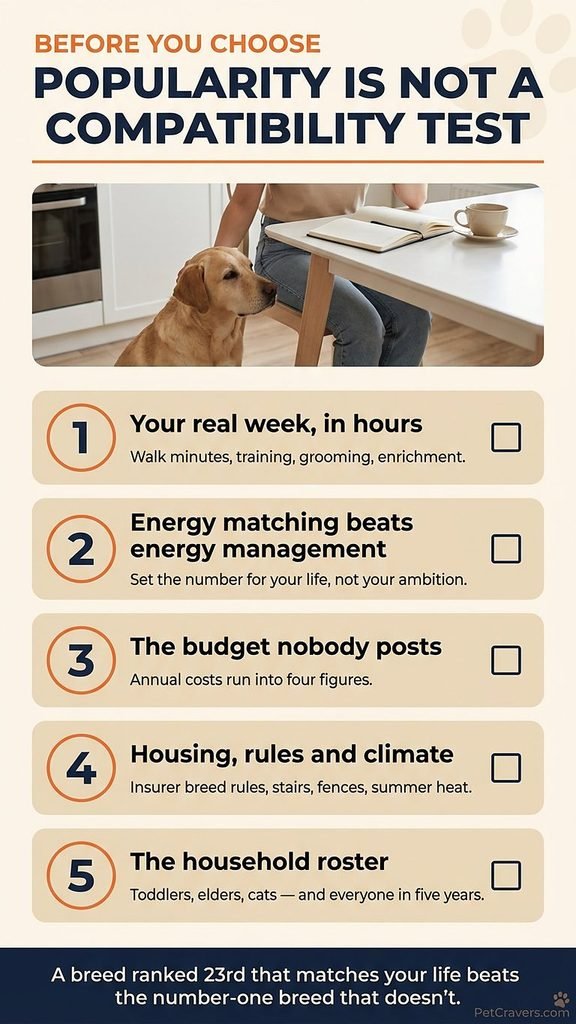
Before You Choose a Breed: Popularity Is Not a Compatibility Test
Fifty breed profiles are a starting point, not a verdict. Before any dog becomes yours, answer the harder questions.
Your real week, in hours. Count walk minutes, training, grooming, and the daily enrichment every dog needs. A Vizsla isn’t a pet; it’s a second social life. A Pug is closer to a houseplant with feelings. No breed chart can read your calendar.
Energy matching beats energy management. Most rehoming for “too much dog” is arithmetic: nine hours alone, a thirty-minute walk and a young Border Collie equals destroyed drywall or compulsive behavior. And over-exercising giant-breed puppies harms developing joints. Set the number for your life, not your ambition.
The budget nobody posts. In most wealthy countries, realistic annual costs run into four figures — food, preventatives, insurance, dental cleanings, and the emergency that will happen. Large breeds multiply every line; flat-faced and long-backed breeds often carry structural surgery costs. The cheapest puppy is usually the most expensive dog.
Grooming is a fifteen-year subscription. “Low-shedding” usually means “high-clipping” — Poodle owners live on a six-to-eight-week grooming cycle or learn to clip. Double-coated breeds demand no trimming, only vacuuming. Pick the bill you’ll actually pay. [Internal link: dog grooming at home guide]
Housing, rules and climate. Rental restrictions, insurer breed rules (some still target “bully” or shepherd types regardless of the individual dog — verify locally), staircases, fence height, summer heat for short muzzles: all of it outranks any popularity list. The “big dogs can’t live in apartments” rule is folklore, not physics.
The household roster. Toddlers need dogs tolerant of noise and grabbing — and every dog needs adult supervision with small children, full stop. Elders may be happiest with a steady adult dog. Cats demand low prey drive, which rules out many hounds, terriers and sighthounds whatever their résumés. No breed guarantees gentleness; the individual dog’s history does.
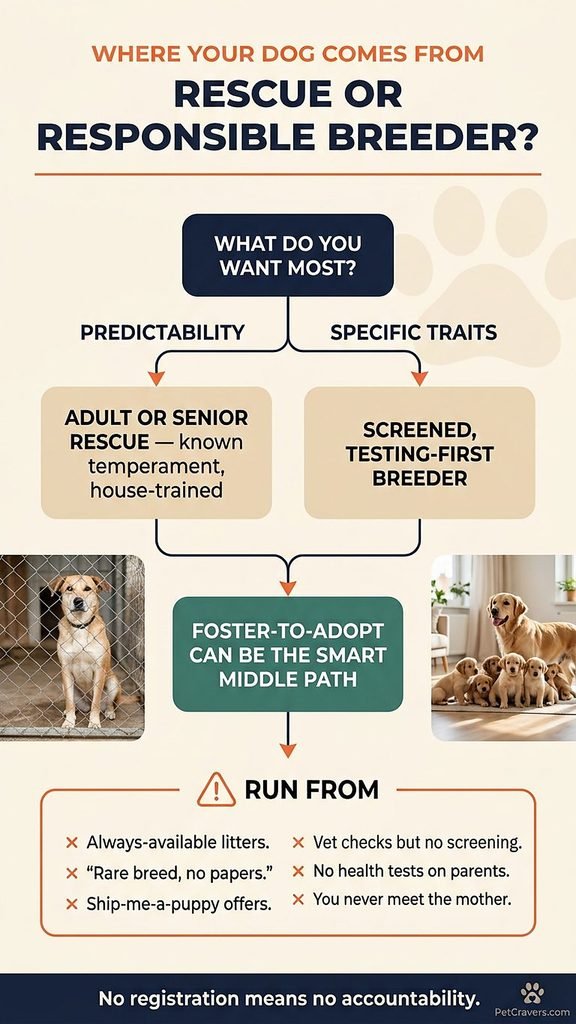
Puppy or adult — and from where. Puppies let you shape foundations but cost two years of chaos; adult rescues arrive with known habits and fewer surprises. Both are legitimate paths. Weigh the fifteen-year (or seven-year) horizon too: a Chihuahua outlasts leases and jobs; a Bernese gives you perhaps eight years of the same life. Plan the goodbye before the hello, and expect any individual dog — purebred or not — to differ from the breed average.
Adoption, Rescue, and Responsible Breeders
Popularity distorts the whole picture, so here’s the correction: the most-registered breeds are also among the most surrendered. Labs, shepherds, spaniels, Huskies and bully types fill shelters worldwide — you can often adopt the exact breed on this list, adult and known, for less than a puppy’s price, and breed-specific rescues exist for nearly every entry here, staffed by people who know each breed’s worst days as well as its best. [Internal link: adopting a rescue dog — what to expect]
A good rescue is a better-sorted path, not a discounted one: weeks of behavior assessment, full medical workups, honest reports on house-training and reactivity — because the real product is matching, not shipping.
If you want a puppy, treat breeder selection as a research project. Responsible breeders health-test both parents for the breed’s documented risks — hips, elbows, eyes, heart, DNA panels — and will name the protocols (OFA, PennHIP, BAER; each breed’s recommended test list is public through the Canine Health Information Center). They raise puppies in their home with early socialization, let you meet the mother, ask you uncomfortable questions, and contractually take the dog back at any age if life goes sideways. Run from always-available litters, “rare breed, no papers,” ship-me-a-puppy offers, and guarantees buried in fine print: no registration means no accountability. Adopting a popular-breed rescue, buying from a testing-first breeder, or fostering to adopt can each be the responsible choice — the only irresponsible one is choosing by trend.
Frequently Asked Questions
What is the most popular dog breed in the world?
No official worldwide ranking exists. Cross-country registration studies converge on the Labrador Retriever as the most-registered breed globally, while the French Bulldog leads the American AKC list for 2022–2025 and the Labrador still leads the UK. Golden Retrievers and German Shepherds complete the podium in most countries.
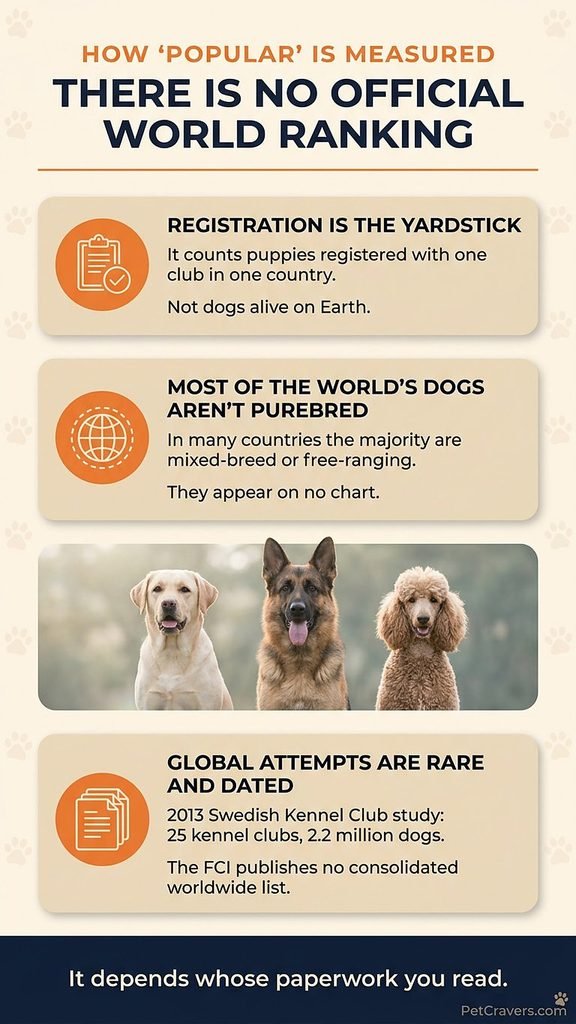
What are the 10 most popular dog breeds?
In the AKC’s 2025 rankings: 1 French Bulldog, 2 Labrador Retriever, 3 Golden Retriever, 4 German Shepherd, 5 Dachshund, 6 Poodle, 7 Beagle, 8 Rottweiler, 9 German Shorthaired Pointer, 10 Bulldog. The UK Kennel Club’s recent charts lead with Labrador, Cocker Spaniel, French Bulldog — different order, largely the same names.
Which popular dog breeds are good for families?
Labrador and Golden Retrievers top the global consensus for tolerance and sturdiness, with Beagles, Boxers, Cavaliers, Bulldogs, Newfoundlands and spaniels close behind. The deciding factors are adults, not dogs: supervision with young children, how the dog is raised, and matching energy to household noise.
Which popular breeds are suitable for first-time owners?
Cooperative people-pleasers: Labrador, Golden, Poodle, Cavalier, Bichon, Brittany, Boston Terrier, Cocker Spaniel. Save Akitas, Chow Chows, Cane Corsos, Rottweilers, Malinois, Shiba Inus and most terriers — their size, suspicion or self-direction punishes wobble, not because they’re bad dogs but because they need consistency beginners don’t have yet.
What is the most popular small dog breed?
The French Bulldog is the most popular small breed in the US and among the most-registered worldwide; Dachshunds, Chihuahuas, Yorkshire Terriers and Pomeranians fill out global small-breed top tens, while toy breeds like the Maltese lead several Asian registration charts outright.
What is the most popular large dog breed?
Among large breeds the Labrador Retriever leads globally; German Shepherds, Rottweilers, Boxers and Bernese post the biggest modern giant-range numbers, while Great Danes and Saint Bernards win raw cultural recognition. Popularity in the largest sizes tends to favor the gentle over the spectacular.
Which popular breeds require the most exercise?
Expect one to two hours of purposeful activity daily from adult Border Collies, Australian Cattle Dogs, Belgian Malinois, German Shorthaired Pointers, Vizslas, Weimaraners, Dalmatians, Siberian Huskies and Jack Russells. Walking alone rarely satisfies a herding or pointing breed — they need to run, sniff, search and think.
Which popular breeds shed the most?
Double-coated breeds shed year-round and “blow” seasonally: German Shepherds, Huskies, Malamutes, Samoyeds, Akitas, Chow Chows, Newfoundlands, Golden and Labrador Retrievers, Border Collies. The lowest-shedding popular choices — Poodle, Bichon, Yorkie, Maltese, Shih Tzu, Miniature Schnauzer — trade fur for clippers. Every coat costs something; decide which currency you can spend.
Which popular dog breeds are easiest to train?
Border Collies, Poodles, German Shepherds, Labrador and Golden Retrievers are the classic quick learners, with Bichons and Cockers surprising people among small breeds. “Easy” means the dog wants to cooperate — not that the owner’s work vanishes. Hounds, spitz and terriers train fine; they just negotiate terms.
Does a popular breed make a good pet for everyone?
No. Popularity counts registrations, not satisfied owners. Frenchies top charts partly because apartment life favors them — and struggle in hot climates; Labs dominate partly because breeders are everywhere — and swamp sedentary homes. A breed ranked 23rd that matches your life beats the number-one breed that doesn’t.
Should I get a puppy or adopt an adult dog?
Puppies let you shape early training but cost sleep, consistency and an adolescent detour; adult and senior rescues arrive house-trained with known temperament — a far smaller forecasting error. Want specific traits (size, coat, working drive)? A screened breeder is reasonable. Want predictability? Get a grown dog.
How important is breed temperament when choosing a dog?
Important as averages, useless as guarantees. Breed predicts meaningful chunks of energy, prey drive, sociability and trainability; upbringing, health and individual history fill the rest. Treat it like a weather forecast — pack for the pattern, watch the actual sky, and meet the real animal before deciding.
Can mixed-breed dogs be a good alternative to popular purebreds?
Often, yes. Most shelter dogs are retriever, shepherd, spaniel or hound crosses carrying those breeds’ strengths without the price tag, and broader gene pools generally reduce the odds of conformation-linked problems (real, if oversold). Trade-offs: adult size can surprise, and no breeder stands behind the dog afterward.
What should I consider before choosing a dog breed?
Five things: your weekly time budget (exercise, grooming, training, money); everyone in the home, now and in five years; housing rules and climate; your dog experience; and the breed’s health profile and lifespan. Compare against the “who it fits” notes above, talk to a trainer or vet — then meet actual dogs of your shortlisted breeds.
The Final Word
Fifty breeds, one lesson: popularity is a rumor of lovability — genuinely useful, and not evidence of fit. The French Bulldog’s four-year reign and the Labrador’s three decades of dominance reflect real, durable goodness and marketing, housing stock and supply. What each breed needs in exchange for everything it gives is the specific life you can offer: the right movement, grooming, training, money and years.
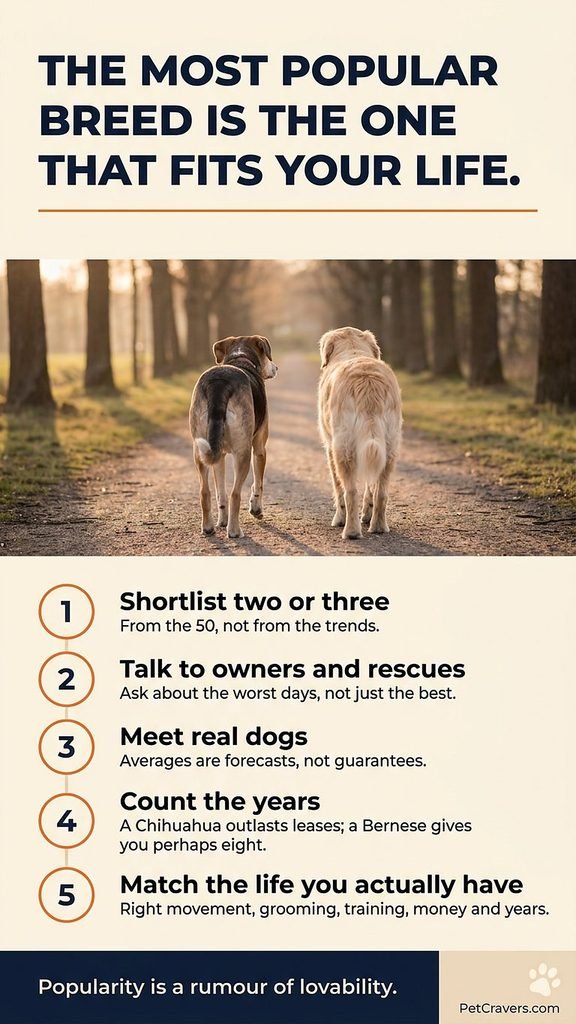
The most popular dog breed in the world isn’t a breed at all — it’s the one whose needs and yours overlap for a decade or more. Let this guide introduce you, shortlist two or three, talk to owners and rescues, meet real dogs, and choose the dog that fits the life you actually have.
For what comes next — the training, behavior, body-language, grooming and bonding guides that turn a good decision into a great dog — keep exploring the dog library at PetCravers.com.
Sources and Further Reading
- American Kennel Club — “The Most Popular Dog Breeds of 2025” (registration rankings published 2026): akc.org/expert-advice/dog-breeds/most-popular-dog-breeds-2025/
- American Kennel Club — Breed A-to-Z database (standards, sizes, coat and health profiles): akc.org/dog-breeds/
- The Kennel Club (UK) — breed registration statistics (Labrador 34,141; Cocker Spaniel 23,177; French Bulldog 13,789 in the most recent published year), as reported by Countryfile and The Scotsman: countryfile.com/animals/pets/most-common-dog-breed
- C. Hasselgren, for the Swedish Kennel Club (2013) — “Registration figures worldwide”: a study of 2.2M+ dogs across 25 national kennel clubs, reproduced at DogWellNet — the leading estimate of the most-registered breeds on Earth
- Fédération Cynologique Internationale (FCI) — international federation of ~90 national kennel clubs and 350+ breed standards: fci.org
- Orthopedic Foundation for Animals (OFA) — health-screening programs: offa.org; Canine Health Information Center (CHIC) — breed-specific recommended screening protocols: caninehealthinfo.org
- AKC Canine Health Foundation — “Purebred Dogs: Health Testing for a Stronger Breed”: akc.org/expert-advice/health/health-testing-for-a-stronger-breed/
- O’Neill, D.G. et al. (2013) — “Longevity and mortality of owned dogs in England,” The Veterinary Journal
- Adams, D.P.J. et al. (2010) — “Mortality, health and behavioural characteristics of 182 dog breeds in the UK between 1995 and 2007,” Journal of Small Animal Practice
- Boroffka, K. et al. (2021) — veterinary-records study of English Bulldog health and conformation, PLOS ONE
- Wikipedia — “List of most popular dog breeds” (aggregated multi-country registry tables for cross-checking national rankings)

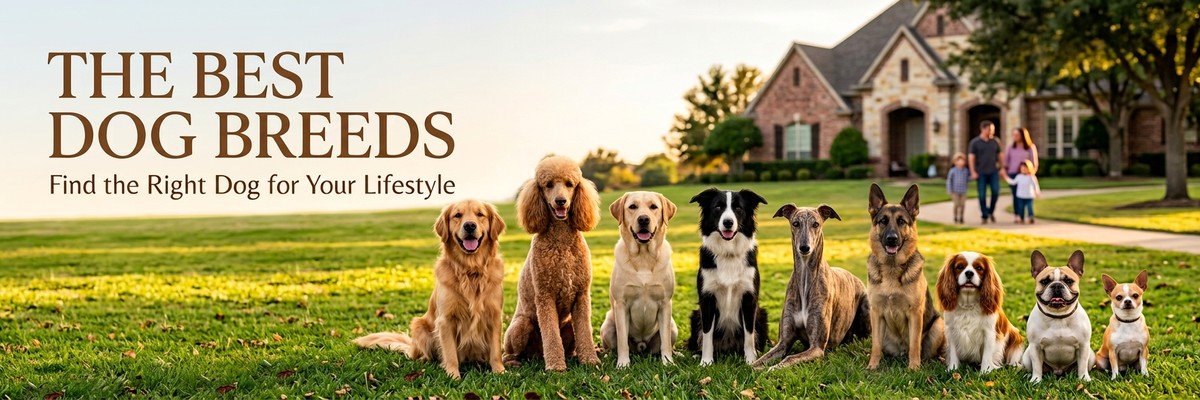
Leave a Reply