 Skip to content
Dogs understand human body language remarkably well, often responding to our gestures, posture, facial expressions, and movements before we say a word. Have you ever noticed your dog reacting when you point toward something, change your posture, frown, or extend your arms? These everyday reactions raise an intriguing question: How do dogs interpret human body language, and what can they actually understand?
Body language plays a crucial role in communication between humans and dogs. While verbal commands are important, dogs also pay close attention to non-verbal signals such as hand gestures, posture, facial expressions, eye contact, and movement. These cues can help dogs understand what we want, anticipate our actions, and respond to our emotional state.
Understanding how dogs read human body language can improve training, reduce miscommunication, and strengthen the bond between dogs and their owners. In this article, we’ll explore how dogs perceive gestures, posture, facial expressions, and gaze, examine the scientific evidence behind their social perception, and discuss practical ways to use body language more effectively when communicating with your dog.
How Dogs Understand Human Body Language
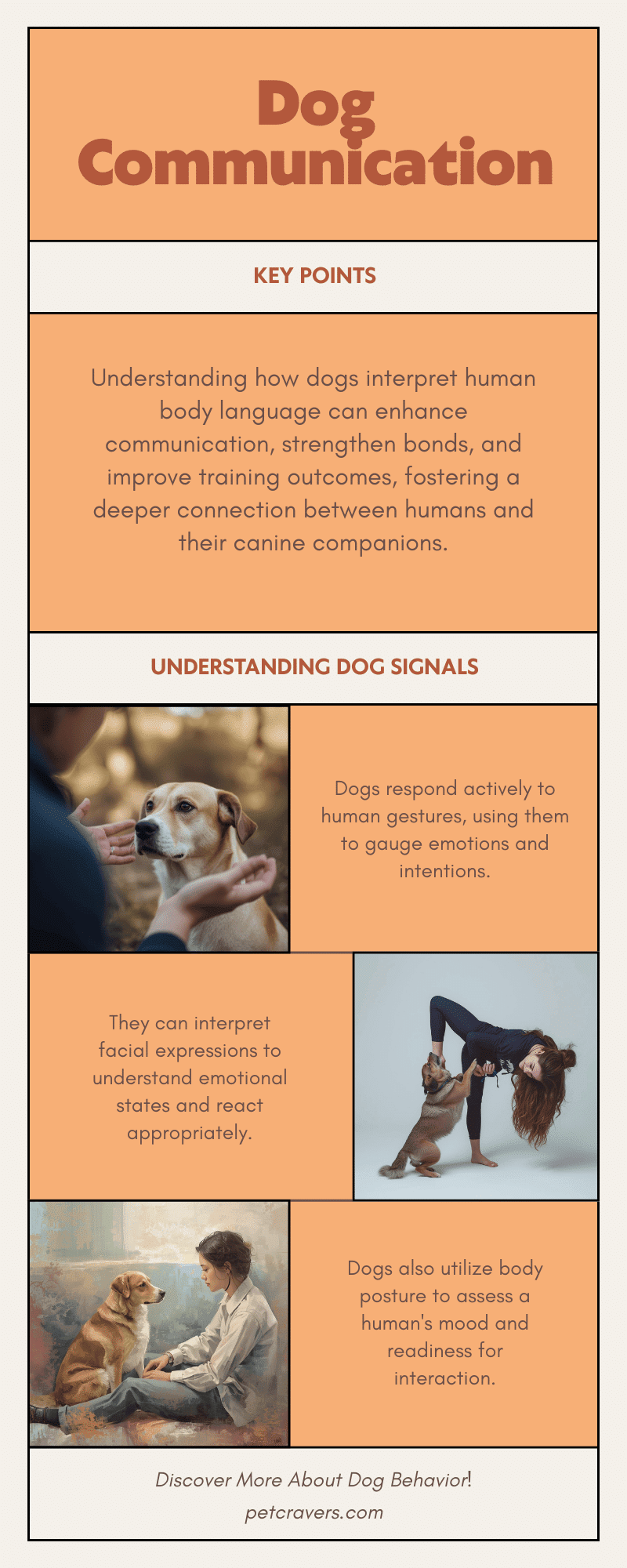
Dogs understand human body language by combining visual cues with context, previous experience, and the emotional state of the person interacting with them.
1. Sensory Strengths
- Vision and Motion Detection: Dogs excel at noticing movement. They can detect the direction of a hand gesture, the tilt of a head, or a shift in posture, which helps them anticipate human intentions.
- Attention to Subtle Cues: Dogs pick up on minor changes in body tension, limb positioning, and facial micro-expressions, giving them a nuanced understanding of our mood and intentions.
2. Reading Gestures and Posture
- Dogs are adept at interpreting gestures, such as pointing or beckoning, and can link them to specific actions or commands.
- Posture conveys emotional cues: an upright, confident stance may signal leadership, while slouched or tense posture may indicate stress or discomfort. Dogs respond accordingly, adjusting their own behavior to match the situation.
3. Interpreting Facial Expressions
- Facial cues, like smiles, frowns, or narrowed eyes, communicate emotional context that dogs can read and react to.
- Dogs may approach when seeing a happy, relaxed face or exhibit caution if they detect anger or fear.
4. Static vs. Dynamic Signals
- Static signals (e.g., crossed arms or a fixed posture) provide information about mood or intent.
- Dynamic signals (e.g., waving, leaning forward, pointing) often indicate direct actions or commands. Dogs are skilled at combining these cues with verbal signals to understand the full message.
Key Takeaway
Dogs rely on a combination of visual, contextual, and emotional cues to interpret human body language. Their sensitivity to gestures, posture, and facial expressions allows them to navigate social interactions effectively and respond in ways that strengthen communication and bonding.
Scientific Evidence: How Dogs Understand Human Body Language
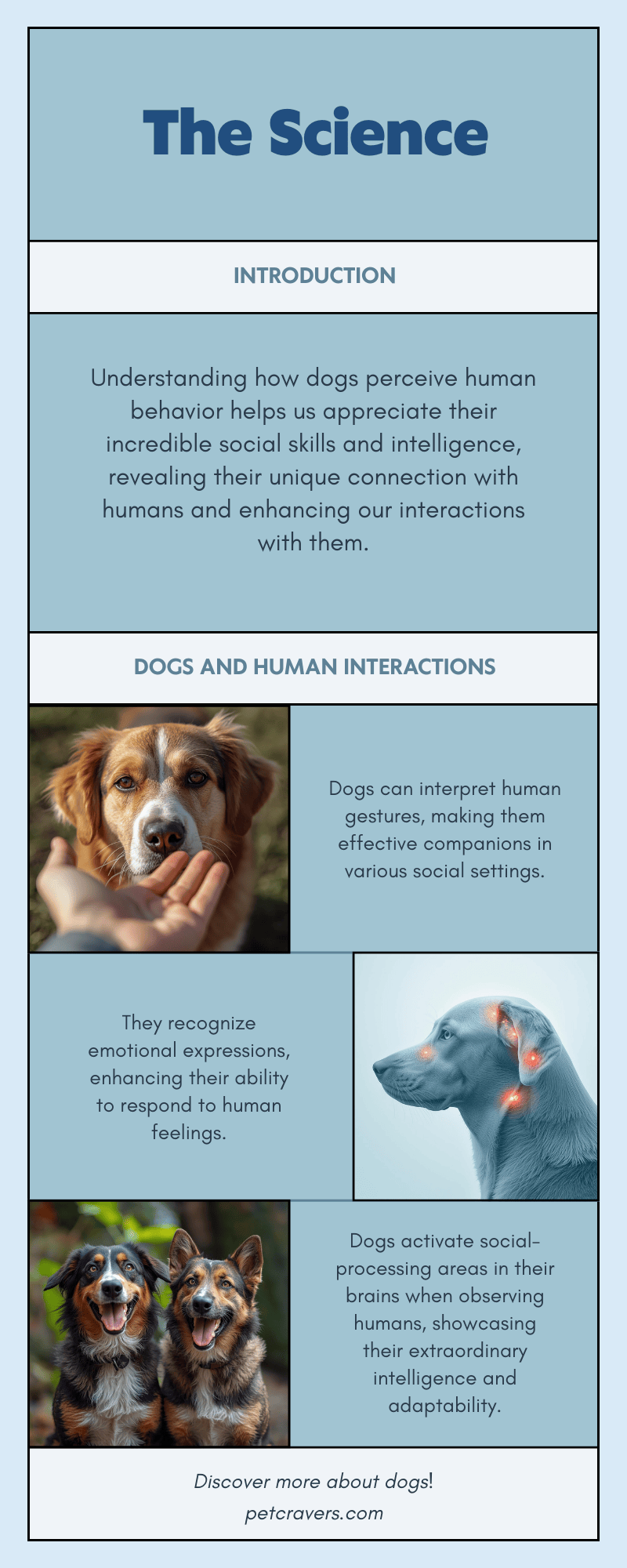
Research suggests that dogs understand human body language by paying attention to gestures, pointing, gaze direction, and other visual signals.
1. Behavioral Studies
- Dogs can reliably follow pointing gestures, even without verbal commands, demonstrating that they understand the direction and intention behind human gestures.
- Experiments show that dogs distinguish between intentional and accidental human actions, indicating advanced social perception.
- Dogs often respond differently to familiar humans versus strangers, highlighting the role of social learning and experience in interpreting body language.
2. Brain Research
- Functional MRI (fMRI) studies reveal that dogs’ brains activate in areas associated with social processing when observing human gestures or facial expressions.
- Dogs respond more strongly to positive cues (smiles, happy gestures) than to neutral or negative expressions, suggesting they link visual signals with emotional context.
3. Comparison to Other Animals
- While some primates and other mammals can follow human pointing or gaze, dogs appear to be uniquely attuned to human gestures due to thousands of years of domestication.
- This adaptation allows dogs to understand subtle human cues better than even some close evolutionary relatives, emphasizing their social intelligence and cooperative nature.
Key Takeaway
Scientific evidence confirms that dogs are not just guessing—they can interpret human body language with remarkable accuracy, using it to guide their behavior, anticipate actions, and respond to emotional cues.
Common Human Cues Dogs Recognize
Dogs are highly observant and respond to a variety of human body language cues. Understanding these cues can improve communication, training, and everyday interactions.
1. How Dogs Understand Human Body Language Through Gestures
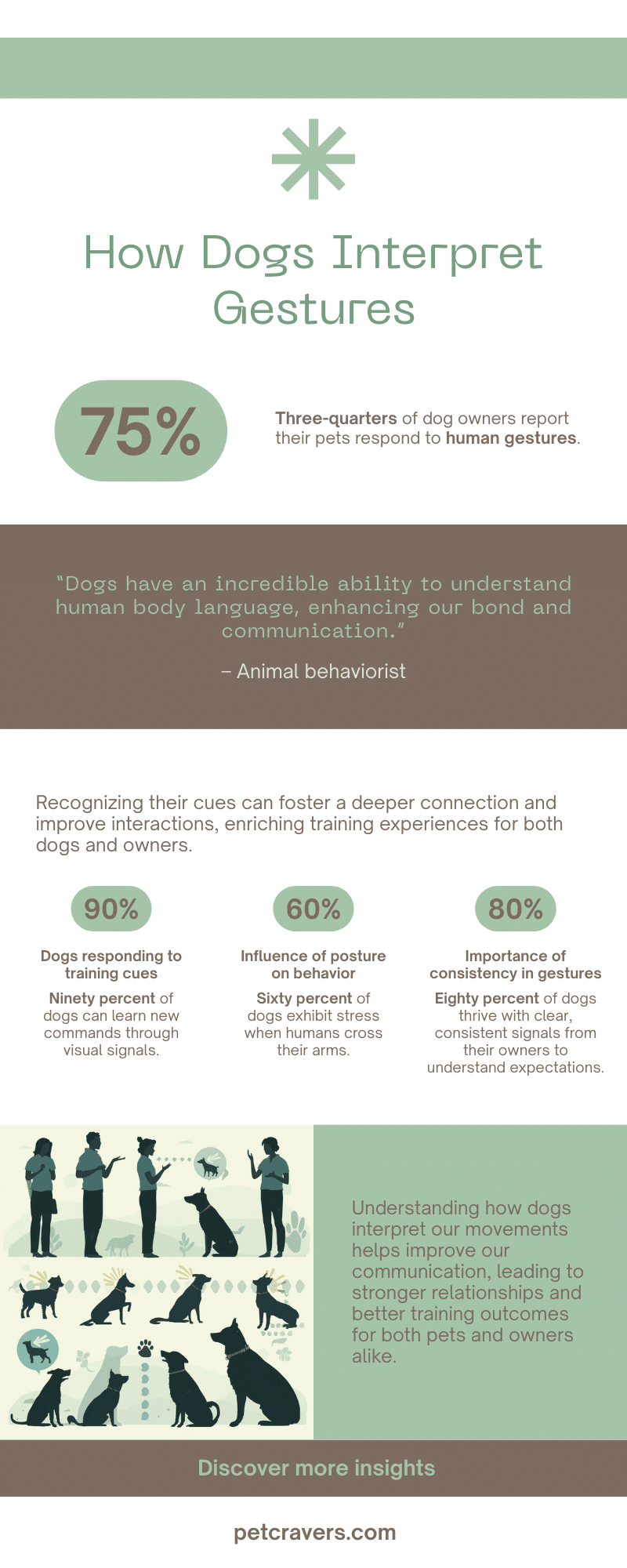
Dogs understand human body language particularly well when gestures are consistent and repeatedly associated with specific actions or rewards.
- Pointing: Dogs can follow the direction of a finger or hand to locate objects, doors, or treats.
- Waving or Beckoning: Dogs often interpret arm movements as invitations to approach, play, or stay back.
- Hand Signals for Commands: Many dogs can learn sit, stay, come, or lie down based purely on consistent hand signals.
2. How Dogs Understand Human Body Language Through Posture
Your posture can provide important information. Dogs understand human body language partly by noticing changes in your stance, movement, and physical orientation.
- Leaning Forward: Often interpreted as an invitation to interact or a signal of urgency.
- Crossed Arms or Rigid Posture: May signal tension or disapproval; dogs can respond with caution or hesitation.
- Relaxed Stance: Indicates a calm environment and encourages approach or engagement.
3. How Dogs Understand Human Body Language Through Facial Expressions
Dogs can respond to changes in human facial expressions and emotional cues, which helps explain how dogs understand human body language during everyday interactions.
- Smiles or Relaxed Faces: Convey friendliness, making dogs more likely to approach or engage.
- Frowns or Narrowed Eyes: Can indicate displeasure, prompting dogs to behave cautiously or avoid certain actions.
- Raised Eyebrows or Open Mouths: Often read as curiosity or excitement, eliciting playful responses.
4. Eye Contact and Gaze
- Dogs can follow the direction of your gaze, helping them understand where to focus attention.
- Direct eye contact may be perceived as a sign of connection, while prolonged staring can be interpreted as a threat depending on context.
Key Takeaway
Dogs are capable of reading a wide range of gestures, postures, facial expressions, and gaze cues. Being mindful of your body language allows for clearer communication and stronger bonds with your dog.
Factors That Affect Dogs’ Interpretation
While dogs are skilled at reading human body language, several factors influence how accurately and consistently they interpret our cues. Understanding these factors can help improve communication and training outcomes.
1. Breed and Temperament
- Some breeds, especially those bred for companionship or herding, may be more attentive to human cues.
- Independent or stubborn breeds might require more repetition and reinforcement to respond reliably.
- Individual temperament also plays a role—some dogs are naturally more observant or motivated by interaction.
2. Age and Socialization
- Puppies are highly adaptable and can quickly learn to interpret gestures during early socialization.
- Adult dogs may take longer but can still learn through consistent exposure.
- Senior dogs may experience slower response times due to sensory decline or cognitive aging.
3. Experience with Humans and Training
- Dogs with extensive exposure to human interaction tend to read gestures more accurately.
- Training that pairs gestures with rewards reinforces understanding and responsiveness.
- Lack of socialization can lead to misinterpretation or hesitation.
4. Emotional State
- Stress, fear, or anxiety can impair a dog’s ability to focus on cues.
- Calm, positive environments enhance receptiveness and learning.
5. Context and Environment
- Distractions, noise, or unfamiliar surroundings can reduce attention and accuracy.
- Dogs are more likely to interpret body language correctly in familiar or controlled settings.
- Gradually introducing cues in varied environments helps generalize understanding.
6. Consistency and Clarity of Human Signals
- Conflicting verbal and non-verbal cues can confuse dogs.
- Clear, consistent gestures, posture, and expressions improve recognition and response.
Key Takeaway
A dog’s interpretation of human body language depends on breed, age, socialization, training, emotional state, context, and consistency. By managing these factors, owners can enhance communication and strengthen the human-dog bond.
Training: Helping Dogs Understand Human Body Language
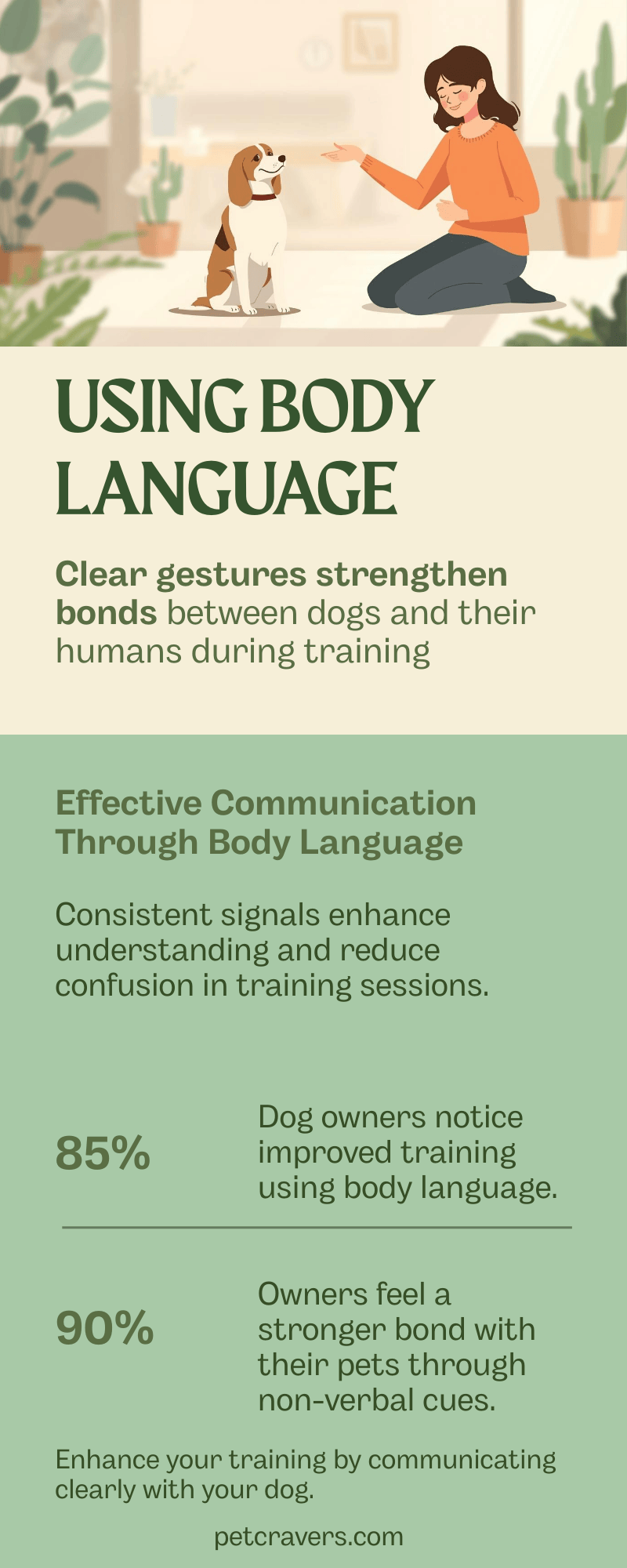
Consistent hand signals, posture, and gestures can make it easier for dogs to understand human body language during training.
1. Using Gestures Alongside Verbal Commands
- Pairing hand signals or gestures with verbal commands reinforces learning.
- Example: A raised hand while saying “sit” provides both auditory and visual cues, increasing the likelihood of correct response.
- Over time, some dogs can respond to gestures alone, making communication smoother in noisy or distant environments.
2. Importance of Consistency and Clarity
- Use the same gesture for the same command every time.
- Avoid multiple signals for a single action, as inconsistency can confuse your dog and slow training progress.
- Clear, deliberate movements are easier for dogs to understand than small or ambiguous gestures.
3. Combining Body Language with Positive Reinforcement
- Reward dogs immediately when they respond correctly to gestures or posture cues.
- Positive reinforcement strengthens the association between the visual cue and desired behavior.
- Treats, praise, or play can all be used to reinforce learning effectively.
4. Leveraging Posture and Proximity
- Leaning forward slightly can signal encouragement or urgency, prompting dogs to pay attention.
- Standing upright and calm conveys confidence, helping dogs feel secure while learning.
- Avoid intimidating or tense postures, which may cause fear or hesitation.
5. Reducing Reliance on Verbal Commands Alone
- Many dogs respond more quickly to visual cues than to verbal commands, especially in situations where hearing may be impaired (distance, noise, or aging).
- Teaching a combination of verbal and non-verbal signals makes your dog more adaptable and responsive.
Key Takeaway
Integrating body language into training—through gestures, posture, and consistent signals—enhances communication, improves obedience, and strengthens the bond between dog and owner. Dogs respond more reliably when they understand both what you say and how you physically convey it.
Common Miscommunication When Dogs Understand Human Body Language Differently
Even when dogs understand human body language, they may interpret a particular gesture differently depending on context, previous learning, stress, and their relationship with the person.
1. Misreading Dog Responses
- Owners may misinterpret a dog’s reaction to gestures or posture, thinking the dog understands more than it does.
- For example, a dog avoiding eye contact may be showing submission or stress, not disobedience.
- Careful observation of subtle cues ensures accurate interpretation of behavior.
2. Conflicting Signals
- Dogs rely on consistency between verbal and non-verbal cues.
- Saying “sit” while leaning back or gesturing ambiguously can confuse the dog.
- Always align your tone, gestures, and posture with the desired command.
3. Overestimating Dog’s Understanding
- Dogs may appear to understand complex body language, but in reality, they are responding to repeated patterns, tone, or rewards.
- Avoid assuming they grasp abstract concepts; focus on clear, consistent communication.
4. Inconsistent Gestures or Posture
- Using multiple gestures for the same command or changing posture frequently weakens comprehension.
- Standardizing signals reinforces learning and strengthens recognition.
5. Neglecting Environmental and Emotional Context
- Dogs may misinterpret cues if stressed, distracted, or in a noisy environment.
- Calm, familiar settings enhance understanding, while chaotic environments can hinder responsiveness.
Key Takeaway
Miscommunication often arises from inconsistency, conflicting cues, or misreading dog signals. By observing your dog carefully and using clear, aligned gestures, posture, and tone, you can reduce confusion and improve daily interactions.
Everyday Applications
Understanding and using body language effectively is not just for training—it can improve daily interactions, safety, and bonding with your dog.
1. Improving Daily Communication
- Subtle gestures, posture, and facial expressions help guide your dog through routines like mealtime, walks, or playtime.
- For example, a hand signal can indicate when it’s time to sit or stay, making transitions smoother.
2. Enhancing Training and Recall
- Combining verbal commands with gestures improves responsiveness during training sessions.
- Eye contact and pointing gestures help dogs locate targets, enhancing recall in indoor and outdoor settings.
3. Managing Behavior
- Body language can redirect unwanted behaviors.
- Example: Standing upright and calmly extending an arm can stop a dog from jumping or approaching restricted areas.
4. Strengthening Emotional Bond
- Dogs are sensitive to emotional cues in body language.
- Relaxed posture, smiles, and calm movements signal safety and friendliness, fostering trust and connection.
5. Safety and Environmental Awareness
- Dogs can anticipate human actions through gestures and posture, which is particularly useful in emergency or busy settings.
- Clear, consistent signals ensure dogs respond appropriately, reducing risks in outdoor or public spaces.
Key Takeaway
Effectively using body language enhances communication, training, behavior management, safety, and emotional bonding. Awareness of your gestures and posture allows dogs to better understand your intentions and respond appropriately.
Enhancing Your Dog’s Understanding of Your Body Language
Training your dog to interpret and respond accurately to your body language strengthens communication, cooperation, and trust. The following strategies can help:
1. Practice Clear and Consistent Gestures
- Use distinct, deliberate movements for each command or signal.
- Avoid small or ambiguous gestures that can be misinterpreted.
- Repeat gestures consistently to reinforce learning and recognition.
2. Observe and Adapt to Your Dog’s Responses
- Pay attention to how your dog reacts to different postures, gestures, and facial expressions.
- Adjust your signals if your dog seems confused, hesitant, or stressed.
- Positive reinforcement when your dog responds correctly helps solidify understanding.
3. Combine Visual and Verbal Cues
- Pair gestures with verbal commands to strengthen comprehension.
- Over time, dogs can often respond to gestures alone, which is useful in noisy or distant environments.
4. Use Play and Reward-Based Interactions
- Incorporate games and treats when practicing body language cues to make learning enjoyable.
- Reward-based training motivates dogs to pay attention and respond reliably.
5. Gradually Introduce Distractions
- Start training in quiet, familiar environments.
- Gradually add distractions, such as other pets, people, or outdoor stimuli, to generalize your dog’s understanding.
6. Maintain Calm and Confident Posture
- Dogs are sensitive to human emotional states reflected in posture and movement.
- Calm, confident body language helps dogs feel secure, making them more receptive to cues.
Key Takeaway
Enhancing your dog’s understanding of body language requires clarity, consistency, observation, and positive reinforcement. With patience and practice, dogs can reliably interpret your gestures and movements, improving obedience, communication, and emotional connection.
Conclusion
Dogs are remarkably skilled at interpreting human body language, including gestures, posture, facial expressions, and gaze. This ability allows them to respond to cues, anticipate actions, and navigate interactions with humans effectively. While dogs do not understand our body language in the same conceptual way humans do, they can associate specific movements and expressions with intentions, rewards, or emotional states.
Consistent use of clear, deliberate gestures and posture, combined with positive reinforcement, ensures that your dog understands your signals accurately. By aligning verbal commands with body language, observing your dog’s responses, and maintaining calm, confident behavior, you can improve communication, reduce misinterpretation, and strengthen the bond between you and your dog.
Final Thought: Understanding and leveraging body language is a powerful tool for enhancing training, safety, behavior management, and emotional connection. By being mindful of your movements and expressions, you can create a stronger, more trusting, and cooperative relationship with your dog.





Leave a Reply