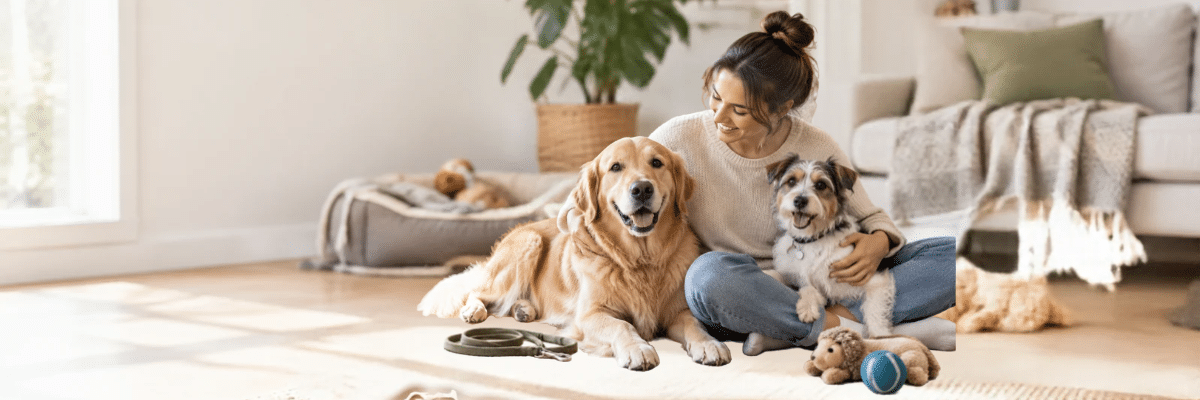
Choosing your first dog is one of those decisions that feels simple until you start looking. A friend swears by their Labrador. A colleague adores their tiny Papillon. Instagram is full of fluffy Bichon Frise puppies and calm, couch-loving Whippets. Everyone seems certain — and everyone seems to be describing a different dog, even when they use the same breed name. That confusion is exactly why a first-time dog owner guide needs to do more than list popular breeds. It needs to help you think clearly about temperament, care needs, and lifestyle compatibility, because those three things will shape your daily life with a dog far more than appearance ever will.
A dog is not a purchase you can easily exchange. It is a living, feeling companion who will need feeding, exercise, training, veterinary care, and emotional attention every day for — depending on breed and individual health — roughly 10 to 16 years. That is a decade or more of walks in the rain, vet bills you did not plan for, training setbacks, and quiet moments on the sofa that make it all worthwhile. Getting the match right at the start does not guarantee perfection, but it dramatically reduces the mismatch that leads to frustration, surrender, and heartbreak for both owner and dog. The American Veterinary Medical Association (AVMA) puts it plainly: the primary reason dogs are given up to shelters is unfulfilled expectations, so make an informed decision rather than an impulsive one. This guide is built to help you do exactly that.
Here is the uncomfortable truth many breed roundups skip: there is no single ranking of the best dog breeds for first-time owners that works for everyone. A breed that is a dream for a retired couple in a quiet house with a garden may be a poor fit for a young professional in a small apartment who works long hours. A tiny dog that seems easy because it is small can still be demanding — small dogs need housetraining, dental care, and socialization just as much as large dogs, and some small breeds are vocal, fragile, or surprisingly stubborn. A large, famously friendly breed can still overwhelm a first-time owner who underestimates exercise needs, shedding, food costs, and the sheer physical strength of a 35-kilogram dog who has decided to pull on the lead. Size, energy, grooming, health, and trainability interact. You have to weigh them together, against your real life.
That is the approach this article takes. We will look at twelve beginner-friendly dog breeds — a balanced mix of small, medium, and large dogs — and examine each one honestly: temperament and personality, how trainable they typically are and how they respond to positive reinforcement, exercise and mental stimulation needs, grooming and shedding, typical health considerations and the veterinary expenses they can bring, compatibility with children, other pets, apartments, and different household lifestyles, the common challenges inexperienced owners run into, and finally a clear verdict on why the breed may or may not suit a first-time owner. We will also compare all twelve side by side in a table, explain how to choose between small, medium, and large dogs, weigh puppies against adult and rescue dogs, cover responsible adoption and ethical breeding, walk through practical preparation from supplies to daily routines, flag common first-time mistakes, discuss breeds that need more experienced handling without unfairly labelling them, and finish with a decision-making guide you can actually use to shortlist breeds. Along the way we will cite veterinary and behavioural evidence — including research on what breed does and does not predict about behaviour — so you can separate fact from folklore.
If you are short on time, the quick answer below gives you the headline recommendations. If you have time to read properly — and we hope you do, because this is a long-term commitment — the full guide will help you arrive at a shortlist that fits you, not just a list that is popular online.
In this guide
- Quick answer: the shortlist of beginner-friendly breeds
- Why breed matters — and why it is not the whole story
- How we chose these twelve breeds
- At a glance: comparison table of all twelve breeds
- Small breeds: Cavalier King Charles Spaniel, Bichon Frise, Shih Tzu, Papillon
- Medium breeds: Havanese, Poodle, Whippet, Greyhound
- Large breeds: Labrador Retriever, Golden Retriever, Bernese Mountain Dog, Rough Collie
- How to choose between small, medium, and large dogs
- Puppies, adult dogs, or rescue dogs: which suits a first-time owner?
- Responsible adoption, ethical breeding, and meeting the dog first
- Preparing for your first dog: supplies, training, socialization, vet care, nutrition, grooming, routines
- Common mistakes first-time owners make — and how to avoid them
- Breeds that may need more experienced handling
- Mixed-breed dogs: why individual temperament beats labels
- Your decision-making guide: how to shortlist breeds that fit you
- FAQs and final word
Quick Answer: Which Are the Best Dog Breeds for First-Time Owners?
| The short answer • For most first-time owners, the most reliably beginner-friendly choices are the Labrador Retriever, Golden Retriever, Cavalier King Charles Spaniel, Poodle (Miniature or Standard), Bichon Frise, Havanese, Papillon, Shih Tzu, Whippet, and Greyhound — plus, for active owners who can meet their exercise and grooming needs, the Bernese Mountain Dog and Rough Collie. If you want one small dog: the Cavalier King Charles Spaniel or Havanese. If you want one medium dog: the Poodle or Whippet. If you want one large dog: the Labrador Retriever or Golden Retriever. But read the conditions: every one of these breeds still needs daily exercise, training, socialization, grooming, and veterinary care, and individual dogs vary. The best breed for you is the one whose energy, size, grooming, health profile, and lifestyle demands you can realistically meet for the next decade or more — ideally after meeting the actual dog or puppy you plan to bring home. |
That shortlist is deliberately conditional. Beginner-friendly does not mean effort-free. It means the breed’s typical temperament, trainability, and care needs are more forgiving of the learning curve every new owner faces — the missed housetraining cues, the imperfect recall, the first anxious night, the chewed shoe. Even so, a poorly socialized, under-exercised, or unhealthy individual of any breed can struggle, while a well-bred, well-raised, well-trained dog of a breed with a more demanding reputation can thrive in the right hands. Breed is a starting point for your search, not a verdict on any individual dog. Keep that lens on throughout this guide, and you will make a far better decision than anyone who simply picks the most popular breed.
Why Breed Matters — and Why It Is Not the Whole Story
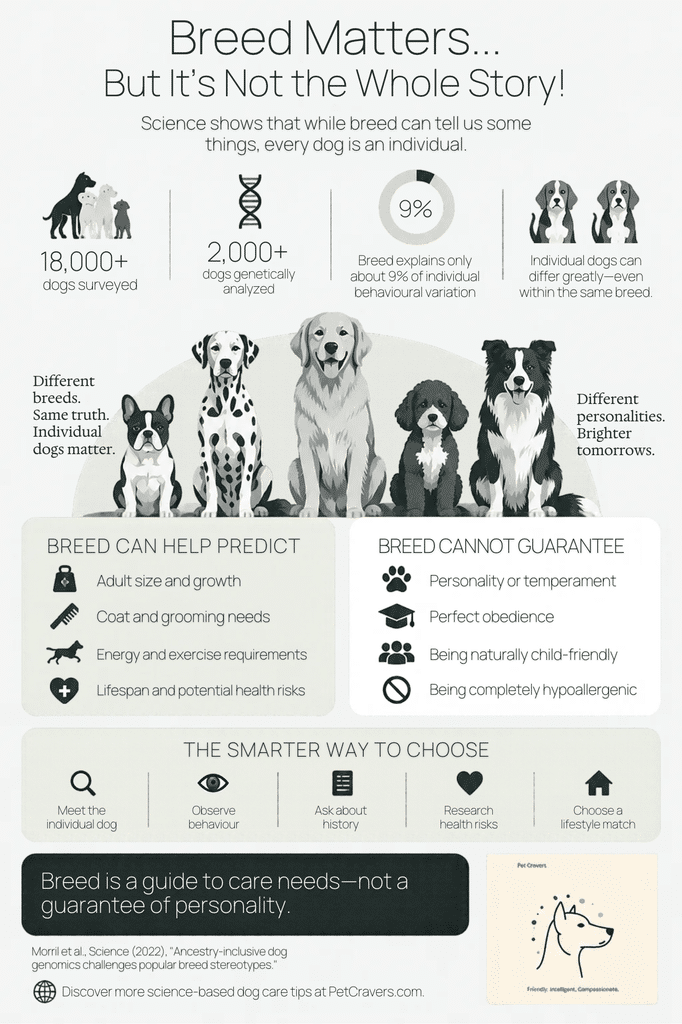
It helps to understand what science actually says about breed and behaviour before you build a life decision on it. The largest study of its kind, published in Science in 2022 by Morrill and colleagues, surveyed more than 18,000 dogs and sequenced over 2,000 of them. The researchers found that breed explained only about 9% of the variation in individual behavioural traits such as biddability, agonistic behaviour, and how dogs react to strangers. In other words, knowing a dog’s breed tells you something, but it tells you far less than most people assume. Individual heritability — the genetic influence on a particular dog — was over 25%, which means two dogs of the same breed can differ substantially, and a mixed-breed dog can be just as predictable (or unpredictable) as a pedigree dog. The study also found that modern breeds have been selected primarily for appearance and aesthetic traits, not for the behavioural stereotypes we attach to them. That is a powerful corrective to the idea that a breed label is a personality guarantee.
So why talk about breeds at all? Because breed still matters for the things that are more strongly linked to genetics and body type: size and growth pattern, coat type and grooming needs, energy and exercise requirements, lifespan, and predisposition to certain health conditions. A Whippet will almost certainly be smaller, shorter-lived in its growth, and more sprint-oriented than a Bernese Mountain Dog. A Poodle’s curly coat will need different care from a Labrador’s short double coat. A Cavalier’s predisposition to mitral valve disease is a real veterinary consideration that a responsible owner should know about before choosing the breed. Breed gives you a useful map of likely care demands and health risks. It does not give you a character reference for the individual dog in front of you. For that, you need to meet the dog, ask about their history, observe their behaviour, and — if you are buying a puppy — scrutinize the parents and the breeder’s practices.
This is also why we avoid absolute language throughout this guide. You will not read that any breed is completely hypoallergenic, because peer-reviewed research has not supported that claim for any breed. Studies measuring the dog allergen Can f 1 in homes of so-called hypoallergenic breeds, including Poodles and Labradoodles, found no meaningful reduction in allergen levels compared with other breeds — and in one well-known study, hair samples from hypoallergenic breeds actually contained higher levels of the allergen. If you have allergies, the only responsible approach is to spend extended time with the specific breed and, ideally, the specific dog, and to discuss testing and management with your doctor. Similarly, you will not read that any breed is maintenance-free. Even the lowest-grooming breeds need nail trims, dental care, parasite prevention, and regular health checks. And you will not read that any breed is naturally obedient or guaranteed good with children. Children and dogs need supervision, training, and mutual respect in every household, whatever the breed. What we can say — honestly — is that some breeds are, on average, more responsive to training, more tolerant of handling, or more suited to apartment life, and those averages are worth knowing when you are choosing where to start your search.
| How to read the breed profiles • Each profile uses the same structure so you can compare breeds fairly: temperament, trainability, exercise, grooming, health and costs, home fit, challenges for new owners, and a verdict. Health notes describe predispositions to discuss with a veterinarian and a responsible breeder — they are not predictions that your individual dog will develop a condition. Cost notes are relative (lower / moderate / higher) rather than invented dollar figures, because veterinary prices vary enormously by country, region, and clinic. Always budget for routine preventive care plus an emergency buffer, whatever breed you choose. |
How We Chose These Twelve Breeds
We started with the breeds most often recommended for beginners — Labrador Retriever, Golden Retriever, Cavalier King Charles Spaniel, Poodle, Bichon Frise, Shih Tzu, Papillon, Havanese, and Whippet — and then asked what was missing. The answer was balance. A guide that only lists small, fluffy companion dogs would mislead large-dog lovers; a guide that only lists large sporting dogs would mislead apartment dwellers. So we built a balanced selection across sizes: four small breeds, four medium breeds, and four large breeds. We favoured breeds with a reputation for sociability, responsiveness to reward-based training, and manageable energy for typical households, while still including breeds with honest trade-offs — for example, the Cavalier’s heart condition, the Bernese Mountain Dog’s shorter lifespan and heavy shedding, or the Whippet’s prey drive — because a trustworthy guide must show the whole picture.
We also applied a few filters. First, the breed should be widely available through responsible breeders, rescues, or breed-specific rescues, so that a first-time owner can realistically find a well-bred or well-assessed dog. Second, the breed’s typical care needs should be achievable for a committed beginner who is willing to learn — not effortless, but learnable. Third, we prioritized breeds where veterinary evidence about health predispositions is available from sources such as the Royal Veterinary College’s VetCompass programme, Cornell University’s Riney Canine Health Center, the Orthopedic Foundation for Animals (OFA), and the American Kennel Club’s (AKC) breed health testing guidance. Where evidence was thin, we said so rather than filling gaps with speculation. Finally, we included two breeds — the Bernese Mountain Dog and Rough Collie — that are less commonly listed as beginner dogs but deserve consideration for the right owners, to show that the best choice depends on your circumstances, not on a fixed league table.
One more principle guided our selection: conditional recommendations. Instead of declaring a universal winner, each profile ends with who the breed suits best and who should look elsewhere. That is not hedging — it is respect for the reality that a calm, retired apartment dweller and a young family with a garden and a love of hiking need different dogs. If you finish reading and find that none of these twelve breeds matches your life, that is useful information too. It may point you toward a mixed-breed rescue dog whose individual temperament fits you perfectly, or toward waiting until your circumstances change. We will explore both of those paths later in this guide.
At a Glance: Comparison of the Twelve Beginner-Friendly Breeds
Use this table as a starting point for shortlisting, not as a final decision. Every column describes a breed average; your individual dog may sit above or below it. Exercise figures are typical daily totals for a healthy adult, including walks, play, and training, and will vary with age, health, and individual energy. Grooming and health-cost ratings are relative within this group.
| Breed (size) | Typical temperament | Trainability | Exercise / day | Grooming & shedding | Health watch-outs | Best home fit |
| Cavalier King Charles Spaniel (small, 5–8 kg) | Gentle, affectionate, eager to please | High — very responsive to rewards | 45–60 min | Moderate brushing; moderate shedding | Mitral valve disease, syringomyelia, patellar luxation | Quiet homes, apartments, older owners |
| Bichon Frise (small, 5–8 kg) | Cheerful, playful, sociable | High — smart, food-motivated | 45–60 min | High — frequent brushing + professional clips; low shedding | Bladder stones, patellar luxation, eye & skin issues | Apartments, allergy-aware homes (with testing) |
| Shih Tzu (small, 4–7 kg) | Affectionate, calm, dignified | Moderate — can be stubborn | 30–45 min | High if coat kept long; low shedding | Brachycephalic airway issues, eye & dental disease, patellar luxation | Apartments, calm households |
| Papillon (small, 2–5 kg) | Bright, alert, friendly, energetic | High — one of the most trainable small breeds | 45–60 min | Low–moderate brushing; moderate shedding | Patellar luxation, heart & eye conditions | Active small-dog owners, apartments |
| Havanese (small–medium, 5–8 kg) | Gentle, playful, adaptable | High — eager to learn | 45–60 min | Moderate–high brushing; low shedding | Patellar luxation, heart & eye conditions | Families, apartments, first-time owners |
| Poodle — Miniature/Standard (medium–large, 7–32 kg) | Intelligent, active, devoted | Very high — among the easiest dogs to train | 60–90 min | High — regular clips; low shedding | Hip dysplasia (Standard), bloat, Addison’s, eye disease | Active homes, allergy-aware homes (with testing) |
| Whippet (medium, 11–18 kg) | Gentle, quiet indoors; fast & prey-driven outdoors | Moderate–high with positive methods | 45–60 min (sprints + walks) | Low — weekly brush; light shedding | Heart murmurs, eye disease, thin-skin injuries, anaesthetic sensitivity | Apartments & houses with secure exercise |
| Greyhound (medium–large, 25–35 kg) | Calm, gentle, affectionate; retired racers often placid | Moderate — sensitive, reward-responsive | 45–60 min | Low — weekly brush; light shedding | Dental disease, heart & thyroid considerations, sighthound anaesthesia | Calm homes, apartments, rescue adopters |
| Labrador Retriever (large, 25–36 kg) | Friendly, outgoing, food-obsessed | Very high — highly trainable | 60–90+ min | Low–moderate; heavy seasonal shedding | Hip/elbow dysplasia, obesity, exercise-induced collapse (rare) | Active families, outdoor lifestyles |
| Golden Retriever (large, 25–34 kg) | Gentle, patient, people-oriented | Very high — very trainable | 60–90+ min | Moderate–high; heavy shedding | Hip/elbow dysplasia, cancers, hypothyroidism | Families with time for exercise & grooming |
| Bernese Mountain Dog (large, 32–52 kg) | Calm, good-natured, devoted | Moderate–high | 60 min (avoid over-exercise when young) | High — frequent brushing; heavy shedding | Hip/elbow dysplasia, cancers, bloat, shorter lifespan | Houses with space, cooler climates |
| Rough Collie (medium–large, 20–34 kg) | Gentle, intelligent, sensitive | High — responsive to training | 60–90 min | Moderate–high; heavy shedding | Eye conditions (Collie eye anomaly), skin & thyroid issues | Active, quieter homes; herding-breed lovers |
Table 1: At-a-glance comparison of twelve beginner-friendly breeds. Use it to shortlist, then read the full profiles and meet individual dogs before deciding.
A few patterns jump out of the table. First, trainability is not reserved for large dogs — the Papillon, Havanese, and Poodle are among the easiest dogs to train of any size, which is why they appear in so many beginner-friendly dog breed lists. Second, grooming effort does not track with size: the smallest breeds in this guide (Bichon Frise, Shih Tzu) can demand more coat care than the largest (Labrador, Whippet). Third, every breed has a health watch-out worth discussing with a veterinarian and a breeder. That is normal — no breed is free of predispositions — but it means health screening of parent dogs, and your willingness to budget for monitoring and potential treatment, should be part of your decision from day one. We will unpack each of these trade-offs breed by breed now.
Small Breeds: Compact Companions for First-Time Owners
Small dogs are often assumed to be the easiest choice for beginners, but size alone does not make a dog easy. Small breeds still need housetraining, socialization, dental care, and daily exercise — and because they are small, owners sometimes skip training or carry them everywhere, which can create anxious, reactive, or poorly socialized dogs. The four small breeds below are genuinely beginner-friendly, but each has its own demands. If you are drawn to a small dog, the best small dogs for first-time owners are those whose energy, vocal tendencies, grooming, and health profile you can meet consistently — not simply the smallest dog available.
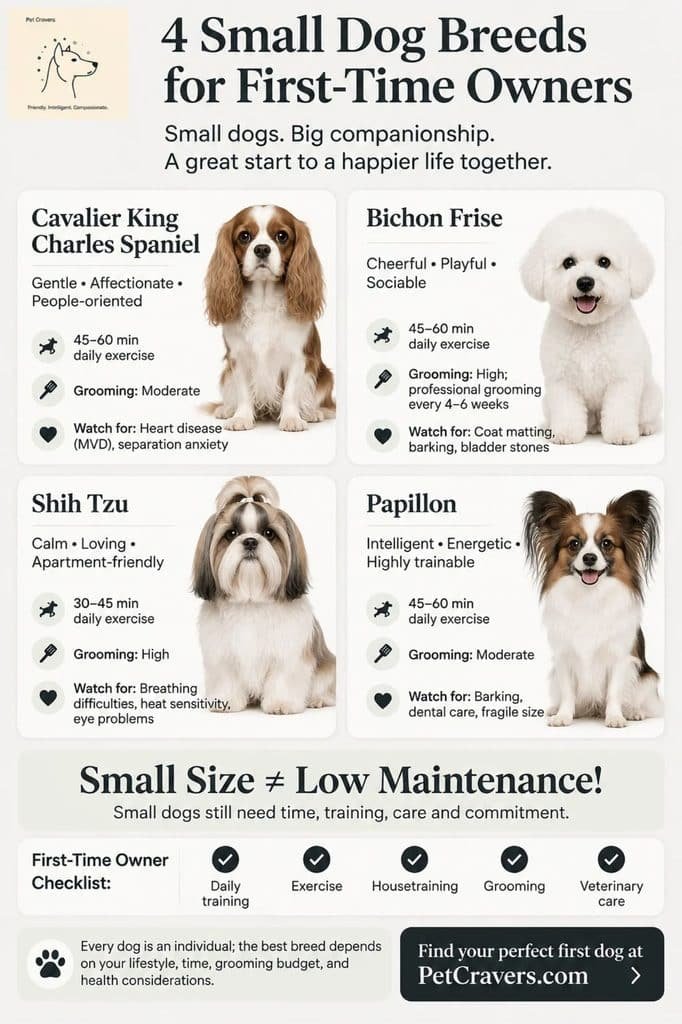
1. Cavalier King Charles Spaniel — The Gentle Velcro Companion
Temperament and personality. The Cavalier King Charles Spaniel is often described as one of the most gentle and affectionate of all small breeds, and that reputation is well earned. Cavaliers are typically sociable, eager to please, and deeply bonded to their people — the kind of dog who follows you from room to room and settles happily at your feet. They are usually tolerant and good-natured rather than feisty, which makes them appealing calm dog breeds for new owners who want companionship without high drama. That said, they are still spaniels: curious, playful, and interested in the world, with a nose that enjoys investigating. Individual Cavaliers vary in confidence and energy, and puppies can be lively and mouthy like any young dog, but the breed average leans strongly toward sweetness and adaptability.
Trainability and positive reinforcement. Cavaliers are highly responsive to reward-based training. They want to please, they learn quickly, and they generally respond better to praise, treats, and play than to any form of pressure. This makes them excellent for a first-time owner learning handling skills — they forgive early mistakes and reward consistent, kind training with rapid progress. Housetraining is usually straightforward, though like many small breeds, Cavaliers can be slow to become fully reliable if routines are inconsistent, so expect to invest in a clear schedule during the first months.
Exercise and mental stimulation. A healthy adult Cavalier typically needs around 45 to 60 minutes of exercise a day, split into walks and play, plus mental stimulation through training, puzzle toys, and sniffy walks. They enjoy companionship more than athletic challenge; they are happy to join a gentle walk and then nap. Puppies and adolescents need shorter, more frequent sessions to protect growing joints, and older Cavaliers will need less. Without enough stimulation, even a gentle breed can become bored, vocal, or destructive, so daily interaction matters even when the dog seems content to cuddle.
Grooming and shedding. Cavaliers have a silky, feathered coat that needs brushing several times a week to prevent tangles, especially behind the ears, under the legs, and around the tail. They shed moderately and year-round, with heavier shedding when the coat changes. Ears need regular checking and cleaning because the breed is prone to ear infections, and teeth need attention because small breeds are predisposed to dental disease. Most owners manage grooming at home with a brush, comb, and occasional trim, but you should budget time — this is not a wash-and-forget coat.
Health considerations and veterinary expenses. This is the most important section for any prospective Cavalier owner, and it must be understood clearly. Cavaliers have a well-documented predisposition to degenerative mitral valve disease (MVD), a progressive heart condition in which the mitral valve thickens and leaks. Research from the Royal Veterinary College’s VetCompass programme, which studies disorders in dogs under primary veterinary care in the UK, has identified heart murmurs and mitral valve disease among the most common disorders in the breed. The condition is common enough that many Cavaliers develop some degree of it as they age, though severity and age of onset vary widely. Syringomyelia, a painful neurological condition linked to skull shape, is also a recognized concern in the breed, as are patellar luxation (kneecap dislocation), eye conditions, and ear infections. None of this means every Cavalier will be affected, or that the breed is a poor choice — many Cavaliers live long, comfortable lives — but it does mean that choosing a Cavalier is a commitment to heart monitoring, potential long-term medication, and possibly specialist cardiology care. Responsible breeders screen for MVD with cardiac auscultation and, in many countries, echocardiography, and they should be able to show you recent results for both parents. Budget accordingly: routine care plus annual heart checks, with a contingency for cardiac medication and monitoring if disease develops. Pet insurance, if available in your country, is worth serious consideration for this breed.
Compatibility with children, other pets, apartments, and lifestyles. Cavaliers often do well with older, gentle children who can interact respectfully, and they usually get along with other dogs and, with proper introductions, cats. Their moderate exercise needs and generally quiet nature make them suitable for apartments, provided they get daily walks and are not left alone for very long periods — Cavaliers are prone to separation anxiety because of their strong bond to people, so gradual alone-time training is essential. They suit people who are home much of the time or who can arrange company, dog care, or flexible work. They are less suited to households that are away all day, every day, without a plan for companionship.
Common challenges for inexperienced owners. The two predictable challenges are separation anxiety and health anxiety. A Cavalier who has never been taught to settle alone may panic when left, leading to vocalization, destructive behaviour, and distress. Prevent this from day one with short, gradual absences and positive associations with alone time. The second challenge is underestimating the health commitment: owners who choose a Cavalier for appearance alone, without researching MVD or asking about parental screening, may be unprepared for the emotional and financial impact of heart disease. Neither challenge is a reason to avoid the breed — both are manageable with preparation — but both require foresight.
Verdict: may or may not suit a first-time owner? The Cavalier may suit you if you want a gentle, affectionate, trainable small companion, you are home much of the time, you can commit to regular grooming and lifelong heart monitoring, and you choose a breeder who health-tests rigorously. It may not suit you if you work long hours away from home, you cannot budget for potential cardiac care, or you want a dog who is content to be left alone for eight hours daily. For the right owner, the Cavalier is a deeply rewarding first dog. For the wrong circumstances, its devotion becomes a liability. That conditional logic applies to every breed in this guide.
2. Bichon Frise — Cheerful, Playful, and Coat-Dependent
Temperament and personality. Bichons are cheerful, playful, and sociable dogs with a clownish streak that makes them delightful companions. They are typically affectionate and people-oriented, with a confident, outgoing attitude that belies their small size. Many Bichons are alert and may bark at visitors or sounds, so they are not silent dogs, but their barking is usually communicative rather than aggressive. They enjoy interaction and play, and while they can be independent-minded, they generally prefer to be involved in family life. As with all breeds, individual Bichons range from outgoing to more reserved, and early socialization shapes confidence enormously.
Trainability and positive reinforcement. Bichons are intelligent and food-motivated, which makes them responsive to positive reinforcement training. They learn quickly, enjoy trick training and games, and generally want to engage with their owners. They can also be a little stubborn or easily distracted, so training needs to be upbeat, varied, and rewarding rather than repetitive. Housetraining can take patience — small dogs in general may be slower to housetrain, partly because owners miss subtle cues — but with a consistent routine, crate training, and prompt rewards for toileting outside, most Bichons become reliable.
Exercise and mental stimulation. Expect roughly 45 to 60 minutes of daily exercise for an adult Bichon, including walks, play, and training. Bichons enjoy walks and games but are not endurance athletes; they are more interested in companionship and mental engagement than in long hikes. Puzzle feeders, scent games, and short training sessions help prevent boredom. Puppies need age-appropriate, shorter sessions, and the breed’s playful energy means you should plan for indoor play on wet or cold days.
Grooming and shedding. This is where Bichons make their biggest demand. The white, curly double coat mats easily and needs brushing several times a week — ideally daily for the coat to stay comfortable — plus professional grooming every four to six weeks to maintain a clip, clean the face and feet, and keep the coat in good condition. Bichons shed little, which is why they are often marketed as hypoallergenic, but as discussed earlier, no breed has been shown to be completely hypoallergenic, and shedding little is not the same as producing no allergen. If allergies are a concern, spend time with Bichons and discuss testing with your doctor before committing. Owners who love the Bichon look but dislike grooming should consider a shorter, practical clip and a realistic grooming budget — professional grooming is a recurring cost, not an occasional luxury. Eyes also need regular wiping and trimming, and teeth need care.
Health considerations and veterinary expenses. Bichons are predisposed to bladder stones (calcium oxalate uroliths), patellar luxation, eye conditions including cataracts and progressive retinal atrophy, skin allergies, and ear infections. The Merck Veterinary Manual notes that small breeds including the Bichon Frise are more commonly affected by calcium oxalate bladder stones, which cannot be dissolved medically and require surgical removal if they form, with dietary management to reduce recurrence. That means potential costs for urinalysis, imaging, surgery, and prescription diets. Patellar luxation ranges from mild cases that need only weight management and monitoring to more severe cases that benefit from surgical correction, as described by Cornell’s Riney Canine Health Center. Overall, Bichons are not a high-risk breed, but they are not a no-risk breed either. Budget for routine dental care, eye checks, and the possibility of urinary or orthopaedic treatment, plus the ongoing cost of professional grooming.
Compatibility with children, other pets, apartments, and lifestyles. Bichons often do well in apartments because of their size and moderate exercise needs, and they usually enjoy family life with older children who can play gently. They typically get along with other dogs and can live with cats given proper introductions. Their sociability means they generally prefer not to be left alone for very long periods, so owners who work full-time should plan for midday company or dog care. They suit people who enjoy grooming routines, want a playful companion, and are willing to invest in coat care. They are less suited to owners who want a truly low-maintenance coat or who are away from home all day without support.
Common challenges for inexperienced owners. The main challenge is underestimating grooming. New owners sometimes choose a Bichon for its fluffy appearance without realizing that the coat needs frequent brushing and regular professional care; neglected coats mat painfully and can lead to skin problems. The second challenge is housetraining and barking: small, alert dogs need the same training investment as large dogs, and barking should be managed early with training and environmental management rather than ignored. Both challenges are entirely preventable with realistic expectations.
Verdict. The Bichon Frise may suit you if you want a cheerful, trainable, low-shedding small dog, you enjoy grooming or can budget for it, and you can provide companionship during the day. It may not suit you if you want a wash-and-go dog, you have untested allergies and assume the breed will be safe, or you cannot commit to the coat care that keeps the dog comfortable. Choose a Bichon for its personality and lifestyle fit, not just its teddy-bear look, and you will have a wonderful first dog.
3. Shih Tzu — Calm, Affectionate, and Dignified
Temperament and personality. Shih Tzus are affectionate, calm, and dignified small dogs who were bred as companions and palace dogs, and they still carry that composed, people-focused temperament. They are typically gentle and friendly, with a quiet confidence that makes them appealing calm dog breeds for new owners. They are not usually hyperactive or demanding, but they are not inert either — they enjoy play, exploration, and attention, and they can be alert barkers who announce visitors. Shih Tzus tend to bond closely with their families and may be reserved with strangers at first, warming up with positive experiences. Their brachycephalic (short-faced) build means they are not built for vigorous exercise or heat, which shapes both their lifestyle fit and their health considerations.
Trainability and positive reinforcement. Shih Tzus are intelligent but can be independent-minded and stubborn, so they are not always among the easiest dogs to train. They respond best to patient, positive reinforcement with high-value rewards, short sessions, and consistency. Harsh or repetitive methods tend to backfire with this breed. Housetraining requires persistence: Shih Tzus can be slow to housetrain, and owners who use puppy pads inconsistently or miss cues may prolong the process. A crate-based routine, frequent outdoor opportunities, and immediate rewards for toileting outside will help. A first-time owner who expects instant obedience may find the Shih Tzu’s pace frustrating; an owner who enjoys the process of gentle training will find the breed rewarding.
Exercise and mental stimulation. A healthy adult Shih Tzu typically needs 30 to 45 minutes of exercise a day, including gentle walks and play. They are not built for long hikes, running, or heat, and over-exercising — especially in warm weather — can cause distress because of their short airways. Mental stimulation through training, puzzle toys, and sniffy, unhurried walks is just as important as physical exercise. Puppies need short sessions, and older dogs will need less. The key is regular, gentle activity rather than occasional intense exercise.
Grooming and shedding. Shih Tzus have a long, flowing double coat that, if kept long, needs brushing several times a week to prevent matting, plus regular professional grooming. Many owners choose a shorter puppy clip for practicality, which reduces daily effort while keeping the dog comfortable. The breed sheds little, but again, low shedding does not equal hypoallergenic. Eyes need daily wiping and the hair around them needs trimming to prevent irritation and tear staining, and teeth need regular care because small, short-faced breeds are prone to dental disease and crowding. Grooming is a genuine commitment with this breed, even with a shorter clip.
Health considerations and veterinary expenses. Shih Tzus are brachycephalic, meaning their skull shape shortens the airway, and this brings specific health considerations. The Royal Veterinary College’s VetCompass research on Shih Tzus, published in Canine Medicine and Genetics, has documented elevated risks for breathing-related disorders, eye problems, dental disease, and other conditions associated with the breed’s conformation. Brachycephalic obstructive airway syndrome (BOAS) can cause noisy breathing, exercise intolerance, and heat sensitivity, and in severe cases requires surgical correction. Eye conditions are also a concern because the breed’s prominent eyes are vulnerable to injury and ulceration. Patellar luxation, heart conditions, and kidney disease are additional predispositions to discuss with a veterinarian. None of this means a Shih Tzu cannot live a comfortable life — many do, especially with weight management, heat avoidance, and prompt veterinary care — but it does mean that prospective owners should choose breeders who prioritize health and breathing function, ask about parental screening, and budget for potentially higher veterinary costs related to airway, eye, and dental care. The OFA’s Respiratory Function Grading Scheme, which includes the Shih Tzu among eligible breeds, is one example of the kind of functional assessment responsible breeders may use. If you are considering any brachycephalic breed, discuss breathing, heat tolerance, and anaesthetic considerations with your veterinarian before committing.
Compatibility with children, other pets, apartments, and lifestyles. Shih Tzus are often well suited to apartments and calm households because of their size and moderate exercise needs. They can do well with older, gentle children and usually get along with other dogs and cats, though their dignity means they may not enjoy rough play or being overwhelmed by very young children. They suit people who want a calm, affectionate companion and are home much of the time. They are less suited to active, outdoorsy households, homes in very hot climates without air conditioning, or owners who want a dog for running or hiking. Their alert barking also means apartment owners should train quiet behaviour early and consider neighbours.
Common challenges for inexperienced owners. The predictable challenges are housetraining persistence, grooming consistency, and underestimating health needs. New owners may be surprised by how long housetraining takes, how much coat care is involved, or how seriously heat and breathing must be taken. All three are manageable with preparation, but they require the owner to take the breed’s specific needs seriously rather than treating a Shih Tzu as a decorative accessory.
Verdict. The Shih Tzu may suit you if you want a calm, affectionate, apartment-friendly companion, you can commit to grooming and gentle training, and you will prioritize health and heat management. It may not suit you if you want an athletic dog, you live in a hot climate without cooling, or you expect a breed that trains effortlessly. For a calm, attentive first-time owner, the Shih Tzu can be a deeply satisfying choice.
4. Papillon — Small, Bright, and Surprisingly Athletic
Temperament and personality. Papillons are bright, alert, friendly, and energetic small dogs — often described as big dogs in small bodies. They are typically sociable and confident, with a lively curiosity that makes them engaging companions. Papillons are usually good-natured with people and other dogs, though they can be alert barkers and may be reserved with strangers until they have had positive experiences. Their intelligence and enthusiasm mean they thrive on interaction; a Papillon who is ignored all day may become anxious or destructive, while a Papillon who is included in training and play becomes a delightful, devoted companion. They are not lap ornaments — they are active little dogs who want a job, even if that job is learning tricks in the living room.
Trainability and positive reinforcement. Papillons are among the most trainable of all small breeds and are frequently cited among the easiest dogs to train. They are intelligent, eager to learn, and highly responsive to positive reinforcement, treats, and play. Many Papillons excel at obedience, agility, and trick training, which makes them excellent for a first-time owner who wants to learn training skills and see quick progress. Housetraining is usually achievable with consistency, though small dogs still need frequent opportunities and prompt rewards. The Papillon’s trainability is a genuine advantage for beginners — provided the owner actually trains, rather than assuming the dog will be naturally obedient.
Exercise and mental stimulation. Expect about 45 to 60 minutes of daily exercise for an adult Papillon, including walks, play, and training. Papillons enjoy walks and games and have more stamina than their size suggests, but they are not built for long-distance running. Mental stimulation is especially important because of their intelligence: puzzle toys, training sessions, scent games, and varied walks help prevent boredom. Puppies need shorter sessions, and the breed’s energy means you should plan for indoor enrichment on days when outdoor exercise is limited.
Grooming and shedding. Papillons have a long, silky coat with a distinctive fringed ear set, but — unusually for a long-coated breed — they have no undercoat, which makes grooming more manageable than many owners expect. Brushing two to three times a week usually keeps the coat tangle-free, with occasional trims to tidy the feet and feathering. Papillons shed moderately, especially when the coat changes, so expect some hair on clothing and furniture. Teeth need regular care, as with all small breeds, and ears should be checked. Overall, grooming is moderate and achievable at home for most owners.
Health considerations and veterinary expenses. Papillons are predisposed to patellar luxation, heart conditions including mitral valve disease and patent ductus arteriosus, eye conditions such as progressive retinal atrophy and cataracts, and dental disease. Cornell’s Riney Canine Health Center notes that patellar luxation is more common in small breeds and can range from mild cases managed conservatively to more severe cases requiring surgery. Responsible breeders screen for patellar luxation, cardiac conditions, and eye disease, and should be able to provide results for both parents. Budget for routine dental care, annual eye and heart checks, and the possibility of orthopaedic or cardiac treatment. Overall veterinary costs for Papillons are typically moderate, but dental and orthopaedic care can add up, so preventive care and weight management matter.
Compatibility with children, other pets, apartments, and lifestyles. Papillons can do well in apartments because of their size, provided they get daily exercise and mental stimulation. They often enjoy life with older children who can play respectfully, and they usually get along with other dogs and cats. Their energy and intelligence suit active small-dog owners who enjoy training and interactive play. They are less suited to very quiet, sedentary households where the dog will be left alone for long periods, or to owners who want a dog who is content with minimal interaction. Their alertness also means barking management should be part of early training, especially in apartments.
Common challenges for inexperienced owners. The main challenges are under-exercising and under-training a small dog because it is small. Owners sometimes carry Papillons everywhere, skip housetraining, or assume a tiny dog needs little exercise, which can lead to anxiety, barking, and housetraining problems. The second challenge is fragility: Papillons are small and can be injured by rough handling, falls, or being stepped on, so children and visitors need to be taught gentle handling, and the dog should be supervised. Both challenges are easily avoided with realistic expectations.
Verdict. The Papillon may suit you if you want a small, intelligent, trainable, and energetic companion, you enjoy training and interactive play, and you can provide daily exercise and mental stimulation. It may not suit you if you want a sedentary lap dog, you cannot commit to training, or you have very young children who cannot yet handle a small dog gently. For an engaged first-time owner, the Papillon is one of the most rewarding small breeds to choose.
Medium Breeds: The Flexible Middle Ground
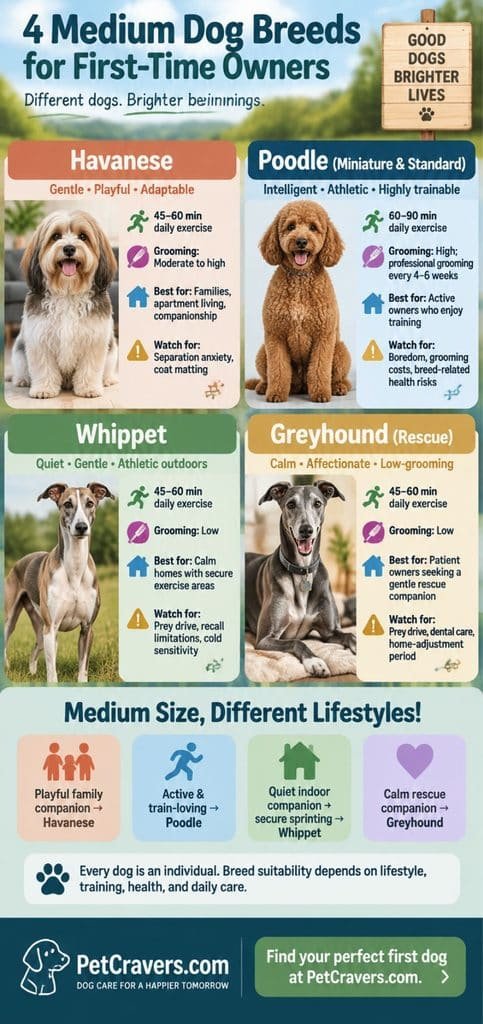
Medium-sized dogs often hit a sweet spot for first-time owners: large enough to feel substantial and robust, small enough to manage in most homes and cars, and typically with moderate exercise and cost demands. The four medium breeds below illustrate different versions of that sweet spot — a highly trainable Poodle, a gentle and adaptable Havanese, a quiet sprinting Whippet, and a calm rescue Greyhound. Each suits a different lifestyle, which is precisely the point: medium does not mean interchangeable.
5. Havanese — Gentle, Playful, and Adaptable
Temperament and personality. Havanese are gentle, playful, and adaptable small-to-medium dogs who were bred as companions and still excel in that role. They are typically affectionate and sociable, with a sweet, good-natured disposition that makes them appealing family dogs for beginners. Havanese are usually friendly with people and other dogs, enjoy play, and have a charming, sometimes clownish streak. They are not usually overly demanding or anxious, but they do bond closely and prefer companionship. Individual Havanese vary in energy and confidence, and early socialization helps ensure a well-rounded adult, but the breed average is notably pleasant and easygoing.
Trainability and positive reinforcement. Havanese are intelligent and eager to learn, and they respond very well to positive reinforcement. They enjoy training, games, and tricks, and they generally want to please their owners, which makes them forgiving of a beginner’s early training mistakes. Housetraining is usually achievable with a consistent routine, though small dogs still need frequent opportunities and prompt rewards. Havanese also tend to learn social skills well when given positive experiences with people, dogs, and environments during puppyhood, which is a major advantage for first-time owners who are willing to invest in socialization.
Exercise and mental stimulation. A healthy adult Havanese typically needs 45 to 60 minutes of daily exercise, including walks, play, and training. They enjoy walks and interactive play but are not endurance athletes. Mental stimulation through training, puzzle toys, and sniffy walks helps prevent boredom. Puppies need shorter, more frequent sessions, and the breed’s playful nature means you should plan for indoor games as well. Havanese are adaptable: they can enjoy a more active day and still settle happily in the evening, which makes them suitable for a range of household rhythms.
Grooming and shedding. Havanese have a long, silky double coat that needs brushing several times a week to prevent matting, plus regular professional grooming or home trimming. Many owners keep the coat in a shorter, practical clip to reduce daily effort. The breed sheds little, which contributes to its popularity with allergy-aware owners, but — as with all breeds — low shedding does not guarantee hypoallergenic status, and anyone with allergies should spend time with the breed and discuss testing with a doctor. Ears need regular checking and cleaning, teeth need care, and the coat around the eyes may need trimming. Grooming is a moderate commitment that most owners can manage with a routine.
Health considerations and veterinary expenses. Havanese are predisposed to patellar luxation, heart conditions, eye conditions including cataracts and progressive retinal atrophy, liver shunts, and dental disease. Responsible breeders screen for patellar luxation, cardiac conditions, and eye disease, and should provide results for both parents. The AKC’s health testing guidance for the Havanese lists patella, hip, and ophthalmologist evaluations among the recommended tests from the national breed club. Budget for routine dental care, annual eye and heart checks, and the possibility of orthopaedic treatment for patellar luxation. Overall veterinary costs are typically moderate, but preventive care and early intervention keep costs down.
Compatibility with children, other pets, apartments, and lifestyles. Havanese are often excellent family dogs for beginners because of their gentle, playful temperament and adaptability. They can do well with older children who play respectfully, and they usually get along with other dogs and cats. Their size and moderate exercise needs make them suitable for apartments, provided they get daily walks and are not left alone for very long periods. They suit people who want a friendly, trainable companion and are willing to groom regularly. They are less suited to owners who want a dog who is content to be left alone all day, or who dislike coat care.
Common challenges for inexperienced owners. The main challenges are separation-related anxiety if alone time is not taught gradually, and grooming consistency. Havanese bond closely, so owners should build alone-time skills from day one. Grooming, while not extreme, still requires a routine; neglected coats mat and cause discomfort. Both challenges are straightforward to prevent with early training and a grooming schedule.
Verdict. The Havanese may suit you if you want a gentle, playful, trainable companion for family or apartment life, you can commit to regular grooming, and you will invest in socialization and training. It may not suit you if you want a low-interaction dog or you cannot provide companionship during the day. For many first-time owners, the Havanese is one of the most balanced choices in this guide.
6. Poodle (Miniature and Standard) — Intelligent, Active, and Highly Trainable
Temperament and personality. Poodles are intelligent, active, and devoted dogs — far more than the pampered stereotype suggests. Originally bred as water retrievers and working dogs, Poodles are athletic, alert, and people-oriented, with a keen mind and a strong desire to engage. They are typically friendly and sociable, enjoy learning, and bond closely with their families. Poodles can be alert barkers and may be reserved with strangers at first, but with socialization they are usually confident and well-mannered. They are not calm, sedentary dogs; they are bright, energetic companions who thrive on activity and interaction. Miniature Poodles (roughly 7 to 15 pounds) and Standard Poodles (roughly 40 to 70 pounds) share the same temperament and care needs, differing mainly in size — a useful reminder that size and personality are separate decisions.
Trainability and positive reinforcement. Poodles are consistently ranked among the easiest dogs to train, and for good reason: they are intelligent, eager to please, and highly responsive to positive reinforcement. They learn quickly, enjoy complex training, and excel at obedience, agility, and trick training. For a first-time owner, this trainability is a major advantage — the dog will meet you halfway as you learn handling skills. Housetraining is usually straightforward with consistency. The Poodle’s intelligence also means the owner must provide mental stimulation; a clever dog who is bored will invent its own entertainment, which may not be what you want. Training is not optional with a Poodle — it is the activity that makes the breed shine.
Exercise and mental stimulation. Expect 60 to 90 minutes of daily exercise for an adult Poodle, including walks, play, training, and ideally some off-lead exercise in a secure area. Standard Poodles in particular enjoy walks, swimming, and active play. Mental stimulation is equally important: training sessions, puzzle toys, scent games, and varied walks. Puppies need shorter sessions to protect growing joints, and adolescents need structured outlets for their energy. A Poodle who gets only a brief garden break and no training will likely become restless, vocal, or destructive — not because the breed is difficult, but because its needs are unmet.
Grooming and shedding. Poodles have a dense, curly coat that does not shed much but does need regular care. The coat should be brushed several times a week to prevent matting, and professional grooming every four to six weeks is typical to maintain a clip, clean the face and feet, and keep the coat in good condition. Poodles are often marketed as hypoallergenic because they shed little, but research has not shown that any breed is completely hypoallergenic, and Poodle hair and homes can contain significant levels of dog allergen. Anyone with allergies should spend extended time with Poodles and discuss testing with a doctor. Ears need regular cleaning because the breed is prone to ear infections, and teeth need care. Grooming is a genuine, recurring commitment — budget time and money for it.
Health considerations and veterinary expenses. Standard Poodles are predisposed to hip dysplasia, gastric dilatation-volvulus (bloat), Addison’s disease, eye conditions including progressive retinal atrophy and cataracts, sebaceous adenitis (a skin condition), and certain cancers. Cornell’s Riney Canine Health Center lists Standard Poodles among the breeds predisposed to GDV, a life-threatening emergency in which the stomach fills with air and twists; preventive gastropexy surgery, often performed at the time of spaying or neutering, greatly reduces the risk of twisting. The Merck Veterinary Manual notes that Standard Poodles are overrepresented among breeds affected by Addison’s disease, a hormonal condition requiring lifelong replacement therapy and monitoring. Miniature Poodles share some predispositions, including patellar luxation and eye disease. Responsible breeders screen for hip dysplasia (in Standards), eye disease, and other breed-specific conditions, and should provide results for both parents. Budget for routine preventive care, annual eye and hip monitoring as advised by your veterinarian, and a contingency for bloat prevention, dental care, and potential long-term medication. Veterinary costs for Poodles are typically moderate to higher, largely because of grooming, dental care, and the potential for orthopaedic or emergency treatment.
Compatibility with children, other pets, apartments, and lifestyles. Poodles can do well with older children who can engage in training and play, and they usually get along with other dogs and cats. Miniature Poodles can suit apartments provided they get daily exercise and mental stimulation; Standard Poodles need more space and exercise and are better suited to houses with access to outdoor exercise. Poodles suit active, engaged owners who enjoy training and outdoor activities. They are less suited to sedentary households, owners who are away all day without a plan for exercise and companionship, or anyone who wants a dog who is content with minimal interaction. Their alertness also means barking management should be part of early training.
Common challenges for inexperienced owners. The main challenges are under-exercising and under-training an intelligent, active breed, and underestimating grooming. New owners sometimes choose a Poodle for its low-shedding coat without realizing the grooming commitment, or they underestimate how much exercise and mental stimulation a Standard Poodle needs. Both challenges are preventable with realistic expectations and a daily routine that includes training.
Verdict. The Poodle may suit you if you want a highly trainable, intelligent, active companion, you enjoy training and exercise, and you can commit to regular grooming. It may not suit you if you want a calm, low-energy dog, you dislike grooming, or you cannot provide 60 to 90 minutes of daily activity and interaction. For an active, engaged first-time owner, the Poodle — in either size — is one of the most rewarding choices available.
7. Whippet — Gentle Indoors, Athletic Outdoors
Temperament and personality. Whippets have a distinctive dual temperament that surprises many people: indoors, they are gentle, quiet, and affectionate, often seeking the softest spot on the sofa for a nap; outdoors, they are athletic sighthounds with explosive speed and a strong prey drive. They are typically gentle and patient with people, enjoy companionship, and are not usually demanding or boisterous in the home. Whippets are sensitive dogs who respond better to gentle, positive training than to pressure. They are not effective guard dogs — they are lovers, not defenders — and they generally prefer a calm household rhythm. Their sensitivity also means they can be anxious if overwhelmed by noise, rough handling, or excessive demands, so a calm, predictable home suits them well.
Trainability and positive reinforcement. Whippets are intelligent and can be trainable, but they are sighthounds, not obedience specialists. They respond well to positive reinforcement, especially with high-value rewards and play, and they learn housetraining and basic manners readily. Recall, however, is the breed’s Achilles heel: a Whippet who sees a squirrel, rabbit, or deer may chase with single-minded focus, and off-lead recall in open spaces cannot be reliably trusted. This is not disobedience in a moral sense — it is genetics. A first-time owner must understand that secure, enclosed exercise areas and a long line or lead in open spaces are part of responsible Whippet ownership. Training should focus on engagement, recall in secure areas, and impulse control, with realistic expectations.
Exercise and mental stimulation. A healthy adult Whippet typically needs 45 to 60 minutes of daily exercise, including walks and, crucially, opportunities to sprint in a secure, enclosed area. Whippets enjoy short, fast bursts of running more than long, steady exercise. Mental stimulation through training, puzzle toys, and sniffy walks helps prevent boredom. Puppies need shorter sessions, and the breed’s thin coat means they feel the cold — coats in winter and warm bedding are essential. Without secure sprinting opportunities, a Whippet may become frustrated; with them, the breed is a calm, satisfying companion.
Grooming and shedding. Whippets have a short, fine coat that needs only weekly brushing and sheds lightly. They are among the lowest-grooming breeds in this guide. Nails need regular trimming, teeth need care, and the thin skin needs checking after exercise for cuts or grazes. Whippets also need coats in cold weather and should not be left outdoors in cold or wet conditions. Overall, grooming is minimal — one of the breed’s genuine advantages for busy owners.
Health considerations and veterinary expenses. Whippets are generally healthy but have sighthound-specific considerations. They are prone to thin-skin lacerations from high-speed play, painful paw-pad corns, inherited eye disease including progressive retinal atrophy, and cardiac murmurs or mitral valve disease that warrant monitoring. Sighthounds, including Whippets, can also be sensitive to certain anaesthetic agents and may recover more slowly from some sedatives, so owners should flag the breed to their veterinary team before any procedure and ensure sighthound-appropriate protocols are used. Responsible breeders screen for eye disease and cardiac conditions and should provide results for both parents. Budget for routine preventive care, dental care, annual heart and eye checks, and the possibility of treatment for skin injuries or lameness. Veterinary costs are typically moderate, with the main variables being dental care and any orthopaedic or cardiac monitoring.
Compatibility with children, other pets, apartments, and lifestyles. Whippets can do well in apartments because they are quiet and calm indoors, provided they get daily exercise in secure areas. They often do well with older, gentle children and usually get along with other dogs, though their prey drive means cats and small animals require careful management and introductions. They suit people who want a calm indoor companion with athletic outdoor potential, and who can provide secure exercise. They are less suited to owners who want a dog who can be reliably off-lead in open countryside, who live in very cold climates without providing coats and shelter, or who want a dog who is always ready for adventure. Their quiet nature makes them good neighbours, but their prey drive makes secure fencing non-negotiable.
Common challenges for inexperienced owners. The main challenge is underestimating prey drive and recall limitations. New owners sometimes assume a gentle indoor dog will be gentle outdoors, and are shocked when the dog chases. The second challenge is cold sensitivity: Whippets without coats in winter can become miserable and ill. Both challenges are easily avoided with secure exercise, a long line, and winter coats.
Verdict. The Whippet may suit you if you want a quiet, gentle, low-grooming medium dog, you can provide secure sprinting exercise, and you understand sighthound prey drive. It may not suit you if you want a reliably off-lead dog in open spaces, you live in a very cold climate without providing protection, or you want a high-energy, always-active companion. For the right owner, the Whippet is a calm, elegant, and deeply affectionate first dog.
8. Greyhound — The Calm, Gentle Rescue Companion
Temperament and personality. Greyhounds — especially retired racing Greyhounds, who are widely available through rescue organizations — are known for a calm, gentle, and affectionate temperament that surprises people who associate the breed with racing speed. In the home, many retired Greyhounds are placid, quiet, and devoted, content to nap for much of the day and enjoy gentle walks. They are typically gentle with people and enjoy companionship, though they can be sensitive and may be shy with strangers at first. Greyhounds are not usually boisterous or demanding, which makes them appealing calm dog breeds for new owners. That said, they are still sighthounds with prey drive, and individual Greyhounds vary in confidence, energy, and background — a dog who has lived in a kennel may need time to adjust to home life, learn housetraining, and build confidence with stairs, slippery floors, and household routines.
Trainability and positive reinforcement. Greyhounds are sensitive and reward-responsive, and they generally learn well with positive reinforcement, patience, and gentle handling. They are not usually driven to excel at obedience, but they learn housetraining, leash manners, and basic cues readily when given time and consistency. Retired racers may need to learn that the home is not a kennel, that toys and beds are theirs, and that people are companions rather than handlers. Training should be calm and encouraging, with realistic expectations about recall: like all sighthounds, Greyhounds cannot be trusted off-lead where they might chase small animals. A first-time owner who is patient and gentle will find Greyhounds forgiving and rewarding.
Exercise and mental stimulation. A healthy adult Greyhound typically needs 45 to 60 minutes of daily exercise, including gentle walks and, where possible, secure sprinting opportunities. Despite their racing reputation, most retired Greyhounds are not endurance athletes in retirement; they enjoy short bursts of speed and then rest. Mental stimulation through training, puzzle toys, and sniffy walks helps prevent boredom. Puppies and young Greyhounds need shorter sessions, and the breed’s thin coat and low body fat mean they feel the cold and need coats and warm bedding. Without secure exercise and companionship, a Greyhound may become anxious or withdrawn; with them, the breed is a calm, satisfying companion.
Grooming and shedding. Greyhounds have a short, fine coat that needs only weekly brushing and sheds lightly. They are among the lowest-grooming breeds in this guide. Nails need regular trimming, teeth need particular attention because Greyhounds are prone to dental disease, and the thin skin needs checking after exercise. Greyhounds also need coats in cold weather and should not be left outdoors in cold conditions. Overall, grooming is minimal, though dental care is important.
Health considerations and veterinary expenses. Greyhounds are predisposed to dental disease, which can be significant and may require professional cleaning under anaesthesia, as well as heart and thyroid considerations that warrant monitoring. Sighthound anaesthetic sensitivity applies, so owners should flag the breed to their veterinary team before any procedure. Retired racers may also have orthopaedic wear from racing that needs monitoring. Responsible rescues and breeders provide veterinary records and health screening, and prospective adopters should ask about dental status, heart checks, and any racing-related injuries. Budget for routine preventive care, dental care (which can be a significant cost), annual heart and thyroid monitoring as advised, and the possibility of orthopaedic treatment. Veterinary costs are typically moderate, with dental care being the main variable.
Compatibility with children, other pets, apartments, and lifestyles. Greyhounds can do well in apartments because they are quiet and calm indoors, provided they get daily exercise. They often do well with older, gentle children and usually get along with other dogs, though their prey drive means cats and small animals require careful management — many retired Greyhounds cannot safely live with cats or small pets, and rescues will assess this honestly. They suit calm households, retired owners, and people who want a gentle, low-energy companion. They are less suited to very active households, homes with cats or small pets where the dog’s prey drive cannot be managed, or owners who want a dog for running or hiking. Their quiet nature makes them good neighbours, but their size and prey drive require responsible management.
Common challenges for inexperienced owners. The main challenges are adjusting a kennel-raised dog to home life, managing prey drive, and dental care. New owners may underestimate how much time a retired racer needs to learn housetraining, stairs, and household routines, or they may assume a calm dog needs little exercise. Both require patience and realistic expectations. The second challenge is assuming a Greyhound can live with cats or small pets without assessment; rescues can advise on individual dogs, and that advice should be followed.
Verdict. The Greyhound may suit you if you want a calm, gentle, low-grooming companion, you are willing to adopt a rescue dog and support its adjustment to home life, and you can manage prey drive responsibly. It may not suit you if you want a high-energy dog, you have cats or small pets and cannot manage the risk, or you want a dog who is instantly housetrained and confident. For a calm, patient first-time owner, the retired Greyhound is one of the most underrated and rewarding choices in this guide.
Large Breeds: Friendly, Trainable, and Physically Demanding
Large dogs bring real advantages for first-time owners — robustness, visibility, and often excellent trainability — but they also bring physical demands that small-dog owners do not face: food costs, vet costs, exercise needs, shedding volume, and the simple fact that a 35-kilogram dog who jumps up or pulls on the lead is a different proposition from a 5-kilogram dog who does the same. The four large breeds below are genuinely beginner-friendly, but only for owners who can meet their size-related demands. If you are drawn to a large dog, the best family dogs for beginners in this group are those whose exercise, grooming, and health needs you can meet consistently — not simply the most popular large breed.

9. Labrador Retriever — Friendly, Outgoing, and Food-Obsessed
Temperament and personality. Labrador Retrievers are friendly, outgoing, and people-oriented dogs who have earned their reputation as one of the world’s most popular family breeds. They are typically sociable, playful, and enthusiastic, with a joyful energy that makes them engaging companions. Labradors usually enjoy interaction with people and other dogs, love water and retrieving, and have a famously food-motivated nature. That food motivation is a double-edged sword: it makes training easier, but it also means Labradors will scavenge, beg, and gain weight easily if food is not managed. Individual Labradors vary in energy and confidence — some are calm and steady, others are exuberant and boisterous — and early socialization and training shape which version you get. Labradors are not automatically calm or well-mannered; they are friendly and trainable, which is different.
Trainability and positive reinforcement. Labradors are among the easiest dogs to train, and they are highly responsive to positive reinforcement. Their food motivation, eagerness to please, and intelligence make them excellent learners for a first-time owner. They excel at obedience, retrieving, and many dog sports. Housetraining is usually straightforward with consistency. The Labrador’s trainability is a genuine advantage, but it requires the owner to actually train: an untrained Labrador is a large, strong, enthusiastic dog who may jump, pull, and steal food. A trained Labrador is a delightful, responsive companion. The difference is entirely in the owner’s investment.
Exercise and mental stimulation. A healthy adult Labrador typically needs 60 to 90 minutes or more of daily exercise, including walks, play, retrieving, and ideally swimming or other activities the dog enjoys. Labradors are athletic and energetic, especially when young, and they need both physical exercise and mental stimulation through training, puzzle toys, and varied walks. Puppies need shorter, age-appropriate sessions to protect growing joints, and adolescents need structured outlets for their energy. Without enough exercise and stimulation, a Labrador may become destructive, vocal, or overweight — not because the breed is difficult, but because its needs are unmet. Owners who cannot commit to daily exercise should seriously consider a lower-energy breed.
Grooming and shedding. Labradors have a short, dense double coat that needs weekly brushing and sheds heavily, especially during seasonal coat changes. Expect hair on clothing, furniture, and floors, particularly in spring and autumn. Labradors also need regular nail trims, dental care, and ear checks. The coat is easy to maintain compared with long-coated breeds, but shedding volume is high. Owners who dislike dog hair should think carefully before choosing a Labrador — or any heavy-shedding breed — because the hair will be a daily reality.
Health considerations and veterinary expenses. Labradors are predisposed to hip and elbow dysplasia, obesity, and exercise-induced collapse (a rare condition in which dogs collapse during intense exercise). The Royal Veterinary College’s VetCompass research on Labradors has documented elevated risks for hip dysplasia, elbow dysplasia, obesity, and other conditions, and the breed’s popularity means these predispositions affect many dogs. Cornell’s Riney Canine Health Center notes that hip dysplasia is common in medium and large breeds including Labradors, and that early diagnosis and weight management improve outcomes. Obesity deserves special attention: research published in Cell Metabolism in 2016 found that about 23% of Labradors carry a deletion in the POMC gene that disrupts satiety signals and increases food motivation, adding roughly 1.9 kilograms per copy of the variant. That genetic predisposition, combined with the breed’s love of food, makes weight management a lifelong priority. Responsible breeders screen for hip and elbow dysplasia and eye disease, and should provide results for both parents. Budget for routine preventive care, annual hip and weight monitoring, dental care, and the possibility of orthopaedic treatment. Veterinary costs for Labradors are typically moderate to higher, largely because of size, orthopaedic risk, and weight-related conditions. Feeding costs are also higher than for small breeds — a large dog eats significantly more.
Compatibility with children, other pets, apartments, and lifestyles. Labradors often do well with older children who can play respectfully, and they usually get along with other dogs and, with proper introductions, cats. Their size and energy mean they are better suited to houses with access to outdoor exercise than to small apartments, though a Labrador in an apartment can thrive if the owner commits to daily exercise and training. Labradors suit active families and outdoor lifestyles. They are less suited to sedentary households, owners who are away all day without a plan for exercise, or anyone who cannot manage a large, strong dog’s pulling and jumping. Their friendliness also means they are not guard dogs — they will greet intruders enthusiastically.
Common challenges for inexperienced owners. The main challenges are under-exercising, under-training, and over-feeding a large, food-motivated breed. New owners sometimes underestimate how much exercise a young Labrador needs, how strong a large dog becomes, or how easily weight creeps on. All three are preventable with a daily routine, consistent training, and strict portion control. The second challenge is assuming friendliness equals good behaviour: a friendly, untrained Labrador is still a large, untrained dog.
Verdict. The Labrador Retriever may suit you if you want a friendly, trainable, active large companion, you can commit to 60 to 90 minutes of daily exercise, you can manage shedding and food costs, and you will train consistently. It may not suit you if you want a calm, low-energy dog, you live in a small apartment without a plan for exercise, or you cannot manage weight and feeding. For an active, committed first-time owner, the Labrador remains one of the most rewarding choices.
10. Golden Retriever — Gentle, Patient, and People-Oriented
Temperament and personality. Golden Retrievers are gentle, patient, and people-oriented dogs who are often described as one of the most family-friendly breeds. They are typically affectionate, sociable, and eager to be involved in family life, with a soft, good-natured disposition that makes them appealing best family dogs for beginners. Goldens usually enjoy interaction with people and other dogs, love retrieving and water, and have a gentle mouth that makes them popular with families. They are not usually aggressive or territorial. Individual Goldens vary in energy and confidence — some are calm and steady, others are exuberant — and early socialization and training shape the adult dog. Goldens are friendly and trainable, but they are not automatically calm or well-mannered; a young Golden without training can be boisterous, mouthy, and destructive.
Trainability and positive reinforcement. Golden Retrievers are among the easiest dogs to train and are highly responsive to positive reinforcement. They are intelligent, eager to please, and food-motivated, which makes them excellent learners. They excel at obedience, retrieving, and many dog sports. Housetraining is usually straightforward with consistency. The Golden’s trainability is a major advantage for a first-time owner, but it requires the owner to train: an untrained Golden is a large, strong, enthusiastic dog who may jump, pull, and steal. A trained Golden is a gentle, responsive companion. The difference is the owner’s investment.
Exercise and mental stimulation. A healthy adult Golden typically needs 60 to 90 minutes or more of daily exercise, including walks, play, retrieving, and swimming. Goldens are athletic and energetic, especially when young, and they need both physical exercise and mental stimulation through training, puzzle toys, and varied walks. Puppies need shorter, age-appropriate sessions to protect growing joints, and adolescents need structured outlets. Without enough exercise and stimulation, a Golden may become destructive, vocal, or overweight. Owners who cannot commit to daily exercise should consider a lower-energy breed.
Grooming and shedding. Goldens have a long, feathered double coat that needs brushing several times a week to prevent matting, especially behind the ears, under the legs, and around the tail. They shed heavily year-round, with heavier shedding during coat changes. Professional grooming every six to eight weeks helps maintain the coat, trim feathering, and keep the dog comfortable. Goldens also need regular nail trims, dental care, and ear checks because the breed is prone to ear infections. Grooming is a moderate-to-high commitment, and shedding volume is high. Owners who dislike dog hair or grooming should think carefully before choosing a Golden.
Health considerations and veterinary expenses. Goldens are predisposed to hip and elbow dysplasia, certain cancers, hypothyroidism, and eye conditions. Cornell’s Riney Canine Health Center lists Golden Retrievers among the breeds predisposed to hypothyroidism, a hormonal condition requiring lifelong medication and monitoring. The Morris Animal Foundation’s Golden Retriever Lifetime Study, launched in 2012 and following more than 3,000 Goldens, is investigating cancer in the breed, with hemangiosarcoma, lymphoma, osteosarcoma, and high-grade mast cell tumours among the cancers of primary interest; the study has documented more than 1,700 confirmed cancers by 2026, and it is estimated that more than half of Goldens in the United States die of cancer. That statistic must be understood in context: it reflects the breed’s cancer predisposition, not a prediction for any individual dog, and many Goldens live long, comfortable lives. Responsible breeders screen for hip and elbow dysplasia, eye disease, and cardiac conditions, and should provide results for both parents. Budget for routine preventive care, annual hip, thyroid, and weight monitoring, dental care, and a contingency for cancer screening and treatment if needed. Veterinary costs for Goldens are typically moderate to higher, largely because of size, orthopaedic risk, and cancer monitoring. Feeding costs are also higher than for small breeds.
Compatibility with children, other pets, apartments, and lifestyles. Goldens often do well with older children who can play respectfully, and they usually get along with other dogs and, with proper introductions, cats. Their size and energy mean they are better suited to houses with access to outdoor exercise than to small apartments, though a Golden in an apartment can thrive with daily exercise and training. Goldens suit active families and outdoor lifestyles. They are less suited to sedentary households, owners who are away all day without a plan for exercise, or anyone who cannot manage a large, strong dog. Their friendliness means they are not guard dogs.
Common challenges for inexperienced owners. The main challenges are under-exercising, under-training, and underestimating grooming and health monitoring. New owners sometimes underestimate how much exercise a young Golden needs, how strong a large dog becomes, or how much coat care is involved. All are preventable with a daily routine, consistent training, and realistic expectations. The second challenge is assuming gentleness equals good behaviour: a gentle, untrained Golden is still a large, untrained dog.
Verdict. The Golden Retriever may suit you if you want a gentle, trainable, active large companion, you can commit to daily exercise, grooming, and health monitoring, and you will train consistently. It may not suit you if you want a calm, low-energy dog, you dislike grooming or shedding, or you cannot budget for potential health care. For an active, committed first-time owner, the Golden is one of the most rewarding choices.
11. Bernese Mountain Dog — Calm, Good-Natured, and Shorter-Lived
Temperament and personality. Bernese Mountain Dogs are calm, good-natured, and devoted dogs who were bred as farm and draught dogs and still carry a steady, gentle temperament. They are typically affectionate and people-oriented, with a calm confidence that makes them appealing to owners who want a large dog without high energy or reactivity. Berners are usually friendly with people and other dogs, enjoy companionship, and have a gentle, patient disposition. They are not usually demanding or boisterous, but they do bond closely and prefer to be with their people. Individual Berners vary in energy and confidence, and early socialization helps ensure a well-rounded adult. The breed’s calmness is a genuine advantage, but it should not be confused with low needs: Berners still need exercise, training, and interaction.
Trainability and positive reinforcement. Bernese Mountain Dogs are intelligent and generally trainable, and they respond well to positive reinforcement. They learn housetraining, leash manners, and basic cues readily, though they are not usually as driven to excel at obedience as Labradors or Poodles. Training should be patient, upbeat, and rewarding, with realistic expectations about pace. Berners are sensitive dogs who respond better to encouragement than to pressure. A first-time owner who is consistent and kind will find the breed forgiving and rewarding, but should not expect the rapid, enthusiastic learning of a Labrador or Poodle.
Exercise and mental stimulation. A healthy adult Bernese typically needs about 60 minutes of daily exercise, including walks and play, but the breed should not be over-exercised, especially when young, because of joint development and health considerations. Berners enjoy walks and companionship more than athletic challenge; they are not built for running or long hikes. Mental stimulation through training, puzzle toys, and sniffy walks helps prevent boredom. Puppies need shorter, age-appropriate sessions, and adolescents need structured, moderate exercise. Without enough stimulation, even a calm breed can become bored or destructive, so daily interaction matters.
Grooming and shedding. Berners have a long, thick double coat that needs brushing several times a week to prevent matting and to manage shedding. They shed heavily, especially during coat changes, and the volume of hair is significant. Professional grooming every six to eight weeks helps maintain the coat. Berners also need regular nail trims, dental care, and ear checks. Grooming is a high commitment, and shedding is heavy. Owners who dislike dog hair or grooming should think carefully before choosing a Berner — or any heavy-shedding, long-coated breed.
Health considerations and veterinary expenses. Berners are predisposed to hip and elbow dysplasia, certain cancers, gastric dilatation-volvulus (bloat), and eye conditions. The breed’s lifespan is notably shorter than many other large breeds — often cited as roughly 7 to 10 years, compared with 10 to 13 years for Labradors and Goldens — which is a profound consideration for any owner, especially a first-time owner who may not have anticipated the emotional impact of losing a dog at a younger age. Responsible breeders screen for hip and elbow dysplasia, eye disease, and cardiac conditions, and should provide results for both parents. Budget for routine preventive care, annual hip and weight monitoring, dental care, and a contingency for bloat prevention (gastropexy may be discussed with your veterinarian), orthopaedic treatment, and cancer screening. Veterinary costs for Berners are typically higher than for smaller breeds, largely because of size, orthopaedic risk, and the potential for emergency treatment. Feeding costs are also high — a Bernese is one of the largest breeds in this guide.
Compatibility with children, other pets, apartments, and lifestyles. Berners often do well with older, gentle children and usually get along with other dogs and, with proper introductions, cats. Their size and coat mean they are better suited to houses with space and access to outdoor exercise than to small apartments, and they do best in cooler climates because of their thick coat. Berners suit people who want a calm, gentle large companion and can provide space, grooming, and companionship. They are less suited to apartment dwellers, owners in hot climates, sedentary households where the dog will be left alone, or anyone who cannot manage a very large dog’s size and shedding. Their calmness makes them good neighbours, but their size requires responsible management.
Common challenges for inexperienced owners. The main challenges are underestimating size, shedding, and lifespan. New owners sometimes underestimate how large a Bernese becomes, how much hair the coat produces, or how much it costs to feed and provide veterinary care for a very large dog. The second challenge is the shorter lifespan: owners who choose a Berner should do so with eyes open about the likely timeframe and the emotional commitment that involves. Both challenges are manageable with realistic expectations, but they require foresight.
Verdict. The Bernese Mountain Dog may suit you if you want a calm, gentle, devoted large companion, you have space and a cooler climate, you can commit to heavy grooming and higher costs, and you accept the shorter lifespan. It may not suit you if you live in a small apartment or hot climate, you dislike shedding, or you cannot budget for a very large dog. For the right owner, the Berner is a deeply loving first dog — but it is a choice to make with full awareness of its trade-offs.
12. Rough Collie — Gentle, Intelligent, and Sensitive
Temperament and personality. Rough Collies are gentle, intelligent, and sensitive dogs who were bred as herding and farm dogs and still carry a thoughtful, people-oriented temperament. They are typically affectionate and devoted, with a gentle disposition that makes them appealing to owners who want a medium-to-large dog without high reactivity. Collies are usually friendly with people and other dogs, enjoy companionship, and have a loyal, sometimes reserved nature. They are not usually aggressive or territorial, but they are alert and may bark at visitors or sounds. Individual Collies vary in energy and confidence, and early socialization helps ensure a well-rounded adult. The breed’s sensitivity is a strength in the right home — Collies bond deeply and respond to gentle handling — but it also means they can be anxious if overwhelmed by noise, rough handling, or excessive demands.
Trainability and positive reinforcement. Rough Collies are intelligent and responsive to training, and they generally learn well with positive reinforcement. They enjoy learning, games, and tricks, and they respond to encouragement and rewards. Collies are sensitive to tone and body language, so training should be calm, patient, and upbeat. Housetraining is usually straightforward with consistency. A first-time owner who is gentle and consistent will find Collies rewarding learners, but should not expect the exuberant, food-driven enthusiasm of a Labrador. The Collie’s intelligence also means the owner should provide mental stimulation; a clever dog who is bored will find its own entertainment.
Exercise and mental stimulation. A healthy adult Rough Collie typically needs 60 to 90 minutes of daily exercise, including walks, play, and training. Collies enjoy walks and interactive play and have more stamina than their gentle temperament suggests, but they are not built for extreme athletic challenge. Mental stimulation through training, puzzle toys, and sniffy walks helps prevent boredom. Puppies need shorter sessions, and adolescents need structured outlets for their energy. Without enough exercise and stimulation, a Collie may become vocal, anxious, or destructive — not because the breed is difficult, but because its needs are unmet.
Grooming and shedding. Rough Collies have a long, thick double coat with a distinctive mane that needs brushing several times a week to prevent matting and to manage shedding. They shed heavily, especially during coat changes. Professional grooming every six to eight weeks helps maintain the coat. Collies also need regular nail trims, dental care, and ear checks. Grooming is a moderate-to-high commitment, and shedding is heavy. Owners who dislike dog hair or grooming should think carefully before choosing a Collie.
Health considerations and veterinary expenses. Rough Collies are predisposed to eye conditions including Collie eye anomaly (a developmental eye condition that can affect vision), skin conditions including dermatomyositis, thyroid conditions, and certain cancers. Responsible breeders screen for eye disease and should provide results for both parents, including DNA testing where available. Budget for routine preventive care, annual eye and skin monitoring, dental care, and the possibility of long-term medication for thyroid or skin conditions. Veterinary costs for Collies are typically moderate to higher, largely because of size, eye and skin monitoring, and potential long-term treatment. Feeding costs are moderate to higher than for small breeds.
Compatibility with children, other pets, apartments, and lifestyles. Rough Collies often do well with older, gentle children and usually get along with other dogs and, with proper introductions, cats. Their size and exercise needs mean they are better suited to houses with access to outdoor exercise than to small apartments, though a Collie in an apartment can thrive with daily exercise and training. Collies suit people who want a gentle, intelligent, medium-to-large companion and enjoy training and outdoor activities. They are less suited to very noisy households, owners who are away all day without a plan for exercise and companionship, or anyone who dislikes grooming or shedding. Their alertness also means barking management should be part of early training.
Common challenges for inexperienced owners. The main challenges are under-exercising and under-training an intelligent herding breed, and underestimating grooming. New owners sometimes underestimate how much exercise and mental stimulation a Collie needs, or how much coat care is involved. The second challenge is sensitivity: Collies who are overwhelmed by noise, rough handling, or excessive demands may become anxious, so a calm, predictable home and gentle training are important. Both challenges are preventable with realistic expectations.
Verdict. The Rough Collie may suit you if you want a gentle, intelligent, trainable medium-to-large companion, you enjoy training and exercise, and you can commit to regular grooming. It may not suit you if you want a calm, low-energy dog, you dislike grooming or shedding, or you live in a very noisy household. For a gentle, engaged first-time owner, the Rough Collie is a rewarding and often overlooked choice.
How to Choose Between Small, Medium, and Large Dogs
Size is often the first thing people decide, and it is a reasonable starting point — but it should not be the only factor. Small, medium, and large dogs differ in predictable ways that affect your daily life, your home, your budget, and your ability to manage the dog physically. Understanding those differences helps you choose a size you can realistically sustain, rather than a size you find appealing in the abstract.
Small dogs (under about 15 pounds / 7 kilograms) offer obvious advantages: they eat less, cost less to feed, take up less space, are easier to transport, and can be lifted into cars or carried in emergencies. They are well suited to apartments and smaller homes. But small does not mean easy. Small breeds still need housetraining, socialization, dental care, and daily exercise, and because they are small, owners sometimes skip training or carry them everywhere, which can create anxious or reactive dogs. Small dogs are also fragile: they can be injured by falls, rough handling, or being stepped on, so households with very young children need to teach gentle handling and supervision. Small breeds are often vocal, and barking management matters in apartments. Lifespan tends to be longer for small breeds, which is a joy and a commitment — you may be caring for a small dog for 14 to 16 years. Choose a small dog if you want companionship, lower running costs, and apartment-friendly size, and you are willing to train and socialize a small dog as seriously as a large one.
Medium dogs (roughly 15 to 50 pounds / 7 to 23 kilograms) often hit a sweet spot: substantial enough to feel robust and visible, small enough to manage in most homes and cars, and typically with moderate exercise and cost demands. Medium dogs are versatile — they can suit apartments with daily exercise, houses with gardens, active owners, and calmer households. Their size means they are less fragile than small dogs but less physically overwhelming than large dogs. Exercise needs vary widely within the medium category, from the calm Greyhound to the active Poodle, so size alone does not predict energy. Choose a medium dog if you want flexibility and balance, and you can meet the specific breed’s exercise and grooming needs.
Large dogs (over about 50 pounds / 23 kilograms) bring advantages that many owners value: robustness, visibility, and often excellent trainability. Large dogs are less fragile, more visible to other dog owners, and frequently easier to housetrain and train because owners take their training seriously. But large dogs bring physical demands: they eat significantly more, veterinary costs are higher, exercise needs are greater, shedding volume is larger, and a large dog who pulls on the lead, jumps up, or decides to run is a serious management challenge. Large dogs need space — not necessarily a mansion, but room to move, stretch, and settle — and access to outdoor exercise. They also tend to have shorter lifespans than small dogs, which owners should consider honestly. Choose a large dog if you want a substantial, trainable companion, you have space and access to exercise, and you can budget for higher feeding and veterinary costs. Do not choose a large dog simply because you find the breed appealing; choose it because you can meet its size-related demands for a decade or more.
| Size is not personality • A small dog can be energetic, vocal, and demanding. A large dog can be calm, gentle, and easygoing. Size predicts feeding costs, space needs, and physical manageability far better than it predicts temperament or energy. Always consider size alongside temperament, exercise needs, grooming, and health — never as a substitute for them. |
A practical way to think about size is to ask three questions. First, can I physically manage this dog? If you cannot lift, control, or transport a large dog in an emergency, or if you have mobility limitations, a smaller dog may be safer for both of you. Second, can I afford this dog? Large dogs cost more to feed, insure, and treat, and those costs rise with age and health needs. Third, does this size fit my home and lifestyle? A large, active dog in a small apartment without access to exercise is a mismatch, however much you love the breed. Answer those questions honestly, and size will help rather than hinder your decision.
Puppies, Adult Dogs, or Rescue Dogs: Which Is Right for a First-Time Owner?
Age and source matter as much as breed. A puppy, an adult dog from a breeder, and a rescue dog each offer different advantages and challenges, and the right choice depends on your time, experience, and expectations. There is no universally best option — only the option that fits your circumstances.
Puppies are appealing for understandable reasons: they are cute, they offer a blank slate for training and socialization, and you can shape their behaviour from the start. But puppies are also demanding in ways that surprise many first-time owners. Puppies need housetraining, which takes weeks to months of consistent routine; they need socialization during a sensitive period in the first three months (and up to about 13 to 16 weeks), when positive experiences shape confidence and behaviour for life; they need frequent feeding, supervision, and veterinary visits for vaccinations and parasite prevention; and they will chew, mouth, and have accidents. The American Veterinary Society of Animal Behavior (AVSAB) emphasizes that early puppy socialization is standard of care and should begin before vaccination is complete, with appropriate precautions such as well-managed puppy classes starting at 7 to 8 weeks after the first vaccine. Puppies also need sleep, structure, and patience — they are babies, not small adults. A puppy may suit you if you have time to be home, you can commit to training and socialization, and you understand that the adult dog’s personality is not yet fully formed. A puppy may not suit you if you work long hours, want a predictable temperament, or cannot provide the supervision puppies need.
Adult dogs (from breeders, owners, or rescues) offer predictability that puppies cannot. Their size, energy, temperament, and housetraining status are largely established, so you know what you are getting. Many adult dogs are already housetrained, know basic commands, and have more settled energy than puppies. Adult dogs can absolutely learn new behaviours — the idea that you cannot teach an old dog new tricks is a myth — but they start from a different baseline, which may include habits you need to work on. An adult dog may suit you if you want a known temperament, you have less time for housetraining and socialization, and you are willing to work with the dog’s existing history. An adult dog may not suit you if you want to shape every behaviour from scratch or if the dog’s history includes challenges you cannot manage.
Rescue dogs — from shelters, breed-specific rescues, and reputable rescue organizations — come in all ages, sizes, and breeds, including many of the breeds in this guide. Rescues can often tell you whether a dog is good with children, cats, other dogs, or apartment living, information a puppy cannot provide about itself. Adopting a rescue dog can be deeply rewarding, and many rescues assess temperament, provide veterinary care, and support adopters through the adjustment period. At the same time, rescue dogs may have unknown histories, may need housetraining or training, and may need time to decompress and build trust. A rescue dog may suit you if you want to adopt rather than buy, you are willing to work with the dog’s history, and you can provide patience and structure. A rescue dog may not suit you if you want a predictable, known history or if the dog’s needs exceed what you can provide. The key is honest matching: reputable rescues will tell you if a dog is not right for your household, and you should listen.
Whichever age and source you choose, the AVMA’s advice applies: avoid acquiring a dog on impulse or as a gift, take time, involve your household, and consider whether a dog fits your lifestyle before committing. Puppies, adults, and rescues can all be wonderful first dogs — the question is which one fits your time, experience, and expectations.
Responsible Adoption, Ethical Breeding, and Meeting the Dog Before You Commit
How you find your dog matters as much as which breed you choose. Responsible adoption and ethical breeding are not just moral preferences — they are practical safeguards for health, temperament, and welfare. A dog from a responsible source is more likely to be healthy, well-socialized, and temperamentally sound. A dog from an irresponsible source may carry health risks, behavioural challenges, and welfare concerns that affect you both for years.
Responsible adoption means working with shelters and rescues that assess dogs, provide veterinary care, and match dogs to households honestly. Ask about the dog’s history, temperament, health, and needs. Ask whether the dog has lived with children, cats, or other dogs. Ask about housetraining, alone-time behaviour, and any known challenges. Meet the dog — ideally more than once — and observe how the dog interacts with you, with other household members, and with the environment. Ask about the adoption process, return policy, and support after adoption. Reputable rescues will ask you questions too — about your home, routine, experience, and plans — and that scrutiny is a good sign, not an obstacle. If a rescue cannot tell you anything about a dog, or pressures you to decide immediately, walk away.
Ethical breeding means choosing a breeder who prioritizes health, temperament, and welfare over appearance or profit. Responsible breeders health-test parent dogs for breed-specific conditions, using programmes such as the Orthopedic Foundation for Animals (OFA) and the Canine Health Information Center (CHIC), which lists the primary health screening tests a breed’s parent club recommends. The AKC’s breed health testing requirements, organized by group, are a useful starting point for understanding what screening to expect for your breed. Responsible breeders should be able to show you recent health results for both parents, tell you about the parents’ temperaments and health histories, raise puppies in the home with early socialization, and allow you to meet the mother (and ideally the father) and see where puppies are raised. They should ask you questions about your home and lifestyle, provide a health guarantee and contract, and take puppies back at any age if circumstances change. Red flags include breeders who cannot show health results, who will not let you meet the parents, who sell puppies in pet stores, parking lots, or online without meeting you, who offer multiple breeds, who pressure you to pay quickly, or who cannot answer questions about health and temperament. Avoid puppy mills and backyard breeders, however cute the puppies look — the health and welfare costs are real, and supporting them perpetuates harm.
Health screening is the practical core of ethical breeding. For the breeds in this guide, that may include hip and elbow evaluations, cardiac examinations, eye examinations, patellar luxation evaluations, and DNA testing for specific conditions, depending on the breed. The OFA’s CHIC programme, working with breed parent clubs, lists the primary health screening tests breeders should perform before breeding, and results are publicly searchable. As a prospective owner, you should ask to see results for both parents and, where possible, search them yourself. Health screening does not guarantee a healthy dog — no test can — but it significantly reduces the risk of inherited conditions and demonstrates a breeder’s commitment to welfare. If a breeder cannot or will not provide health information, that is a reason to look elsewhere, however appealing the puppies.
Meeting the dog before you commit is non-negotiable. For a puppy, meet the parents, observe the puppies’ behaviour, and assess the breeder’s home and practices. For an adult or rescue dog, meet the dog in a calm environment, observe body language, and ask about behaviour in different situations. The AVMA advises choosing a dog who is active, friendly, inquisitive, and not afraid of you, who accepts gentle handling and does not show signs of aggression. Spend time with the dog, watch how the dog responds to you and to household members, and consider whether the dog’s energy and temperament fit your life. If possible, meet the dog more than once, and involve everyone in the household. A dog who is right for you will not need to be rushed into a decision — responsible breeders and rescues will encourage you to take time.
| Questions to ask any breeder or rescue • Can I see health results for both parents? What health screening do you do, and can I verify it? Can I meet the mother (and father)? How are puppies/dogs raised and socialized? What is the temperament of the parents? What vaccinations, parasite prevention, and veterinary care have been provided? What is your contract, health guarantee, and return policy? What happens if I can no longer keep the dog? A responsible source will answer these questions openly. An irresponsible source will evade them. |
Preparing for Your First Dog: A Practical Guide
Preparation turns anxiety into confidence. The weeks before your dog arrives are the time to set up your home, plan your routines, and line up support — so that when the dog arrives, you can focus on building trust and learning together rather than scrambling for basics. This section covers the practical essentials: supplies, training, socialization, veterinary care, nutrition, grooming, and daily routines.
Essential Supplies: What You Actually Need
You do not need to buy everything at once, but having the essentials ready before your dog arrives makes the first days calmer. Start with food and water bowls, a collar with an ID tag (and a microchip, registered with your details), a lead, and a crate or playpen for housetraining and safe rest. A comfortable bed, appropriate food for the dog’s age and size, treats for training, and safe chew toys are essential. A brush and comb appropriate for the coat, dog toothbrush and toothpaste, and nail clippers or a plan for nail care should be on hand. Poop bags, enzyme cleaner for accidents, and a basic first-aid kit (with your veterinarian’s number) complete the list. The ASPCA’s general dog care guidance includes a similar checklist: food and treats, dishes, toys and safe chews, grooming tools, collar with licence and ID, lead, carrier for smaller dogs, training crate, bed, and toothbrush. Resist the urge to over-buy toys and gadgets before you know your dog; a few safe, appropriate items and a plan to add more as you learn what your dog enjoys is enough. Pet-proof your home: secure electrical cords, remove hazards, store medications and cleaning products safely, and check fences and gates.
Training: Positive Reinforcement From Day One
Training is not about dominance or perfection — it is about communication. Dogs learn through association and repetition, and the most effective, humane method is positive reinforcement: rewarding behaviours you want so the dog chooses to repeat them. The AVSAB’s position statement on humane dog training recommends reward-based methods only and advises against training methods that rely on fear, pain, or intimidation. For a first-time owner, that means using treats, praise, play, and life rewards to teach housetraining, leash manners, recall, handling, and calm behaviour. Start with short, frequent sessions — a few minutes at a time — and end on a success. Be consistent: use the same cues, reward the same behaviours, and manage the environment so the dog cannot practise mistakes. Consider a reputable puppy class or trainer who uses reward-based methods; the AVSAB and AVMA both support early puppy classes as a way to socialize puppies and teach owners handling skills. If you adopt an adult or rescue dog, training still matters — adult dogs can learn new behaviours, and reward-based training builds trust and confidence. Avoid punishment, alpha rolls, shock collars, and other aversive methods; they may suppress behaviour in the short term but damage trust and increase anxiety and aggression in the long term.
Socialization: Positive Experiences, Not Just Exposure
Socialization is the process of giving your dog positive experiences with people, dogs, environments, sounds, and handling during the sensitive period of puppyhood (the first three months, up to about 13 to 16 weeks) and continuing throughout life. It is not about forcing interactions or visiting dog parks — it is about controlled, positive exposure where the dog can observe, choose to engage, and be rewarded for calm, confident behaviour. For puppies, that means meeting a variety of friendly people, hearing household sounds, experiencing different surfaces and environments, and learning that handling, grooming, and veterinary visits are safe. For adult and rescue dogs, socialization means gradual, controlled introductions and positive associations with new experiences. The AVSAB emphasizes that socialization should begin before vaccination is complete, with appropriate precautions such as well-managed classes and controlled exposures. Socialization is a lifelong practice, not a puppy-only phase, and it is one of the most important investments a first-time owner can make.
Veterinary Care: Preventive Care and a Trusted Vet
Find a veterinarian before you need one. The AVMA advises selecting a veterinarian before acquiring a pet, and your vet can help you choose a dog that fits your lifestyle and advise on care. Your first visit should happen within the first week or two of bringing your dog home, to establish a baseline, check vaccinations and parasite prevention, discuss nutrition and weight, and plan preventive care. Puppies need a series of vaccinations and frequent visits; adult dogs need annual or twice-yearly wellness exams, dental care, and parasite prevention. The AAHA Canine Life Stage Guidelines recommend wellness exams every 6 to 12 months and note that most dogs show dental disease by age 3, which is why dental care matters from the start. Keep records of vaccinations, parasite prevention, weight, and health issues. Budget for routine preventive care plus an emergency buffer — veterinary emergencies are expensive, and having a plan (savings, insurance where available, or a credit option) prevents difficult decisions under stress. Learn the signs of common emergencies — such as repeated attempts to vomit without producing anything, a bloated abdomen, collapse, difficulty breathing, or inability to urinate — and know where your nearest emergency veterinary clinic is.
Nutrition: Complete, Balanced, and Appropriate
Feed a complete and balanced diet appropriate for your dog’s age, size, and life stage. Puppies need puppy food (large-breed puppy food for large breeds), adults need adult food, and seniors may need senior food. The World Small Animal Veterinary Association (WSAVA) Global Nutrition Guidelines recommend asking pet food manufacturers about qualified nutritionists, quality control, and published research, rather than relying on marketing claims. Look for a statement that the food is complete and balanced for the relevant life stage, feed according to the manufacturer’s guidelines adjusted for your dog’s body condition, and monitor weight regularly. The ASPCA advises that treats and additions should not total more than 10% of daily food intake, and that people food should be limited because it can cause nutritional imbalances and obesity. Avoid feeding foods toxic to dogs, including chocolate, xylitol, grapes and raisins, onions and garlic, alcohol, and raw yeast dough, as listed by the ASPCA Poison Control. Fresh water should be available at all times. If you are considering homemade, raw, or grain-free diets, discuss them with your veterinarian, because nutritional adequacy is complex and mistakes can cause serious harm. Body condition matters more than brand: your dog should have a visible waist from the side and above, and you should be able to feel ribs easily under a thin layer of fat.
Grooming: Coat, Nails, Teeth, and Ears
Grooming needs vary by breed, but every dog needs regular attention to coat, nails, teeth, and ears. Brush according to coat type — several times a week for long or curly coats, weekly for short coats — to prevent matting, distribute skin oils, and check for lumps, parasites, or skin issues. Bathe only as needed; most dogs do not need frequent bathing, and over-bathing can dry the skin. Trim nails regularly (every few weeks) or arrange for professional nail care; long nails cause pain and joint problems. Brush teeth daily if possible, or at least several times a week, with dog-specific toothpaste; dental disease is common and painful, and prevention is far cheaper and kinder than treatment. Check and clean ears regularly, especially for breeds prone to ear infections. For breeds that need professional grooming, book appointments in advance and budget for them as a recurring cost. Grooming is also a bonding opportunity — handle your dog gently, reward cooperation, and stop if the dog is stressed.
Daily Routines: Predictability Builds Confidence
Dogs thrive on routine. A predictable daily rhythm — regular feeding times, walks, training, play, rest, and alone-time practice — helps your dog feel safe, housetrain faster, and behave more calmly. For puppies, that means frequent toileting opportunities, short training sessions, play, and plenty of sleep (puppies sleep a great deal). For adult and rescue dogs, routine helps them decompress and learn household expectations. Build alone-time skills gradually: short absences with positive associations, increasing duration as the dog remains calm. Exercise, mental stimulation, and rest should all be part of the routine — a dog who is only exercised but never given mental stimulation or rest will not be a calm dog. PetCravers.com’s guidance on how routine helps rescue dogs adjust applies to all dogs: consistency, positive reinforcement, enrichment, and controlled social interaction build trust and confidence. Your routine will evolve as your dog matures, but predictability is the foundation.
Common Mistakes First-Time Dog Owners Make — and How to Avoid Them
Most first-time mistakes come from good intentions and incomplete information. Recognizing them early helps you avoid the frustration and guilt that many new owners feel. Here are the most common ones, and what to do instead.
Choosing a breed for appearance alone. It is natural to fall for a breed’s looks, but appearance should be the least important factor in your decision. Choose based on temperament, energy, grooming, health, and lifestyle fit, and let appearance be a tie-breaker among suitable options. A dog who fits your life will be beautiful to you because you live well together.
Underestimating exercise, training, and grooming. Many new owners underestimate how much daily exercise, training, and coat care a dog needs — especially with large, active, or long-coated breeds. Be honest about the time you can commit, and choose a breed whose needs you can meet on your worst week, not just your best. If you cannot commit to 60 to 90 minutes of daily exercise, do not choose a breed that needs it.
Skipping socialization and training because the dog is cute or small. Small dogs and cute puppies still need housetraining, socialization, and training. Owners who carry small dogs everywhere, skip puppy classes, or assume a puppy will be naturally obedient often end up with anxious, reactive, or poorly housetrained dogs. Train and socialize every dog, whatever the size or appearance.
Using punishment or aversive methods. Punishment may stop a behaviour in the moment, but it damages trust, increases anxiety, and can cause aggression. The AVSAB recommends reward-based training only. If you are struggling, seek help from a certified trainer or veterinary behaviourist who uses humane methods, rather than escalating pressure.
Leaving a dog alone for too long without training. Dogs, especially puppies and bonded breeds, need gradual alone-time training. Leaving a dog alone for eight hours on day one and expecting calm behaviour is unrealistic. Build alone-time skills gradually, provide enrichment, and arrange company or dog care if you work long hours.
Over-feeding and under-exercising. Obesity is common and harmful, especially in food-motivated breeds like Labradors. Measure food, limit treats to 10% of daily intake, monitor body condition, and exercise daily. A lean dog is a healthier, longer-lived dog.
Ignoring health screening and veterinary care. Choosing a dog without asking about parental health screening, skipping vaccinations or parasite prevention, or delaying veterinary care because of cost are false economies. Health screening, preventive care, and prompt treatment save money and suffering in the long term. Budget for veterinary care from day one.
Expecting instant perfection. Housetraining takes weeks to months. Recall takes months of practice. Adolescence brings testing and energy. Progress is rarely linear. Celebrate small wins, be patient, and seek professional help early rather than waiting until problems become entrenched. Most first-time owners feel overwhelmed at some point — that does not mean you have failed, or that your dog is wrong. It means you are learning, and learning takes time.
| When to seek help • If your dog shows persistent anxiety, aggression, destructive behaviour, housetraining problems, or health concerns, seek help early from your veterinarian, a certified trainer, or a veterinary behaviourist. Early intervention is kinder, cheaper, and more effective than waiting. Asking for help is a sign of responsible ownership, not failure. |
Breeds and Breed Types That May Require More Experienced Handling
Some breeds and breed types have needs that are more demanding than those in this guide. That does not make them bad dogs, unsuitable dogs, or dogs to avoid — it means they require more experience, time, and management to thrive. Understanding their needs helps you decide honestly whether you can meet them as a first-time owner, or whether you should gain experience first or choose a more forgiving breed.
Herding breeds (such as Border Collies, Australian Shepherds, and Belgian Malinois in their working lines) were bred to control livestock and often have high intelligence, intense drive, and strong herding instincts. They need significant exercise, mental stimulation, and structured outlets for their instincts, and they can become anxious or destructive if under-stimulated. They can be wonderful companions for experienced, active owners who enjoy training and dog sports, but they are rarely the best choice for a first-time owner with a sedentary lifestyle.
Guardian and protection breeds (such as certain mastiff and guarding types) were bred to protect territory and family, and they can be powerful, independent, and wary of strangers. They need confident, experienced handling, thorough socialization, and responsible management. They can be loyal, devoted companions in the right hands, but their size, strength, and protective instincts require experience.
High-drive terriers and scent hounds (such as Jack Russell Terriers, Dachshunds, Beagles, and Bloodhounds) were bred for hunting and often have strong prey drive, vocal tendencies, and independent-mindedness. They need exercise, training, and management of chasing and barking. They can be delightful companions, but their instincts require understanding and secure exercise areas.
Brachycephalic breeds (such as French Bulldogs, Bulldogs, and Pugs) have short faces that affect breathing, heat tolerance, and exercise capacity. They need careful health management, heat avoidance, and veterinary monitoring. They can be affectionate, charming companions, but owners must take breathing and heat seriously and choose breeders who prioritize health and function.
High-energy sporting and working breeds (such as Border Collies, Australian Cattle Dogs, and working-line retrievers) need significant exercise and mental stimulation. They can excel in the right home, but they are rarely suited to sedentary households or owners who are away all day.
None of these breeds is inherently bad or unsuitable. Each was bred for a purpose, and each can thrive with the right owner, training, and management. The question for a first-time owner is not whether these breeds are good dogs — they are — but whether you can meet their specific needs right now. If you are drawn to one of these breeds, consider gaining experience with a more forgiving breed first, working with a trainer, and being honest about your time and lifestyle. A dog who is well matched to your experience will thrive; a dog whose needs exceed your current capacity will struggle, however much you love the breed.
Mixed-Breed Dogs: Why Individual Temperament Matters More Than Labels
Mixed-breed dogs — often called mongrels, mutts, or crossbreeds — make up a large proportion of the dogs in shelters and rescues, and they can be wonderful first dogs. The Morrill et al. study found that 66% of mixed-breed dogs had more than four breeds in their ancestry, which means mixed-breed dogs are genetically diverse and often unpredictable in appearance and size. That unpredictability is sometimes presented as a disadvantage, but it is also an opportunity: mixed-breed dogs are individuals, and their temperament, energy, and health must be assessed as individuals, not by guessing at breed labels.
The study’s finding that breed explains only about 9% of behavioural variation applies to mixed-breed dogs as much as to pedigree dogs. A mixed-breed dog’s behaviour is shaped by genetics, early life, socialization, training, and environment — not by a label. That means a mixed-breed rescue dog whose temperament, energy, and needs you can observe and assess may be a better match than a pedigree puppy whose adult temperament is unknown. Rescues can often tell you whether a mixed-breed dog is good with children, cats, other dogs, or apartment living, which is valuable information for a first-time owner.
Mixed-breed dogs are not automatically healthier than pedigree dogs, despite the popular claim of hybrid vigour. Health depends on the specific genetic mix, parental health, and care. A mixed-breed dog from healthy parents who receives preventive care may be very healthy; a mixed-breed dog with unknown history may carry health risks. The same is true of pedigree dogs. Health is individual, not categorical. What matters is veterinary care, weight management, dental care, and prompt treatment — for every dog.
If you are considering a mixed-breed dog, focus on the individual: meet the dog, ask about history and behaviour, observe energy and temperament, and consider size, grooming, and health needs as they present in that dog. Ask the rescue or shelter about housetraining, alone-time behaviour, and any known challenges. Consider DNA testing if you want to understand ancestry, but do not let breed percentages override what you observe. A mixed-breed dog whose individual temperament fits your life is a better choice than a pedigree dog whose breed label fits a list but whose individual needs do not fit you. Temperament and history matter more than labels — for every dog.
Your Decision-Making Guide: How to Shortlist Breeds That Fit You
You have read about twelve breeds, size choices, age and source options, responsible sourcing, preparation, common mistakes, demanding breeds, and mixed-breed dogs. Now it is time to turn that information into a shortlist. This guide helps you do that systematically, so your decision is based on fit, not impulse.
Step 1: Clarify your non-negotiables. Write down the factors you cannot compromise on. How many hours a day will the dog be alone? What is your daily exercise capacity? Do you have children, cats, or other pets? Do you live in an apartment or a house? What is your grooming tolerance? What is your veterinary budget? What climate do you live in? These answers eliminate many breeds immediately — and that is helpful, not disappointing. A shortlist that fits your reality is better than a long list that does not.
Step 2: Score the twelve breeds against your non-negotiables. Use the comparison table and the full profiles to score each breed on temperament, trainability, exercise, grooming, health, and home fit. Be honest: if you cannot commit to 60 to 90 minutes of daily exercise, score high-energy breeds low. If you dislike grooming, score high-grooming breeds low. If you work long hours, score breeds prone to separation anxiety low. Aim to narrow the list to three or four breeds that score well across your priorities.
Step 3: Consider size, age, and source together. For each shortlisted breed, consider whether you want a puppy, adult, or rescue dog, and whether you will adopt or buy from a responsible breeder. A breed that is available through a reputable rescue may be a better choice than the same breed from a breeder you cannot verify. An adult dog whose temperament you can observe may be a better choice than a puppy whose adult temperament is unknown. Let size, age, and source refine your shortlist, not just breed.
Step 4: Meet dogs and sources. Visit responsible breeders and rescues, meet adult dogs and parents, observe behaviour, and ask the questions listed earlier. Spend time with the actual dogs you are considering. Watch how the dog responds to you, to household members, and to the environment. Ask about health screening, temperament, and history. If a source cannot answer your questions or pressures you to decide, eliminate it.
Step 5: Trial your lifestyle. Before committing, ask yourself: can I meet this dog’s needs on my worst week? Can I afford feeding, grooming, and veterinary care for the next decade? Can I provide exercise, training, and companionship consistently? Can I manage this dog physically — lifting, controlling, transporting? If the answer to any question is no, eliminate that breed or dog, however much you like it. A dog who fits your worst week will thrive; a dog who only fits your best week will struggle.
Step 6: Make the decision — and commit to support. Choose the breed and individual dog who best fit your non-negotiables, your capacity, and your heart. Then commit to the support that dog needs: training, socialization, veterinary care, nutrition, grooming, and routine. Line up a veterinarian, a trainer if needed, and a support network of family, friends, or dog care. Preparation turns a decision into a partnership.
| A final checklist before you commit • Have I clarified my non-negotiables? Have I scored breeds honestly against them? Have I considered size, age, and source together? Have I met dogs and sources and asked about health screening? Can I meet this dog’s needs on my worst week? Can I afford long-term care? Am I committing to training, socialization, veterinary care, and routine? If you can answer yes to all of these, you are ready to welcome your first dog. |
Choosing your first dog is a decision that will shape your daily life for years. It deserves time, honesty, and care — not impulse, not appearance, not popularity. The best dog breeds for first-time owners are not a fixed list; they are the breeds whose temperament, care needs, and lifestyle demands fit your real life, your home, and your capacity for long-term care. Use this guide to shortlist breeds that fit you, meet individual dogs, ask hard questions, and choose with confidence. Your first dog will not be perfect — no dog is — but a well-matched dog, supported with training, socialization, veterinary care, and love, will be a companion you will cherish for a lifetime. Welcome to dog ownership. Take your time, choose well, and enjoy every wag.
Conclusion: The Best Dog Breeds for First-Time Owners Are the Ones That Fit Your Life
The best dog breeds for first-time owners are not the most popular breeds, the cutest breeds, or the breeds at the top of any ranking. They are the breeds whose temperament, trainability, exercise needs, grooming demands, health profile, and lifestyle fit match your home, your routine, and your ability to provide long-term care. For many first-time owners, that will be a Labrador Retriever, Golden Retriever, Cavalier King Charles Spaniel, Poodle, Bichon Frise, Havanese, Papillon, Shih Tzu, Whippet, or Greyhound — or, for the right owners, a Bernese Mountain Dog or Rough Collie. For others, it will be a mixed-breed rescue dog whose individual temperament fits perfectly. The breed is a starting point; the individual dog, your circumstances, and your commitment are what make the match work.
Whatever breed or dog you choose, remember the foundations: positive reinforcement training, early and ongoing socialization, preventive veterinary care, appropriate nutrition, regular grooming, and a predictable daily routine. Avoid the common mistakes, seek help early, and be patient with yourself and your dog. First-time ownership is a learning curve for both of you, and that is okay. With realistic expectations, responsible sourcing, and a lifestyle-first decision, your first dog can be the beginning of a decade or more of companionship, joy, and learning. Choose well, prepare thoughtfully, and welcome your new companion home.
Frequently Asked Questions About the Best Dog Breeds for First-Time Owners
What is the best dog breed for a first-time owner?
There is no single best breed for every first-time owner. The best choice depends on your lifestyle, home, time, and capacity for long-term care. For many beginners, the Labrador Retriever, Golden Retriever, Cavalier King Charles Spaniel, Poodle, Bichon Frise, Havanese, Papillon, Shih Tzu, Whippet, and Greyhound are reliably beginner-friendly because of their temperament, trainability, and manageable care needs — provided you can meet their exercise, grooming, and health requirements. The best breed for you is the one whose needs you can meet consistently, ideally after meeting the individual dog.
What are the easiest dogs to train for beginners?
Labrador Retrievers, Golden Retrievers, Poodles, Papillons, Havanese, and Cavaliers are among the easiest dogs to train because they are intelligent, eager to please, and highly responsive to positive reinforcement. Trainability also depends on the individual dog and the owner’s consistency. Even the most trainable breed needs daily training, patience, and reward-based methods to become a well-mannered companion.
Are small dogs easier for first-time owners than large dogs?
Not necessarily. Small dogs still need housetraining, socialization, dental care, and daily exercise, and they can be vocal, fragile, or stubborn. Large dogs are often more trainable and robust, but they need more exercise, cost more to feed and treat, and are physically more demanding. The right size depends on your home, budget, physical ability, and lifestyle — not on an assumption that small equals easy.
Which breeds are low-maintenance dogs for beginners?
No breed is truly maintenance-free. Even low-grooming breeds like Whippets and Greyhounds need exercise, training, nail trims, dental care, and veterinary care. Whippets, Greyhounds, and Labradors have relatively low grooming needs, but they still need daily exercise and interaction. Choose a breed whose total care needs — exercise, training, grooming, and health monitoring — you can meet, rather than looking for a dog with no needs.
What are the best small dogs for first-time owners?
The Cavalier King Charles Spaniel, Havanese, Papillon, and Bichon Frise are among the best small dogs for first-time owners because of their gentle or playful temperament, trainability, and apartment suitability. The Shih Tzu can also suit calm households. Each has specific needs — grooming, health monitoring, or training persistence — that you should understand before choosing.
What are the best family dogs for beginners?
Labrador Retrievers, Golden Retrievers, Havanese, Cavaliers, and Poodles are often recommended as family dogs for beginners because of their sociability and trainability. However, no breed is guaranteed good with children. Every dog needs supervision around children, training in gentle interaction, and a home where children learn to behave safely and kindly around dogs. Choose a breed whose energy and size fit your family, and always supervise interactions.
Which are calm dog breeds for new owners?
Cavalier King Charles Spaniels, Shih Tzus, Whippets, retired Greyhounds, and Bernese Mountain Dogs are often described as calm breeds because of their gentle, quiet temperament indoors. Calmness also depends on exercise, mental stimulation, training, and environment. A calm breed who is under-exercised or under-stimulated can become anxious or destructive, while a more energetic breed who gets enough exercise and training can be calm in the home.
Should a first-time owner get a puppy or an adult dog?
It depends on your time and expectations. Puppies offer a blank slate but need housetraining, socialization, frequent feeding, and supervision. Adult dogs offer predictability — known size, temperament, and often housetraining — but may have existing habits to work on. Rescue dogs of any age can be wonderful first dogs if their individual temperament fits your household. Choose the age and source that match your time, experience, and expectations.
Are any breeds completely hypoallergenic?
No breed has been shown to be completely hypoallergenic. Research measuring dog allergen Can f 1 in homes of so-called hypoallergenic breeds found no meaningful reduction compared with other breeds. Low-shedding breeds like Poodles and Bichon Frise may suit some allergy sufferers, but anyone with allergies should spend extended time with the breed and discuss testing and management with a doctor before committing.
How much exercise does a first dog need?
It depends on breed, age, and individual energy. As a guide, small companion breeds like Shih Tzus need about 30 to 45 minutes daily, medium breeds like Whippets and Havanese need about 45 to 60 minutes, and active breeds like Labradors, Goldens, and Poodles need 60 to 90 minutes or more. Puppies need shorter, more frequent sessions. Mental stimulation through training and puzzle toys is just as important as physical exercise.
Sources and Further Reading
[1] Morrill et al. (2022). Ancestry-inclusive dog genomics challenges popular breed stereotypes. Science, 376(6592). Breed explains ~9% of behavioural variation; individual heritability >25%. https://www.science.org/doi/10.1126/science.abk0639
[2] American Veterinary Society of Animal Behavior (AVSAB). Position Statements — Humane Dog Training (2021) and Early Puppy Socialization. https://avsab.org/resources/position-statements/
[3] AVMA News (2008). Behavior society supports early puppy socialization — AVSAB guidance on socialization before vaccination is complete. https://www.avma.org/javma-news/2008-10-01/behavior-society-supports-early-puppy-socialization
[4] Vredegoor et al. (2012). Can f 1 levels in hair and homes of different dog breeds: lack of evidence to describe any dog breed as hypoallergenic. Journal of Allergy and Clinical Immunology, 130(4), 904–909. https://research-portal.uu.nl/en/publications/can-f-1-levels-in-hair-and-homes-of-different-dog-breeds-lack-of-/
[5] Nicholas et al. (2011). Dog allergen levels in homes with hypoallergenic dogs. American Journal of Rhinology, 25(4), 252–256. https://pubmed.ncbi.nlm.nih.gov/21819763/
[6] Raffan et al. (2016). A deletion in the canine POMC gene is associated with weight and appetite in obesity-prone Labrador Retrievers. Cell Metabolism, 23(5), 893–900. https://www.cam.ac.uk/research/news/genetic-variant-may-help-explain-why-labradors-are-prone-to-obesity
[7] Morris Animal Foundation. Golden Retriever Lifetime Study — 2026 Update (>3,000 dogs, >1,700 confirmed cancers). https://www.morrisanimalfoundation.org/article/golden-retriever-lifetime-study-2026-update
[8] Golden Retriever Lifetime Study cohort profile. PMC. https://pmc.ncbi.nlm.nih.gov/articles/PMC9182714/
[9] Royal Veterinary College VetCompass — Original Publications hub (breed health studies including Labrador, Cavalier, Shih Tzu). https://www.rvc.ac.uk/vetcompass/papers-and-data/original-publications
[10] Dale et al. (2024). Demography, common disorders and mortality of Shih Tzu dogs under primary veterinary care in the UK. Canine Medicine and Genetics (VetCompass). https://rvc-repository.worktribe.com/output/1699771/demography-common-disorders-and-mortality-of-shih-tzu-dogs-under-primary-veterinary-care-in-the-uk
[11] RVC VetCompass News. Common disorders in Cavalier King Charles Spaniels (Summers et al. 2015) — mitral valve disease, dental, otitis externa. https://www.rvc.ac.uk/vetcompass/news/new-vetcompass-paper-common-disorders-in-cavalier-king-charles-spaniels
[12] RVC VetCompass News. Anal sac disorders in dogs — elevated risk in Cavalier King Charles Spaniel, Shih Tzu, Bichon Frise. https://www.rvc.ac.uk/vetcompass/news/ground-breaking-rvc-research-explores-prevalence-of-anal-sac-disorders-in-dogs
[13] American Veterinary Medical Association (AVMA). Selecting a pet dog — lifestyle, puppy vs adult, health, and preparation guidance. https://www.avma.org/resources/pet-owners/petcare/selecting-pet-dog
[14] AVMA. Pet ownership — responsible pet ownership, choosing wisely, commitment, and investment. https://www.avma.org/resources-tools/pet-owners/responsible-pet-ownership
[15] AAHA. Canine Life Stage Guidelines — puppy, young adult, mature adult, senior/end of life; wellness exams every 6–12 months. https://www.aaha.org/resources/life-stage-canine/
[16] Cornell Riney Canine Health Center. Canine hip dysplasia (CHD) — predisposed breeds, diagnosis, and management. https://www.vet.cornell.edu/departments-centers-and-institutes/riney-canine-health-center/canine-health-topics/canine-hip-dysplasia-chd
[17] Cornell Riney Canine Health Center. Gastric dilatation-volvulus (GDV) or ‘bloat’ — predisposed breeds including Standard Poodles; preventive gastropexy. https://www.vet.cornell.edu/departments-centers-and-institutes/riney-canine-health-center/canine-health-topics/gastric-dilatation-volvulus-gdv-or-bloat
[18] Cornell Riney Canine Health Center. Patellar luxation — small-breed predisposition, grading, and treatment. https://www.vet.cornell.edu/departments-centers-and-institutes/riney-canine-health-center/canine-health-information/patellar-luxation
[19] Cornell Riney Canine Health Center. Cushing’s syndrome — Bichon Frise and Miniature Poodle predispositions. https://www.vet.cornell.edu/departments-centers-and-institutes/riney-canine-health-center/canine-health-information/cushings-syndrome
[20] Cornell Riney Canine Health Center. Hypothyroidism — Golden Retriever predisposition. https://www.vet.cornell.edu/departments-centers-and-institutes/riney-canine-health-center/canine-health-information/hypothyroidism
[21] American College of Veterinary Surgeons (ACVS). Gastric Dilatation-Volvulus — risk factors, signs, and treatment. https://www.acvs.org/small-animal/gastric-dilatation-volvulus/
[22] ACVS. Canine Hip Dysplasia — signs, diagnostics, and treatment options. https://www.acvs.org/small-animal/canine-hip-dysplasia/
[23] ACVS. Prophylactic Gastropexy — prevention of GDV twisting in at-risk breeds including Standard Poodles. https://www.acvs.org/small-animal/prophylactic-gastropexy/
[24] Orthopedic Foundation for Animals (OFA). Diseases in Dogs — CHIC breed health screening programmes and OFA Records Search. https://ofa.org/diseases/
[25] OFA. Get Started — health testing, certification, and CHIC numbers. https://ofa.org/get-started/
[26] OFA. Respiratory Function Grading Scheme — including Cavalier King Charles Spaniel and Shih Tzu (April 2026 update). https://sandbox.ofa.org/respiratory-function
[27] American Kennel Club (AKC). Toy Group Health Testing Requirements — Cavalier, Havanese, Papillon recommended tests. https://www.akc.org/breeder-programs/breed-health-testing-requirements/toy-group-health-testing-requirements/
[28] AKC. Sporting Group Health Testing Requirements — Labrador Retriever hip evaluation. https://www.akc.org/breeder-programs/breed-health-testing-requirements/sporting-group-health-testing-requirements/
[29] Merck Veterinary Manual. Urolithiasis in Dogs — calcium oxalate stones in small breeds including Bichon Frise and Shih Tzu. https://www.merckvetmanual.com/urinary-system/urolithiasis-in-small-animals/urolithiasis-in-dogs
[30] Merck Veterinary Manual. Addison Disease (Hypoadrenocorticism) in Animals — Standard Poodle overrepresentation. https://www.merckvetmanual.com/endocrine-system/the-adrenal-glands/addison-disease-hypoadrenocorticism-in-animals
[31] ASPCA. General Dog Care — feeding, exercise, grooming, handling, housing, and supply checklist. https://www.aspca.org/pet-care/dog-care/general-dog-care
[32] ASPCA Poison Control. People Foods to Avoid Feeding Your Pets — chocolate, xylitol, grapes, onions, alcohol, yeast dough, etc. https://www.aspca.org/pet-care/aspca-poison-control/people-foods-avoid-feeding-your-pets
[33] WSAVA Global Nutrition Committee. Guidelines on Selecting Pet Foods (2021 update) — nutrition toolkit PDF. https://wsava.org/wp-content/uploads/2021/04/Selecting-a-pet-food-for-your-pet-updated-2021_WSAVA-Global-Nutrition-Toolkit.pdf [34] RSPCA (UK). Choosing the best pet for your family — why personality matters more than breed stereotypes. https://www.rspca.org.uk/findapet/advice/families


Leave a Reply