
Introduction
Have you ever noticed your dog’s ears perk up the moment you say “walk” or “treat”? Maybe they tilt their head curiously when you talk, as if they’re genuinely trying to follow the conversation. Dog owners everywhere have experienced these moments and wondered: Does my dog actually understand the words I’m saying, or are they just reacting to my tone of voice?
As we explore the bond between humans and dogs, we often wonder together, do dogs understand human language? This question brings light to the interactions we share with our furry friends, prompting us to look deeper into whether do dogs understand human language.
This is a fascinating question that goes beyond simple curiosity—it touches on the very heart of the human-dog bond. After all, communication is what strengthens relationships. If our dogs truly grasp human words, even in a limited way, it means our interactions with them are richer and more meaningful than we might think.
Research in recent years has revealed that dogs are far more perceptive than once believed. They don’t just hear sounds; they process them, remember them, and connect them to actions, objects, or emotions. Some dogs can even learn hundreds of words, rivaling the vocabulary of a young child. Still, their understanding isn’t identical to ours—it’s shaped by context, association, and tone.
Understanding how dogs respond leads back to the question: do dogs understand human language? Their ability to connect words to actions is remarkable.
Finally, the lasting question remains: do dogs understand human language? This inquiry shapes our understanding and love for them.
This brings us back to the essential inquiry of our times: do dogs understand human language? The answer is more significant than it appears.
This prompts us to ask again, do dogs understand human language? Understanding this can enhance our training and bonding experience.
In this article, we’ll dive into what science says about how dogs interpret human language, whether tone matters more than words, how context shapes their understanding, and practical tips to teach your dog new vocabulary. By the end, you’ll have a deeper appreciation for just how much your furry friend really “gets” when you talk to them.
As we explore the depths of our bond, we can’t escape the question: do dogs understand human language? Their understanding is a journey.
It’s intriguing to consider: do dogs understand human language? This notion sheds light on our communication with these intelligent beings.
Ultimately, when thinking about our pets, we should always return to the question: do dogs understand human language? Their understanding is deep and complex.
This raises an essential point: do dogs understand human language? The answer lies in their remarkable adaptability and learning capacity, which leads us to further explore if do dogs understand human language.
One of the most intriguing questions in this realm is whether dogs truly understand what we say, leading to the broader inquiry: do dogs understand human language?
How Dogs Process Human Language
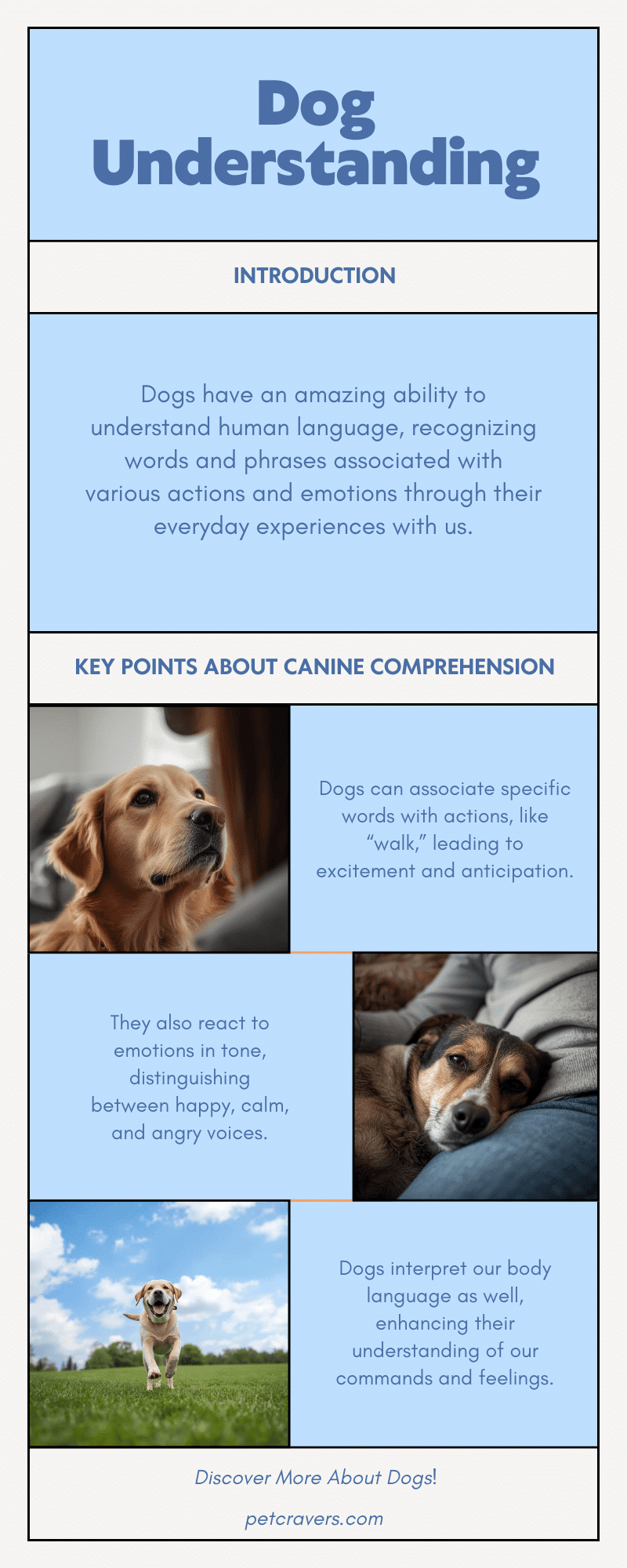
Dogs may not speak our language, but their brains are surprisingly tuned to pick up on the sounds we make. Unlike humans, who rely on grammar and complex sentence structures, dogs focus on sound recognition, tone, and repetition. This makes them excellent at picking out familiar words from the flow of conversation.
To better understand our pets, we should consider the question: do dogs understand human language and what that means for our bond?
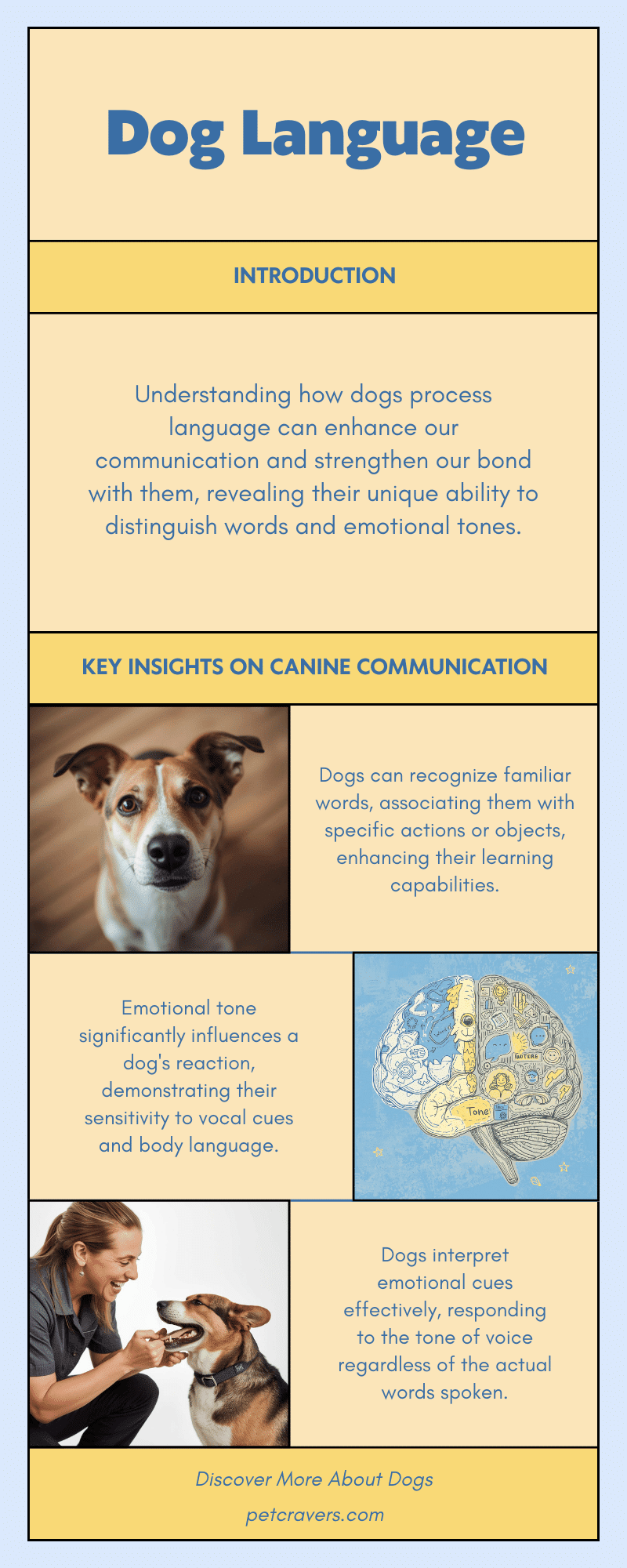
Studies using brain imaging have shown that dogs process language in ways similar to us. For example, researchers found that when a dog hears a known word like “sit” or “ball,” the left hemisphere of their brain—responsible for interpreting meaning—lights up. Meanwhile, the right hemisphere becomes more active when processing tone and emotional cues. This dual processing means dogs aren’t just reacting to noises; they are actively distinguishing between what we say and how we say it.
If you ask yourself, do dogs understand human language? You might be surprised by the answer and the research behind it.
Dogs also rely heavily on pattern recognition. If every time you say “walk,” you grab the leash and head outside, your dog learns to associate the word with the action. Over time, these associations strengthen, creating a small but meaningful “dictionary” in their minds.
The question remains: do dogs understand human language? Dogs can perceive more than we often realize.
As we navigate our relationships, it’s crucial to return to the question: do dogs understand human language? This reflects our growing bond.
Importantly, we often wonder, do dogs understand human language? This curiosity is what drives our interactions.
It’s important to remember, though, that dogs don’t process language abstractly. While a human child may understand that “walk” refers to the concept of walking in different contexts, your dog ties the word directly to the experience itself. In other words, dogs understand words as signals linked to real-life outcomes, not as part of a broader vocabulary system.
This ability shows just how adaptable and intelligent our canine companions are. They don’t just live alongside us—they actively learn from us, decoding pieces of our language to make life together smoother and more connected.
Words vs. Tone: What Matters More?
In our interactions, we often find ourselves pondering, do dogs understand human language? The nuances of their responses are fascinating.
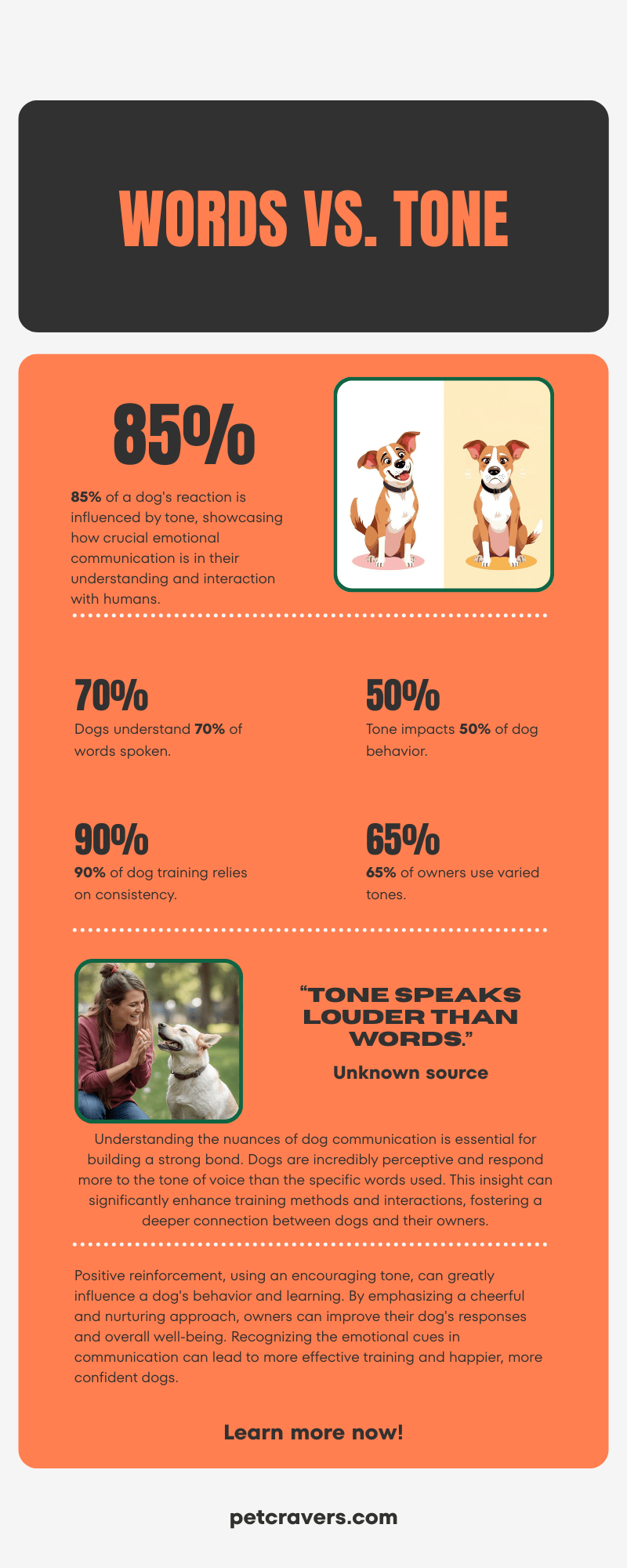
When you tell your dog, “Good boy!” in a cheerful, high-pitched voice, they usually wag their tail with joy. But if you say the exact same words in a stern or flat tone, your dog’s reaction is completely different. This raises an important point: for dogs, tone often carries more weight than the actual word itself.
As we conclude, let’s reflect on whether do dogs understand human language? This remains a pivotal point in our relationship with them.
In every training session, we grapple with the question: do dogs understand human language? Their responses illustrate their learning journey.
In retrospect, we find ourselves asking, do dogs understand human language? This question is fundamental to our interactions.
This leads us to explore, do dogs understand human language? Their ability to engage with us is remarkable.
In studies, researchers ask if dogs understand human language and how they interpret our words and tones.
Thus, as we ponder our relationships, we must always ask: do dogs understand human language? This inquiry is at the heart of connection.
Dogs are experts at reading emotional cues in human speech. Evolution has played a role here—after thousands of years living alongside people, dogs have become remarkably sensitive to our vocal expressions. While they may recognize specific words, their immediate reaction is usually guided by the emotional energy behind them. A happy, encouraging voice often motivates action, while a low, firm tone signals correction or caution.
This leads us to a fascinating conclusion: do dogs understand human language, and how does that affect our interactions?
This doesn’t mean words are irrelevant. In fact, words and tone work best when paired together consistently. For example, if you always say “sit” in a calm, clear voice and reward the behavior, your dog learns to connect that specific sound to the action. But if you were to say “sit” in a frustrated or sarcastic tone, your dog might hesitate or ignore the command entirely, because the emotional signal is conflicting with the learned word.
Real-life examples highlight this balance. Many dogs react to “walk” or “treat” even when whispered, showing that they do recognize the word. But ask them to “sit” in an annoyed tone, and they may respond more slowly—or not at all. This shows that while words provide clarity, tone provides context and motivation.
As we continue our journey, the inquiry remains: do dogs understand human language? The answer is unfolding as we learn more.
In short, dogs don’t just hear us—they feel us through our voices. Successful communication depends on using the right words paired with consistent, positive tones, helping your dog understand both the meaning and the mood behind your message.
Scientific Research on Dogs Understanding Words
Every time we interact, we should consider, do dogs understand human language? The depth of their understanding can surprise us.
Over the past two decades, scientists have been fascinated by the question of whether dogs truly understand human words, and the research has brought remarkable insights. While dogs don’t grasp language in the same way humans do, studies reveal that they can learn and remember a surprising number of words.
One of the most famous cases is a Border Collie named Chaser, often called the “smartest dog in the world.” Chaser learned the names of over 1,000 different objects and could retrieve them correctly when asked. This wasn’t just rote memorization—she showed the ability to categorize objects (like distinguishing between toys and balls) and even learned new words through a process similar to how young children do, called “fast mapping.”
When discussing communication, it’s vital to address: do dogs understand human language? This is integral to fostering our connection.
Brain imaging studies have also deepened our understanding. Using fMRI scans, researchers found that dogs’ brains process familiar words in a way similar to humans. When a dog hears a word they know, like “toy” or “ball,” the part of the brain associated with recognition and reward activates. Interestingly, dogs also notice unfamiliar or nonsense words, showing that they aren’t just tuning out sounds but actively evaluating whether they’ve heard them before.
Another study conducted in Hungary revealed that dogs process words and tone separately, much like humans. The left hemisphere of the brain handles word meaning, while the right processes tone and intonation. This means when you say “good girl” in a cheerful voice, your dog processes both the positive meaning and the happy tone—doubling the reinforcement.
However, research also highlights limitations. Dogs don’t understand grammar, abstract ideas, or complex sentences. For them, words are more like signals tied to actions, objects, or emotions. Still, their ability to learn dozens—or even hundreds—of words shows just how much potential they have when trained with consistency and patience.
This growing body of scientific evidence proves that dogs aren’t simply responding to random sounds. Instead, they’re capable of meaningful word recognition, making communication with them far deeper than once thought.
Context is Key: Situational Understanding
While dogs can learn and respond to specific words, their true strength lies in understanding context. Unlike humans, who can interpret words abstractly, dogs rely on a combination of verbal cues, body language, and environmental signals to make sense of what we’re saying.
For example, when you say “walk” while reaching for the leash, your dog quickly connects the word with the action and the excitement of going outside. But if you say “walk” while sitting at your desk doing paperwork, the reaction may be very different—or even nonexistent. This shows that dogs often interpret words within the framework of what’s happening around them.
Dogs are also masters at reading routines and patterns. They know that after you pour your morning coffee, you might grab their food bowl. Or that when you put on your running shoes, there’s a chance they’re coming along. Words reinforce these patterns, but it’s the predictable sequence of events that helps them truly understand.
Body language plays an equally critical role. If you call your dog’s name with open arms and a smile, they’re far more likely to come running than if you simply say the name without looking at them. Dogs instinctively combine your gestures, posture, and facial expressions with spoken words to form a complete picture.
Context can even explain why some dogs “ignore” commands. It’s not always disobedience—it may be that the cues don’t match. For instance, asking a dog to “sit” at the park, surrounded by distractions, may be harder for them to connect than asking the same word at home in the quiet of the living room.
In short, dogs don’t interpret words in isolation. They process them as part of a bigger communication puzzle, where environment, routine, and body language all provide vital clues. The stronger the consistency between word, action, and context, the more reliably your dog will understand and respond.
Can All Dogs Learn Words?
Not every dog will have a vocabulary as impressive as Chaser the Border Collie, but research and experience show that all dogs are capable of learning words—to varying degrees. Their ability depends on a mix of factors, including breed, training style, environment, and individual personality.
At the end of the day, the fascination remains: do dogs understand human language? This question continues to resonate with dog owners everywhere.
Some breeds, especially those originally bred for herding or working closely with humans (like Border Collies, Poodles, and German Shepherds), tend to excel at word learning. Their natural intelligence and eagerness to please make them quick learners when it comes to commands and object names. But this doesn’t mean other breeds can’t learn words—it may just take more repetition and patience.
Another major factor is training consistency. Dogs thrive on repetition and clear communication. If one family member says “down” while another says “off” for the same behavior, the dog may get confused and struggle to link the word to the action. Using short, simple, and consistent words across all situations gives dogs the best chance to build their “vocabulary.”
Age also plays a role. Puppies are like sponges, soaking up new information quickly, but older dogs are just as capable of learning new words with proper training. In fact, teaching new commands and cues can help keep an older dog mentally sharp, preventing boredom and cognitive decline.
Importantly, dogs don’t need to learn hundreds of words to communicate effectively. Even learning 10–20 useful words—such as “sit,” “stay,” “ball,” “outside,” or “bed”—can dramatically improve daily interactions. What matters most is that the words are tied to clear, consistent outcomes.
Finally, every dog is unique. Some may pick up words almost effortlessly, while others rely more heavily on tone, gestures, or routine. What unites them all is their ability to understand us in ways that strengthen trust and deepen the bond we share.
How to Teach Your Dog New Words
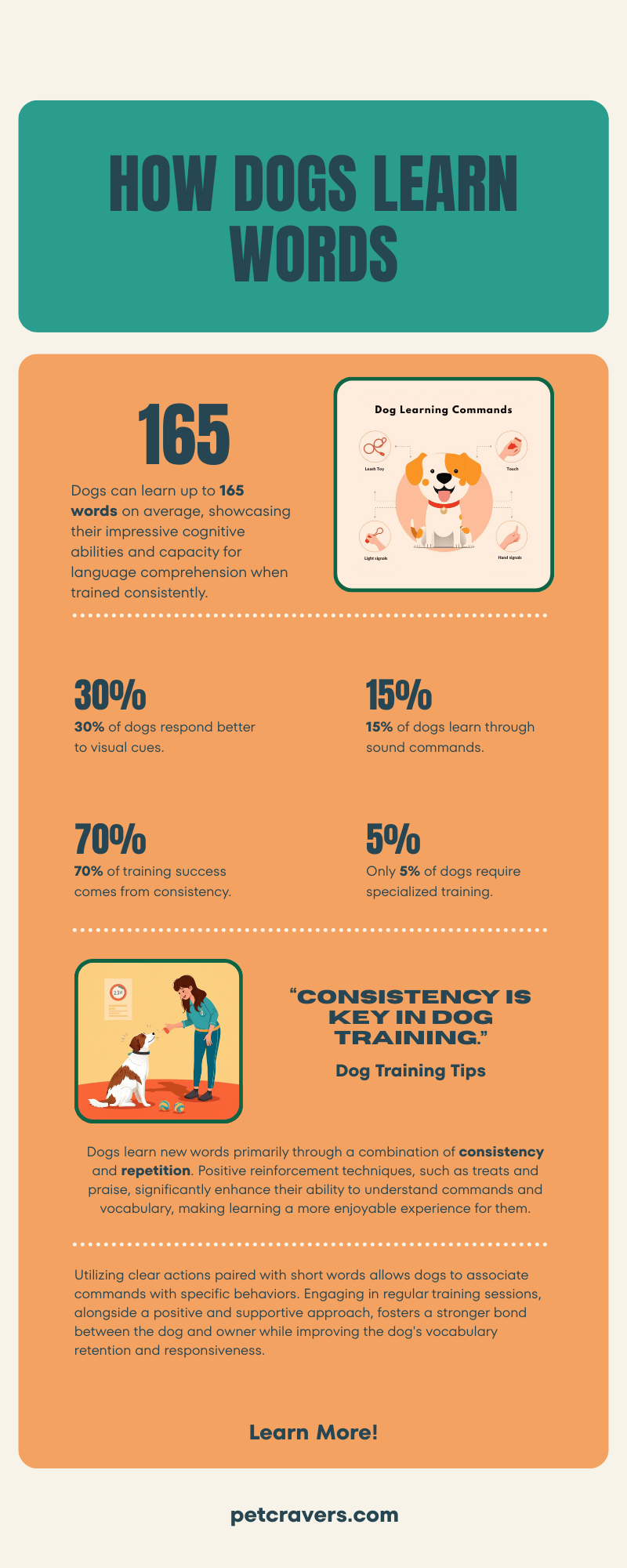
Teaching your dog new words isn’t just about obedience—it’s also about building stronger communication and keeping their mind active. Dogs learn through association and repetition, so the key is pairing words with consistent actions, objects, or experiences until the connection “sticks.” Here are some practical strategies:
1. Keep Words Short and Clear
Dogs respond best to one- or two-syllable words that sound distinct. Commands like “sit,” “stay,” “ball,” or “bed” are easier to recognize than long or complicated phrases. Avoid using words that sound too similar to each other, as this can confuse your dog.
2. Pair Words with Actions or Objects
When teaching a word, make sure your dog sees or experiences the thing you’re naming. For example:
- Hold up their favorite ball and say “ball” before tossing it.
- Say “treat” while showing them a snack.
- Say “walk” as you pick up the leash.
This consistent pairing helps your dog link the sound of the word to the object or action.
3. Use Positive Reinforcement
Reward your dog every time they respond correctly to a word. Rewards can include treats, praise, or playtime—whatever motivates your dog most. The more enjoyable the outcome, the faster they’ll make the connection.
4. Be Consistent
Everyone in the household should use the same words for the same actions. If one person says “down” to mean lying down and another uses it to mean “get off the couch,” your dog will become confused. Consistency creates clarity.
5. Practice in Different Contexts
Dogs learn best when words are used across different situations. For example, once your dog understands “sit” at home, practice it in the yard, at the park, and around distractions. This helps them generalize the meaning of the word beyond one environment.
Ultimately, it’s a beautiful journey of discovery to see how much dogs can grasp. Do dogs understand human language? The answer might surprise you.
To wrap up, we must ask: do dogs understand human language? This question emphasizes the heart of our relationships.
6. Add New Words Gradually
Start with essential commands, then expand their vocabulary slowly. Don’t overwhelm your dog by trying to teach too many words at once. Repetition and patience are key.
7. Keep Training Sessions Short and Fun
Dogs have short attention spans, so limit training sessions to 5–10 minutes at a time. Frequent, fun, bite-sized lessons are far more effective than long, repetitive drills.
By following these steps, you can steadily build your dog’s vocabulary and improve your communication. Whether it’s basic commands, names of toys, or even recognizing family members by name, learning new words stimulates your dog’s brain and strengthens your bond.
Common Misconceptions
When it comes to dogs and human language, there are a lot of myths that can lead to confusion about what our furry companions really understand. Clearing up these misconceptions helps set realistic expectations and improves the way we communicate with them.
It’s not just about commands; we need to explore the question, do dogs understand human language? This inquiry reveals much about our relationships with them.
Our journey ends with the lingering question: do dogs understand human language? This is a profound aspect of our companionship.
1. Misconception: Dogs Understand Full Sentences
Many owners believe their dog understands long phrases like, “Buddy, can you go get your toy from the living room?” In reality, dogs aren’t processing grammar or sentence structure. What they pick up on are key words and familiar cues—in this case, likely “toy” and “get.” To them, the rest of the sentence is just extra noise.
2. Misconception: Dogs Know the Exact Meaning of Words Like Humans Do
In conclusion, we ultimately circle back to the question: do dogs understand human language? It is a question worth exploring further.
Dogs don’t attach abstract concepts to words the way we do. For humans, “walk” means the general idea of walking. For dogs, “walk” means the specific experience of grabbing the leash and going outside. Their understanding is situational and associative, not abstract.
3. Misconception: If a Dog Doesn’t Respond, They Don’t Understand
A common frustration among owners is assuming their dog is being stubborn when they don’t obey a command. In reality, a dog may understand the word but be distracted, stressed, or confused by the context. Sometimes, inconsistent training—like using multiple words for the same command—causes misunderstandings, not disobedience.
4. Misconception: Dogs Only Respond to Tone, Not Words
While tone is incredibly important, it’s not the whole story. Countless dogs reliably respond to words like “sit,” “ball,” or “outside” regardless of the speaker’s tone. Research shows that dogs process tone and word meaning separately, meaning both matter when communicating.
5. Misconception: Only “Smart” Breeds Can Learn Words
While some breeds are more naturally quick to learn (like Border Collies and Poodles), all dogs have the capacity to learn words with consistency and training. Intelligence influences speed, not capability. Even breeds labeled as “stubborn” can develop a meaningful vocabulary when taught with patience.
By understanding these misconceptions, dog owners can set fair expectations. Dogs may not understand language the way we do, but their ability to recognize words and connect them to real-life experiences is still remarkable—and worth celebrating.
Strengthening the Human-Dog Bond Through Words
Talking to your dog isn’t just about commands—it’s about connection. Every time you speak to your dog, whether it’s giving instructions, offering praise, or simply chatting with them around the house, you’re building trust and strengthening the bond you share. Words become more than sounds; they turn into emotional bridges between you and your dog.
1. Words Build Trust and Clarity
Clear, consistent language helps your dog understand what’s expected of them. When your dog learns that “stay” always means to remain in place, or that “good boy” always signals approval, it reduces confusion and builds confidence. This predictability fosters trust—your dog knows you’re a reliable guide in their world.
2. Combining Words with Gestures for Better Understanding
Dogs are naturally skilled at reading body language. When you pair words with consistent hand signals or gestures, you reinforce meaning and make communication stronger. For instance, saying “sit” while moving your hand downward makes it easier for your dog to understand, especially in noisy environments.
3. The Emotional Power of Praise
So, at the end of the day, the question persists: do dogs understand human language? Their responses reveal the depth of our connection.
In summary, when we contemplate the question, do dogs understand human language, we realize how profound our relationship really is.
After exploring this topic, it’s clear that the inquiry of whether do dogs understand human language continues to be relevant and enlightening.
As we conclude, let’s remember the essential question: do dogs understand human language? They do, in ways we can appreciate more.
Dogs thrive on encouragement. Saying “good girl” or “well done” in a warm, cheerful voice doesn’t just reward the behavior—it makes your dog feel safe and loved. Over time, these positive word associations strengthen emotional closeness, turning training into bonding moments.
4. Talking to Your Dog Beyond Training
Even outside of commands, talking to your dog has value. Many dogs enjoy the sound of their owner’s voice and respond with tail wags, head tilts, or relaxed body language. While they may not understand every word, they recognize the rhythm, tone, and affection in your speech, which deepens your connection.
5. Creating a Shared Language
As you consistently use certain words for actions, objects, or routines, your dog develops their own personal “dictionary” with you. Over time, this shared vocabulary makes daily life smoother—whether it’s calling them for dinner, inviting them for a walk, or signaling it’s bedtime. It’s a language unique to your bond.
Every interaction deserves reflection: do dogs understand human language? This influences our daily routines with them.
In the end, words are not just tools for training but also for nurturing love, trust, and companionship. The more we communicate with our dogs—through both words and tone—the deeper and more fulfilling the relationship becomes.
Conclusion
So, do dogs understand human words? The answer is both simple and fascinating: yes, but in their own unique way. Dogs may not grasp grammar or abstract concepts, but they can recognize specific words, associate them with actions or objects, and respond to them—especially when paired with consistent tone, gestures, and context.
In our summary, it’s time to reflect again: do dogs understand human language? This question captures the essence of our bond.
When delving into the nature of our pets, we often ponder the question: do dogs understand human language? This reflection is essential for all dog owners.
Ultimately, as we continue to study their behavior, we must keep in mind the question, do dogs understand human language? Their ability to connect with us is significant.
Understanding how dogs process language helps us communicate more effectively and deepen the bond we share with them. Words, tone, body language, and routine all work together to create a rich system of communication. With patience, repetition, and positive reinforcement, you can teach your dog new words, enhance their understanding, and even enrich their daily life.
Ultimately, dogs are remarkably perceptive companions. They may not “speak” our language, but they understand us in ways that truly matter—through love, attention, and shared experiences. By learning how to communicate clearly and kindly, you can strengthen this bond, making life with your dog more joyful, harmonious, and connected.




Leave a Reply