
Many owners wonder whether dogs can learn multiple languages in real training situations or if they simply respond to tone and gestures.
Imagine calling your dog in English, and it comes running. Then, you try the same command in Spanish or French, and surprisingly, your dog responds just as eagerly. It may seem like a fun coincidence, but many dog owners and professional trainers have observed that dogs can indeed recognize and respond to commands in multiple languages. This raises an intriguing question: can dogs truly learn multiple languages, or are they simply responding to familiar sounds and tones?
Dogs are highly attuned to human communication, but their understanding differs from ours. Unlike humans, who process words and grammar, dogs rely on auditory cues, tone, and body language to interpret instructions. They form associations between specific sounds and actions, which allows them to perform commands accurately, regardless of the language used.
Understanding whether dogs can grasp commands in more than one language is not only a curiosity—it has practical implications. Multilingual training can enhance mental stimulation, cognitive flexibility, and the bond between owner and pet. It also provides a fun way for owners to challenge their dogs and keep training sessions engaging.
In this post, we will explore how dogs understand language, examine the evidence for multilingual learning in dogs, discuss effective training methods, address common challenges, and highlight the benefits of teaching your dog commands in more than one language. By the end, you’ll have a clear picture of what’s possible and how to help your dog become a multilingual superstar.
How Dogs Understand Language
When we talk to our dogs, it might feel like they understand every word we say. In reality, dogs interpret human communication differently from humans. Their understanding is less about the language itself and more about patterns, sounds, and gestures.
Research into canine cognition, such as explained in The Science Behind a Dog’s Brain, shows that dogs process sounds and emotions differently from humans. Their learning is also shaped by conditioning principles, which are explored in How Dogs Learn: Classical vs. Operant Conditioning. Additionally, emotional cues play a major role in communication, as discussed in Do Dogs Really Understand Human Emotions?.

1. Tone vs. Words
Dogs are incredibly sensitive to the tone, pitch, and emotion in our voices. A sharp, firm tone can signal “stop” or “no,” while a soft, cheerful tone often communicates praise or encouragement. This means that even if you change the language, your dog may respond well as long as the tone remains consistent.
2. Command Recognition
Dogs learn to associate specific sounds with actions. For example, the word “sit” becomes a trigger for the dog to lower its hindquarters, and “come” signals that it should approach. These associations are sound-action pairings rather than a true understanding of language in a human sense.
3. The Role of Repetition
Consistency and repetition are key to teaching dogs commands. A dog learns best when the same command is used repeatedly with the same tone and gesture. Repetition strengthens the mental connection between the sound of the word and the action it represents, which is why dogs can eventually respond to the same command in multiple languages if taught carefully.
By understanding that dogs process language primarily through tone, sound, and repetition, owners can better approach multilingual training. Dogs aren’t learning French or Spanish in the human sense—they’re learning distinct cues that happen to come from different languages. With this foundation, it’s easier to introduce multiple commands without confusing your dog.
Can Dogs Learn Multiple Languages? What Science Says
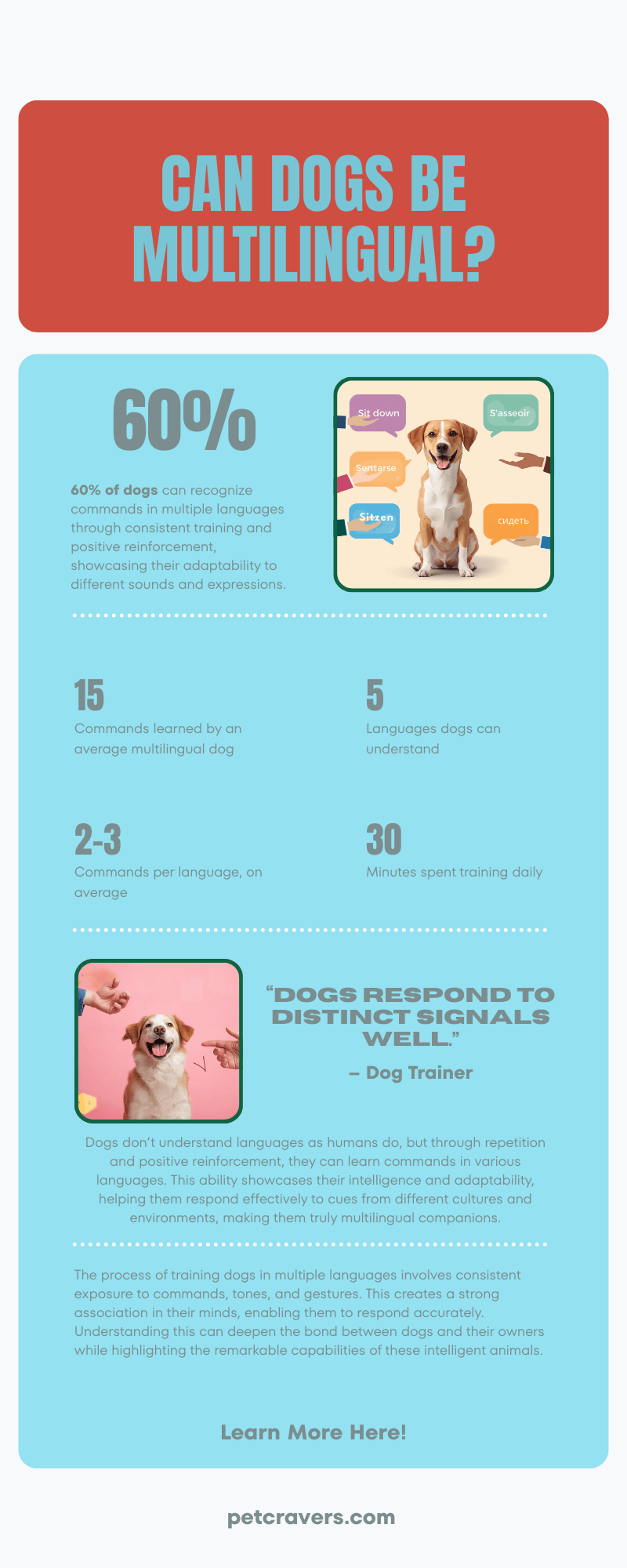
Many dog owners and trainers have reported success in teaching dogs commands in multiple languages. While dogs do not understand languages the way humans do, their ability to associate specific sounds with actions allows them to respond to commands in more than one language.
1. Evidence from Trainers and Pet Owners
Some dogs can respond to “sit” in English, “assis” in French, and “sitz” in German—all correctly. Trainers have noticed that dogs exposed to commands in different languages from an early age often pick up multiple cues faster than adult dogs introduced to new languages later in life.
2. Cognitive Capacity
Dogs have impressive memory and learning abilities. They can distinguish between numerous commands and remember associations between sounds, gestures, and rewards. Breeds with higher intelligence, such as Border Collies or Poodles, often adapt more quickly to multilingual training, though most dogs are capable of learning several commands if given enough repetition and positive reinforcement.
3. Factors That Influence Success
- Age: Puppies are generally more adaptable, but adult dogs can learn new commands too.
- Motivation: Dogs respond better when training includes treats, praise, or play as rewards.
- Training Method: Consistent, positive reinforcement and clear separation of commands between languages reduce confusion.
- Individual Personality: Some dogs are naturally more attentive and eager to learn, while others may need extra patience and time.
Scientific Evidence: Word-Learning Dogs
Scientific research also supports the idea that some dogs can learn and remember many words. A notable study titled Rapid learning of object names in gifted word learner dogs (2021) explored how certain dogs can quickly associate words with objects.
In this research, scientists observed a small group of dogs described as “gifted word learners.” These dogs were able to learn the names of multiple new toys within a short period and accurately retrieve them when asked. The study showed that these dogs could remember object names and identify the correct items even after time had passed.
Researchers such as Claudia Fugazza and Ádám Miklósi found that this learning ability relies on strong word–object associations, a process somewhat similar to how young children learn vocabulary. While not all dogs show this exceptional ability, the study demonstrates that dogs are capable of sophisticated learning when it comes to recognizing specific sounds and linking them to actions or objects.
For dog owners and trainers, this research highlights the importance of consistent verbal cues and repetition. With clear commands and positive reinforcement, many dogs can learn to associate different words—even from different languages—with specific behaviors or objects.
A Famous Case Study: Dogs with Large Vocabularies
One of the most remarkable examples of canine word learning comes from the dog Chaser, trained by psychologist John W. Pilley. Their work was published in the study Border collie comprehends object names as verbal referents in the journal Behavioural Processes.
In this research, Chaser learned the names of over 1,000 different toys and could correctly retrieve them when asked. The dog demonstrated the ability to distinguish between many individual objects based solely on their spoken names.
What made this study especially fascinating was that Chaser showed signs of categorization and memory similar to early language learning in children. For example, the dog could differentiate between familiar and unfamiliar objects and gradually build a large vocabulary through consistent training.
This famous case illustrates that dogs are capable of remembering hundreds of verbal cues when they are trained with repetition, clear naming, and positive reinforcement. While most dogs will not learn thousands of words like Chaser, the study demonstrates that dogs can associate many different sounds with specific meanings.
For dog owners, this suggests that teaching commands in multiple languages is entirely possible. Each command simply becomes another distinct sound cue linked to a behavior. With patience and consistency, dogs can build an impressive set of learned commands.
Brain Research: How Dogs Process Human Words
Scientific studies have also examined how dogs process human speech in their brains. In the study Neural mechanisms for lexical processing in dogs, researchers led by Attila Andics investigated how dogs distinguish between familiar and unfamiliar words.
Published in the journal Science, the study used brain-imaging techniques to observe how dogs react to spoken commands. The results showed that dogs process speech using different parts of the brain for tone and meaning, similar to how humans process language.
The researchers found that dogs are able to recognize familiar words they have learned through training, while unfamiliar words trigger different patterns of brain activity. This suggests that dogs are not simply reacting to tone alone; they can also identify specific sound patterns that they have previously associated with actions or rewards.
This discovery helps explain why dogs can learn commands in multiple languages. Each command becomes a unique auditory cue stored in memory, allowing the dog to recognize and respond to different words—even if they come from different languages.
While dogs may not comprehend grammar or conversational context, they excel at learning distinct cues, which is why multilingual training is entirely feasible. With patience, clear commands, and consistent practice, dogs can recognize and respond to commands in two, three, or even more languages.
Methods to Teach Dogs Commands in Multiple Languages
Teaching a dog commands in multiple languages is not only possible but can also be a fun way to challenge their brain. The key is to use clear, consistent cues and a structured approach to avoid confusion. Here’s how to do it effectively:

1. Introduce One Language at a Time
Start by teaching the dog a command in a single language until they respond reliably. For example, teach “sit” in English first. Once the dog consistently obeys, you can introduce the same command in another language, such as “assis” in French. This gradual approach prevents confusion and ensures the dog understands the association between the sound and the action.
2. Use Clear, Distinct Commands
Choose words that sound noticeably different from each other to reduce overlap. For instance, “sit” (English) and “sitz” (German) have distinct sounds, making it easier for the dog to differentiate. Avoid similar-sounding words in different languages, as this can confuse the dog and slow learning. Even their ability to recognize specific words, such as their own name, as discussed in Do Dogs Recognize Their Own Names?, shows how strongly they can link sounds to meaning.
3. Positive Reinforcement
Reward-based training is the most effective method. Every time the dog responds correctly to a command in any language, immediately offer a treat, praise, or play. This strengthens the association between the sound of the command and the desired behavior, regardless of language.
4. Consistency and Repetition
Dogs are capable of learning multiple verbal cues, but success depends heavily on training consistency. As explained in Why Consistency in Commands Matters, dogs learn through repetition and clear associations. Always use the same word, tone, and gesture for each command in each language. Regular practice sessions, even just a few minutes multiple times a day, help reinforce the new cues. Over time, the dog will respond automatically to commands in multiple languages.
5. Incorporate Gestures
Adding a hand signal or gesture along with verbal commands can further clarify the action expected. Gestures also serve as cross-language cues, helping the dog understand the command even if the verbal word differs.
6. Avoid Mixing Languages Mid-Command
Switching languages while giving a command can confuse the dog. Stick to one language per command during a training session. Once the dog responds reliably in both languages, you can gradually alternate commands to test their multilingual skills.
By following these structured methods, dogs can successfully learn commands in multiple languages, making them not only obedient but also mentally stimulated and more engaged with their owners.
For more evidence-based training approaches, organizations like the ASPCA and the American Kennel Club recommend positive reinforcement and consistency as the foundation of effective dog training. These methods are widely used by professional trainers and can be applied even when teaching commands in multiple languages.
Challenges and Misconceptions
While teaching dogs multiple languages is possible, there are common challenges and misconceptions that owners should be aware of. Understanding these can make multilingual training more successful and prevent unnecessary frustration.
1. Common Myths
- Dogs understand languages like humans do: In reality, dogs do not grasp grammar, vocabulary, or sentence meaning. They respond to distinct sounds, tone, and gestures associated with specific actions.
- Older dogs can’t learn new languages: While puppies may adapt faster, adult dogs can still learn new commands with patience, repetition, and positive reinforcement.
2. Confusion Risk
Introducing too many commands at once, especially in multiple languages, can overwhelm a dog. Dogs may mix up commands or fail to respond if the sounds are too similar. This is why gradual introduction and distinct command words are essential for successful multilingual training.
3. Importance of Patience
Multilingual training requires more time and consistency than single-language training. Dogs may initially respond more slowly, appear hesitant, or occasionally choose the wrong action. Patience and positive reinforcement are crucial during this learning period. Punishment or negative reactions can hinder progress and damage the owner-dog bond.
4. Owner Consistency
Another challenge is human inconsistency. Switching tones, gestures, or command words mid-session can confuse the dog. Owners must commit to using the same sound and body language for each command across sessions, ensuring the dog develops a clear and reliable association.
By understanding these challenges and addressing misconceptions, owners can approach multilingual training realistically and successfully. Awareness of these potential hurdles ensures a smoother, more enjoyable learning experience for both the dog and the owner.
Benefits of Teaching Dogs Multiple Languages
Research shows that the question of can dogs learn multiple languages is not just a curiosity, but a realistic outcome with proper training and reinforcement. Teaching your dog commands in multiple languages is more than a fun party trick—it offers real cognitive, behavioral, and relational benefits. Here’s why multilingual training can be a valuable part of your dog’s life:

1. Mental Stimulation
Learning commands in different languages challenges a dog’s brain, keeping it active and engaged. Multilingual training encourages cognitive flexibility, helping dogs think, remember, and differentiate between cues. Just like puzzles or scent games, this type of mental exercise can reduce boredom and destructive behaviors.
Studies in canine cognition show that dogs benefit significantly from mental challenges and novel learning tasks.
Research published in Applied Animal Behaviour Science highlights that cognitive enrichment activities improve problem-solving ability, reduce boredom-related behaviors, and enhance overall wellbeing in dogs.
👉 You can read related research here:
Applied Animal Behaviour Science Journal (Elsevier)
Multilingual training works similarly because the dog must distinguish between different sound patterns and associate them with actions.
2. Stronger Human-Dog Bond
Training in multiple languages requires clear communication and consistent interaction. This deepens the bond between owner and dog, as the dog learns to pay closer attention to cues and trust their owner’s guidance. It also provides opportunities for positive reinforcement, which strengthens mutual trust and understanding.
According to research in Frontiers in Veterinary Science, positive training methods improve both emotional wellbeing and human–animal communication quality.
👉 Read more here:
Frontiers in Veterinary Science Journal
Multilingual command training enhances communication clarity by encouraging owners to be more consistent with tone, gesture, and reinforcement.
3. Enhanced Obedience
Dogs that learn commands in multiple languages often demonstrate better overall obedience, as they become accustomed to processing and responding to distinct cues. Multilingual training reinforces the dog’s ability to listen, focus, and execute commands reliably in different contexts.
Research in Journal of Veterinary Behavior suggests that structured training improves behavioral flexibility and reduces confusion in command-response learning.
👉 Journal source:
Journal of Veterinary Behavior (Elsevier)
This supports the idea that dogs trained with consistent but varied cues (such as different languages) develop stronger general learning ability, as long as reinforcement is clear and consistent.
4. Fun and Novelty
Introducing new languages keeps training sessions fresh and enjoyable for both the dog and the owner. It transforms everyday commands into mentally stimulating games, preventing routine from becoming boring and keeping your dog excited to learn.
5. Adaptability
Dogs trained in multiple languages may also adapt more easily to new environments, trainers, or family members. Since they’ve learned to respond to different cues, they can generalize their learning more effectively, making them more versatile and confident in various situations.
Overall, multilingual training offers a combination of mental enrichment, improved behavior, and stronger bonding, making it a worthwhile endeavor for any dog owner interested in maximizing their dog’s potential.
Multilingual training provides strong mental stimulation, which is directly linked to improved wellbeing, as explained in The Link Between Mental Stimulation & Dog Happiness. Cognitive enrichment also influences memory and perception, topics further explored in How Dogs Perceive Time and Do Dogs Dream? What Science Says.
Tips for Owners
Successfully teaching your dog commands in multiple languages requires planning, consistency, and patience. Here are some practical tips to make the process smoother and more effective:
1. Start with Basic Commands in Each Language
Begin with simple, essential commands like “sit,” “stay,” “come,” or “down.” Avoid complex phrases at first, as simple words are easier for dogs to associate with actions. Gradually introduce additional commands as your dog becomes confident.
2. Use Consistent Gestures
Pair each verbal command with a hand signal or gesture. Gestures provide a visual cue that reinforces understanding, helping the dog distinguish between commands even when switching languages. Over time, gestures can help the dog respond correctly even if it hesitates on the verbal cue.
3. Keep Training Sessions Short and Positive
Dogs learn best in brief, frequent sessions rather than long, exhausting ones. Aim for 5–10 minute sessions, 2–3 times a day. Always end sessions on a positive note with praise, treats, or play to make learning enjoyable and motivating.
4. Avoid Switching Languages Mid-Command
Consistency is key. Give the entire command in one language before rewarding the correct behavior. Switching languages mid-command can confuse the dog and slow down learning. Once your dog reliably responds to multiple languages, you can gradually alternate commands in a playful manner.
5. Reinforce Commands Regularly
Even after your dog has learned commands in multiple languages, continue to practice periodically. Consistent reinforcement helps maintain the dog’s responsiveness and prevents forgetting.
6. Be Patient and Observant
Every dog learns at a different pace. Some may pick up new languages quickly, while others need more repetition. Watch your dog’s reactions carefully—signs of confusion or stress indicate a need to slow down or simplify training.
By following these tips, owners can create a structured, enjoyable, and successful multilingual training routine, helping their dogs thrive both mentally and behaviorally.
Can Dogs Learn Multiple Languages? Final Verdict
In conclusion, dogs are remarkably adaptable creatures capable of learning commands in multiple languages. While they do not understand language the way humans do, their ability to associate sounds, tones, and gestures with specific actions allows them to respond accurately to multilingual cues. With consistent training, patience, and positive reinforcement, even adult dogs can become proficient in multiple “languages,” making them smarter, more engaged, and more responsive companions.
Multilingual training offers a range of benefits, from mental stimulation and improved obedience to strengthened bonds between dog and owner. It turns ordinary commands into engaging challenges, keeping your dog’s mind active and your interactions fresh and fun.
For dog owners, the key takeaway is simple: approach multilingual training with clarity, consistency, and patience. Start small, reward successes, and gradually expand the number of commands in different languages. Over time, you’ll witness your dog confidently responding to a variety of cues, demonstrating not just obedience but remarkable cognitive flexibility.
So, whether you speak English, Spanish, French, or any other language, don’t hesitate to experiment with multilingual commands. Your dog may surprise you with how quickly they can learn and adapt—turning training into a rewarding, enriching experience for both of you.
Overall, the question of whether dogs can learn multiple languages depends on training consistency and how well cues are reinforced.




Leave a Reply